Make Your EVUNN Journey Personal
Not sure which step is right for your business?
This roadmap is part of the EVUNN business-building journey. Tell us what you’re building and where you are right now, and we’ll point you to the roadmap that’s right for your situation – free.
Free |Takes 1 minute
THE PROBLEM: I've built an offer, but I don't know whether real customers actually want it and will pay for it.
Until real people pay or show a stong willingness to pay for your offer through commitment, you don't have a business
Step 10: Validate Your Offer
Your Stage 1 access includes all the EVUNN Toolkits you’ll need to do the work. Don’t just read. Use them as you move through each step.
By now you must have built the pieces of your offer as follows:
A validated problem
A promising solution
Problem–Solution Fit
A defined customer outcome
A transformation roadmap
A designed offer
A packaged offer
A value proposition
A strengthened offer
A pricing strategy
But all of this is still a hypothesis until real customers respond to it.
You may believe customers will want this or they will see the value and pay this price. You must know that belief isn’t validation.
Validation is about getting evidence.
Your job now is to put the offer in front of real people and learn what actually happens.
The EVUNN Mindset Shift
Now, you go from I Think They Will Buy → Let Me Find Out
Most experts at this stage often become emotionally attached to an offer they’ve spent time creating. That’s dangerous.
You don’t need to prove that your offer is good. You need to discover whether the market responds to it.
So don’t ask: how do I convince people to buy my offer?
Instead ask: What evidence would tell me whether this offer is worth pursuing further? This changes the exercise from selling your idea to learning from the market.
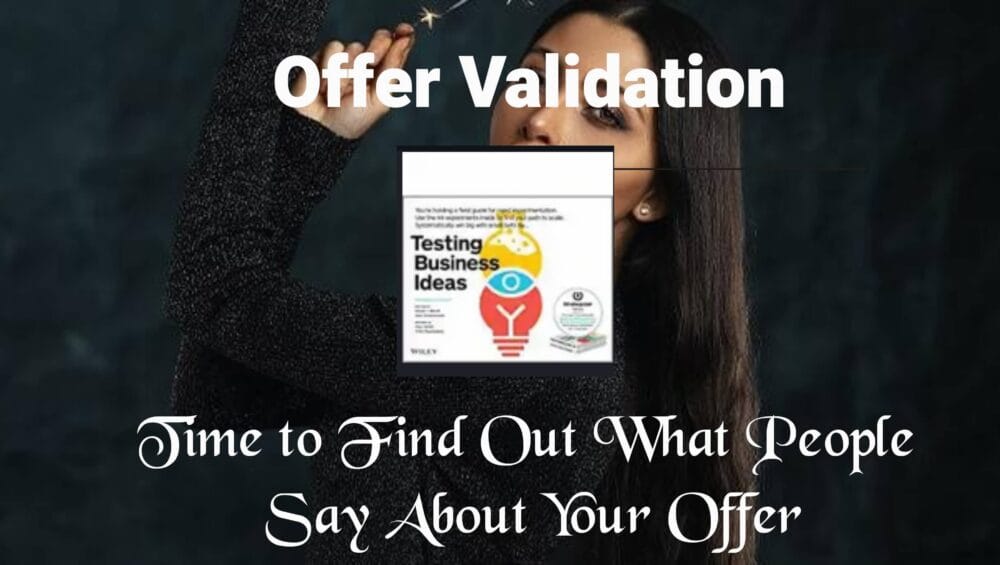
Recommended Book for this Step: Testing Business Ideas
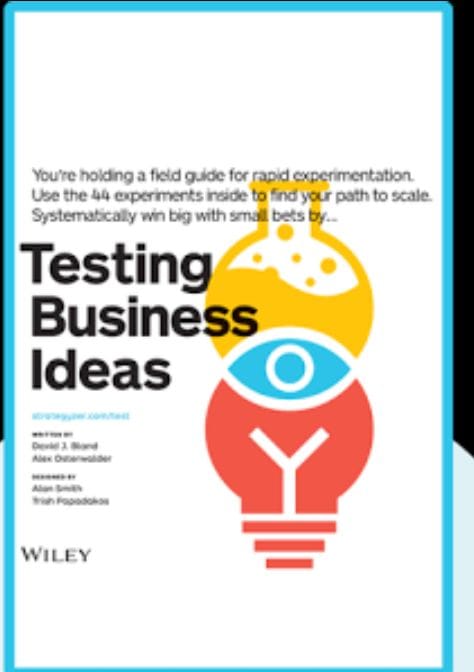
Author: David J. Bland & Alexander Osterwalder
Listen to Audiobook with Audible free trial |Buy the Book at Bookshop
Just like earlier steps, you don’t need to read this book from beginning to end.
Your objective is to learn how to turn your offer assumptions into testable hypotheses and choose appropriate experiments.
Sections of Testing Business Ideas to focus on
Section 2: Test
Hypothesize (Essential)
Learn how to turn assumptions into explicit hypotheses.
For example:
Weak assumption: People will like my consulting offer.
Better: Independent consultants with fewer than 10 active clients will pay ₦X for a structured client acquisition programme because inconsistent lead generation is preventing them from reaching their revenue goals.
Now you have something you can actually test.
Experiment (Essential)
Learn how to design experiments that generate evidence.
The question becomes:
“What is the smallest, fastest and most credible way I can test this assumption?”
Learn (Essential)
Testing isn’t useful unless you know what the evidence means. You need to distinguish between what happened and what you learnt from what happened.
Decide (Essential)
The result of validation should not always be:
YES, launch it.
It could be: proceed or modify or retest or abandon or return to an earlier assumption
Good validation gives you permission to change direction.
Section 3: Experiments
You don’t need to study every experiment in the book under this section. Focus on the experiments that make sense for an expertise-based business.
Especially look at discovery experiments (useful when you still need to understand customer reactions) and validation experiments (useful when you want stronger evidence that customers will actually engage, commit or pay).
The exact experiment should depend on what assumption you are testing.
Listen to Audiobook with Audible free trial |Buy the Book at Bookshop
Your Step 10 Outcome
By the end of this step, you should have an Offer Validation Report containing:
Final Offer
↓
Critical Assumptions
↓
Riskiest Assumption
↓
Testable Hypothesis
↓
Success Criteria
↓
Experiment Selected
↓
Customer Evidence
↓
What We Learnt
↓
Decision
↓
Offer Changes
↓
And then a Validated Offer Direction
This becomes the final output of Phase 2.
Your entire Phase 2 Outcome moved from: I think I have a good offer to I have an offer built around a validated problem, a defined customer and a desired outcome, and I have tested the key assumptions behind the offer with real-world evidence.
It’s time to put your offer in front of real people.
Right now, you may think your offer is valuable. Your customer has to agree.
So, before you spend time promoting it, find out whether the people you want to serve actually want it, understand it, and are willing to pay for it.
🔓Use the EVUNN Execution Toolkit – Offer Validation Toolkit
Don’t guess whether your offer will work.
Use the EVUNN Offer Validation Toolkit to turn the assumptions behind your offer into testable hypotheses, select the right experiments, capture customer evidence, evaluate what you learnt and decide whether to proceed, modify, retest or abandon.
Get this toolkit + every other Stage 1 Toolkit for 12 months, plus access to the EVUNN Doers Community.
₦5,500 today.
Follow the roadmap. Use the tools. Do the work.
You Have Completed Phase 2
You started this phase with: I have a validated problem. What should I create to solve it? And you finish with a validated offer direction.
You now have:
- A promising solution
- Problem–Solution Fit
- A defined customer outcome
- A transformation journey
- A structured offer
- A clear value proposition
- A strengthened offer
- A pricing strategy
- Real-world validation evidence that there is need for your product.
To sell this product, you need something important which is your positioning. You have not yet built a market position.
You now know what you’re offering and why it matters. The next question is: Who exactly should this offer be positioned for, and why should they choose it over the alternatives?
Next? Phase 3: Position & Get Attention
That’s where you move from building the offer to positioning it in the market and creating a system for getting the right people to notice it.