Make Your EVUNN Journey Personal
Not sure which step is right for your business?
This roadmap is part of the EVUNN business-building journey. Tell us what you’re building and where you are right now, and we’ll point you to the roadmap that’s right for your situation – free.
Free |Takes 1 minute
THE PROBLEM: I have spoken to my prospective customer and have discovered a gap but I don't know how to present the offer to get a commitment and a sale
If you discover a gap and present the offer in a way that does not match the gap, you can still lose the sale no matter how good your offer is
Your Stage 1 access includes all the EVUNN Toolkits you’ll need to do the work. Don’t just read. Use them as you move through each step. Learn as you build your business.
Step 5: Present & Close The Offer
In Step 4, you diagnosed the opportunity.
You established:
The customer’s current state
Their desired future state
The gap between the two
What is causing the gap
The impact of the gap
Why the problem matters
Why change may be necessary
Whether the opportunity is worth pursuing
You now have a reason to make a recommendation or to propose your solution
But don’t make this mistake a lot of exlerts make: They uaually jump from:
I understand your problem.
to:
Here is everything I can do for you.
Then they start talking about their expertise, credentials, methodology, services, features, process, experience, price and then they ask: What do you think?
The problem is, that makes the offer become disconnected from the diagnosis. The customer may then be thinking:
How does this actually help me close the gap we just discussed?
Your job in this step is to make that connection clear.
You are moving from:
Diagnosis
↓
Recommendation
↓
Customer Commitment
↓
Decision
The EVUNN Mindset Shift
Now, you Progress from I need to close the sale→ I need to gain the next commitment.
The word closing can make experts uncomfortable. You may think you don’t want to pressure people. So you avoid asking for a decision.
Or you may go in the opposite direction and start trying to persuade the customer. You explain more, add more features, defend your price, offer discount and keep talking.
But closing does not have to mean forcing someone to buy.
Iannarino’s framework is built around gaining commitments throughout the buying process rather than treating the close as one isolated event. The commitments include time, exploration, change, collaboration, consensus, investment, review, resolving concerns, decision and then execution.
Your job is not to force a yes.Your job is to help the customer make the commitments necessary to move forward.
That means asking:
- What does the customer need to commit to next?
- What information do they need?
- Who else needs to be involved?
- Are they committed to change?
- Are they willing to collaborate?
- Are they willing to invest?
- Are they ready to decide?
And once they decide, are they ready to execute?
Recommended Book for Step 5: The Lost Art of Closing
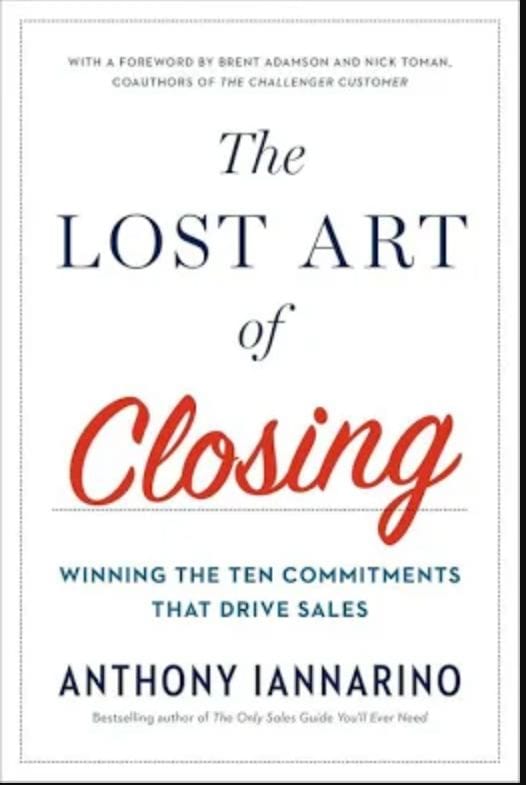
Author: Anthony Iannarino
Time Investment: 6+ hours (Audiobook)
Listen to Audiobook with Audible free trial |Buy the Book at Amazon
The Big Idea from The Lost Art of Closing
Closing is not something you do only at the end of a sales conversation.
It is a process of gaining the commitments that move a customer from their current situation toward the outcome they want.
The Lost Art of Closing identifies ten major commitments:
Time
↓
Explore
↓
Change
↓
Collaborate
↓
Build Consensus
↓
Invest
↓
Review
↓
Resolve Concerns
↓
Decide
↓
Execute
These commitments do not have to happen in a perfectly linear sequence. But they give you a useful way to understand what needs to happen before an opportunity can move forward.
This book teachez you how to guide a qualified customer toward a clear decision.
What Business Problem Does The Lost Art of Closing Solve?
It solves: I have a good solution, but my sales conversations stall because the customer doesn’t commit to moving forward.
You may have:
- A real problem
- A strong diagnosis
- A relevant solution
- A good offer
- A reasonable price
And still fail to make the sale. Why? Because the customer may not yet be committed to:
- Changing
- Collaborating
- Investing
- Getting other stakeholders involved
- Reviewing the proposal
- Resolving concerns
- Making a decision
The offer itself is only one part of the process.
Should I Read The Lost Art of Closing Now?
Yes. Your main go here is to:
Find out how to present a recommendation that connects to the customer’s diagnosed opportunity and gain the commitments needed to move that opportunity toward a decision.
Which Parts of The Lost Art of Closing Matter Most for this Step? Focus on these:
Chapter 1: A new Philosophy of Commitment Gaining (ESSENTIAL)
Start here. This chapter establishes the philosophy behind the entire book.
The important shift is: Don’t obsess over the final close. Instead gain the commitment needed to move the process forward.
This changes how you conduct the conversation. Instead of asking:
How do I get this person to buy?
Ask:
What commitment needs to happen next?
Chapter 2: control the commitments and control the process (ESSENTIAL)
This helps you understand why a sales opportunity can appear healthy while actually going nowhere.
A customer saying: Send me the proposal is not necessarily a meaningful commitment.
A stronger process establishes:
- What happens next
- Who is involved
- When it happens
- What each person needs to do
- What decision will be made
This prevents vague next steps such as: I’ll get back to you.
Chapter 3: Trading Value (ESSENTIAL)
Before asking for a commitment, make sure you are creating value. The customer should receive something useful from the interaction like:
- A useful insight
- A clearer diagnosis
- A better understanding of their situation
- A recommendation
- A useful framework
- A path forward
This reinforces an important EVUNN principle:
Don’t ask for commitment without giving the customer a reason to continue.
Chapter 6: The commitment to change (ESSENTIAL)
This connects directly to Step 4. You already established the gap.
Now determine whether the customer is actually committed to changing the current state. Ask:
- Do they agree the current situation needs to change?
- Do they believe the gap matters?
- Do they want the future state?
- Are they willing to do something differently?
If the customer is comfortable with the current situation, don’t rush into presenting your solution.
You may need to return to diagnosis.
Chapter 7: The Commitment to Collaborate (ESSENTIAL)
Your customer should not be treated as a passive recipient of your expertise.
They may need to:
- Provide information
- Share access
- Give feedback
- Make decisions
- Involve their team
- Participate in implementation
- Help shape the solution
This is particularly important for coaches, consultants and professionals selling expertise. Your offer is not simply: I will do something to you.
It is: We will work together to achieve a defined outcome.
CHAPTER 8: The Commitment to Build Consensus (IMPORTANT)
This matters especially when more than one person influences the purchase.
For example:
The user of the service
The business owner
- A manager
- Finance
- A procurement team
- A partner
- A spouse
- A board
You need to know who else needs to be involved. For a simple B2C purchase, this may be less important.
For B2B consulting or professional services, it can be critical. Don’t build an entire section of your process around complex consensus if your offer is normally sold to one decision-maker.
Use this chapter according to your business model.
Chapter 9: The Commitment to Invest (ESSENTIAL)
This is where the customer decides whether the expected value justifies the investment. Investment isn’t only money.
It can include:
- Money
- Time
- Attention
- Internal resources
- People
- Access
- Political capital
- Implementation effort
Your job is to make the relationship between Investment and Expected Value clear.
Don’t immediately respond to price concerns by discounting. First understand what the customer is actually evaluating.
Chapter 10: The Commitment to Review (ESSENTIAL)
A proposal should not simply be emailed into the void. The customer should commit to reviewing it. Ideally say:
Let’s schedule a time to go through the proposal together.
This gives you an opportunity to:
- Explain the recommendation
- Answer questions
- Confirm alignment
- Identify concerns
- Clarify the investment
- Establish the next commitment
The goal is not to send a document. The goal is to move the buying process forward.
Chapter 12: The Commitment to Decide (ESSENTIAL)
This is where you actually ask for the decision. Many experts get uncomfortable here.
They finish the conversation with:
I’ll leave it with you or
Think about it, or
Let me know.
And then wonder why the opportunity disappears. You need to be willing to ask:
Are you ready to move forward?
Or:
What do you need to decide whether to proceed?
A no is also useful. A clear no is better than an opportunity sitting indefinitely in your pipeline.
The goal is not to force a yes. It is to get a clear decision.
Chapter 13: The Commitment to Execute (IMPORTANT)
The sale isn’t truly complete when the customer says yes. They still need to:
- Sign
- Pay
- Schedule
- Provide information
- Attend
- Implement
- Begin
The transition from: Decision → Executionshould be clear. Your customer should know exactly what happens after they say yes.
Chapter 14: Guidelines for Closing (ESSENTIAL)
Use this chapter as your practical review. After completing Step 5, return to it and ask:
- Am I asking for commitments clearly?
- Am I creating value?
- Am I avoiding pressure?
- Am I establishing specific next steps?
- Am I actually asking for the decision?
- Am I helping the customer move forward?
What parts of The Lost Art of Closing should I save for step 6?
Chapter 11: The Commitment to Resolve Concerns (SAVE FOR STEP 6)
This is deliberately moved into the next step because when you are done with presenting the offer, concerns will arise.
Step 6 is specifically about following up and handling resistance.
YOUR EVUNN ACTION
PRESENT & CLOSE YOUR OFFER
Now take one of the Qualified Sales Opportunities you created in Step 4. Your task now is to turn that diagnosis into a relevant recommendation and move the customer toward a clear decision.
1. Start with the Customers Diagnosis
Return to Step 4 and record. Look at the :
- Current State (Where is the person now?
- Future State: Where does the person want to be?
- Gap: What is preventing the person from getting there?Impact: What is the gap costing the person?
- Why:Why does solving it matter?
Don’t abandon this information when you begin selling. It is the foundation of your offer.
2. Define your Recommendation
Now answer:
Based on everything I have learned, what do I recommend?
Your recommendation should directly address the diagnosed gap.
Avoid:
I offer business consulting.
Instead say:
Based on the challenges you’ve described, I recommend that we work together to build and implement a repeatable customer acquisition process.
The recommendation should feel like a logical response to the diagnosis.
Get the rest of the action steps for this step in EVUNN Premium.
EVUNN Action Steps, Doers Community & Execution Toolkits are for paid users.
Get the Action Steps for this step, plus all Stage 1 Action Steps, access to EVUNN Community and EVUNN Execution Toolkits, with 12 months of access.
EVUNN Mindset Checkpoint
Are you trying to close, or are you helping the customer commit?
You may believe selling means convincing someone to buy. It doesn’t have to.
A better process is:
Understand
↓
Diagnose
↓
Recommend
↓
Create Value
↓
Gain Commitment
↓
Ask for Decision
↓
Execute
The customer should understand why your recommendation makes sense before you ask them to invest. And you should be comfortable accepting:
- Yes
- No
- Not yet
- I need more information
All four are useful. A clear decision is better than an indefinite maybe. Ask yourself: have I earned the next commitment?
If not, don’t force the next stage. Go back and determine what is missing.
Your Step 5 Output
By the end of this step, you should have a PRESENTED OFFER + CLEAR NEXT COMMITMENT
Your process should now look like:
Qualified Sales Opportunity
↓
Customer Diagnosis
↓
Relevant Recommendation
↓
Offer
↓
Customer Commitment
↓
Decision
↓
Execution Plan
The objective is not simply to have sent a proposal. Your objective is to know:
What you recommended
Why it addresses the customer’s gap
What the customer is being asked to invest
What commitment they have made
What decision has been reached
What happens next
Getting a prospect interested is only the beginning. You need to show them how your offer addresses what they need and make it easy for them to decide what to do next.
🔓Use the EVUNN Execution Toolkit: Offer Presentation & Commitment Planner
Don’t create a generic sales pitch.
Use the EVUNN Offer Presentation & Commitment Planner to easily turn a qualified opportunity into a relevant recommendation and identify the commitments needed to move it forward.
The toolkit helps you map:
Customer Diagnosis
↓
Recommended Solution
↓
Value Connection
↓
Offer
↓
Commitment to Change
↓
Commitment to Collaborate
↓
Commitment to Invest
↓
Commitment to Review
↓
Commitment to Decide
↓
Commitment to Execute
Get Offer Presentation and Commitment Planner + every other Stage 1 Toolkit for 12 months, plus access to the EVUNN Doers Community.
₦5,500 today.
Follow the roadmap. Use the tools. Do the work.
What Should I Do Next?
At the beginining of this step, you started with: I understand the customer’s opportunity and I believe I can help.
You should leave this step with:
I can turn that opportunity into a relevant recommendation, gain the commitments needed to move it forward, ask for a decision and establish the path to execution.
You have now moved through:
Prospect
↓
Conversation
↓
Diagnosis
↓
Opportunity
↓
Recommendation
↓
Offer
↓
Commitment
↓
Decision
But not every potential customer will decide to buy immediately. Some will hesitate, raise concerns, ask for more information while some will stop responding or question the price or say, “I need to think about it.”
That does not automatically mean the opportunity is dead.
The next skill you need to master is how to follow up without chasing, understand resistance without becoming defensive, and determine whether an opportunity should continue.
Next: Step 6 – Follow up and Handle Resistance
What do I do when the customer hesitates, raises concerns, asks for more information or stops responding?