Make Your EVUNN Journey Personal
THE PROBLEM: I have identified the right prospects, but I don't know how to approach them and start a conversation that leads to something useful.”
Speak to your prospects to see if there is a sales opportunity
STEP 3: START CUSTOMER CONVERSATIONS
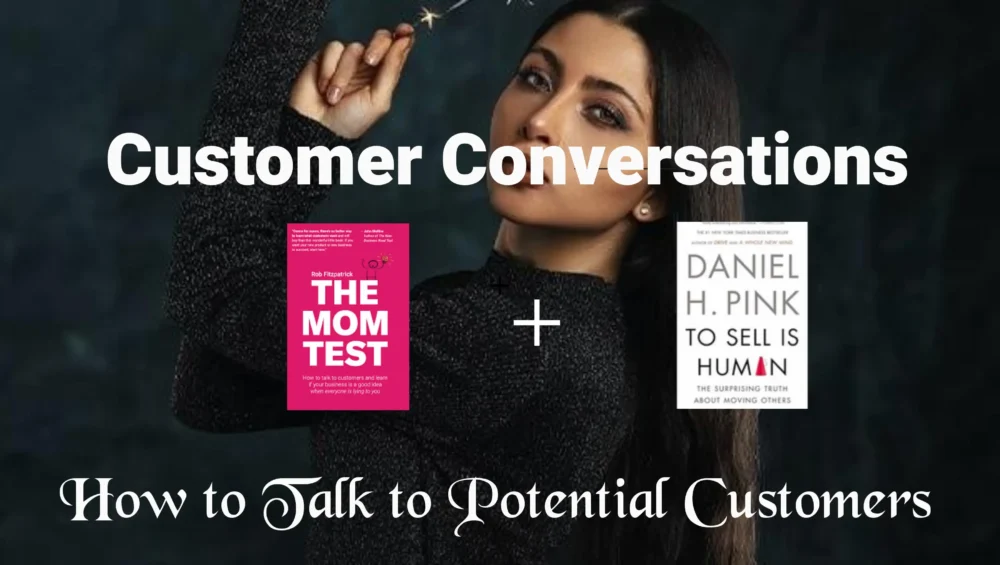
Recommended Book for Step 3 - The Mom Test
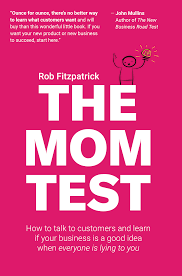
The Big Idea from The Mom Test
People can give you positive feedback about your business idea without ever becoming customers.
They may say:
- “That sounds great.”
- “I would definitely use that.”
- “I know someone who needs this.”
- “That is a really good idea.”
But these statements are not strong evidence.
The Mom Test teaches you how to have conversations that reveal real problems, real behaviour and real commitment instead of relying on opinions, compliments and hypothetical promises.
You are not reading it to become a better salesperson. You are learning how to have better conversations with potential customers.
What Business Problem Does The Mom Test Solve?
It solves: I am talking to prospects, but I don’t know whether the information I’m getting is actually useful.
A conversation can feel successful while giving you very little useful information. A prospect may be polite, agree with everything you say, like your idea, say they would buy, but what matters is what they actually experience and do.
The Mom Test teaches you to look for evidence in:
- Their current situation
- Their past behaviour
- Problems they have already experienced
- Solutions they have already tried
- What the problem has cost them
- What they are doing about it now
- What they are willing to do next
This helps you move from:
They said they like my idea.
to:
I have evidence that this problem exists and matters to them enough to need the offer.
Should I Read Mom Test Now?
Yes. Your objective is to:
Learn how to start and conduct customer conversations that reveal real problems, behaviour and buying signals rather than opinions and polite interest.
Which Part of Mom Test Matter Most for this Step?
Introduction: The Mom Test (ESSENTIAL)
Start here. Understand the central problem the book is trying to solve which is: How do you talk to people about your idea without accidentally getting misleading feedback?
The key lesson is simple:
Don’t ask people to predict what they will do. Learn what they have already done.
This principle should guide your conversations throughout this step.
Avoiding Bad Data (ESSENTIAL)
This is one of the most important sections for you. Learn to recognise the difference between:
- Compliments
- Opinions
- Hypothetical statements
- Real evidence
For example: ‘I think that’s a great service,” is an opinion. “I paid a consultant ₦200,000 last month because I couldn’t solve this problem myself,”is evidence of behaviour.
The first may be encouraging. The second tells you much more.
As you conduct conversations, become suspicious of information that costs the prospect nothing to give you.
Look for what they have actually experienced, tried, spent, changed or committed to.
Asking Important Questions (ESSENTIAL)
This section helps you move from vague conversation to useful discovery.
Your questions should uncover:
- What they are trying to accomplish
- What is preventing them from doing it
- What they have already tried
- How they currently handle the problem
- How often it occurs
- What happens when it is not solved
- What the problem costs them
- How important solving it is
The goal is not to ask every question on a script. The goal is to learn how to ask questions that lead to specific stories and real examples.
Keeping It Casual (ESSENTIAL)
Customer conversations do not need to feel like formal research interviews.
The more natural the conversation, the more likely the prospect is to talk openly about what is actually happening.
Don’t turn the conversation into:
Question.
Answer.
Question.
Answer.
Question.
Answer.
Instead, Listen.
Follow interesting details.
Ask for examples.
Ask what happened next.
Let the conversation develop naturally.
You are trying to understand the prospect, not complete a questionnaire.
Commitment and Advancement (ESSENTIAL)
Not every interested prospect is a serious prospect. Someone saying: Keep me posted, is different from someone who:
- Introduces you to the person responsible or,
- Agrees to another conversation or,
- Shares relevant information or,
- Provides access to their process or,
- Agrees to review a potential solution or
- Commits time to exploring the problem
The lesson is:
Interest is not commitment.
As conversations develop, pay attention to what prospects are willing to do, not simply what they are willing to say.
Finding Conversations (IMPORTANT)
You already created your prospect list in Step 2.
Now use this section to think about how you will actually create opportunities to talk to those people.
Depending on your acquisition channel, this could involve:
- LinkedIn messages
- Phone calls
- Referrals
- Professional networks
- Communities
- Events
- Existing relationships
- Introductions
The objective is not to send a generic sales message to everyone. It is to create a reason for the right person to engage.
Choosing Your Customers (IMPORTANT)
Not every conversation should become a customer relationship. Use what you learn from conversations to become more selective.
You may discover that some prospects:
- Are not experiencing the problem
- Have a different problem
- Do not consider the problem important
- Have already solved it another way
- Are not ready to act
- Are not a good fit for your offer
- That’s useful information.
A conversation can be successful even when it tells you:
This person is not my customer.
Running The Process (IMPORTANT)
Customer conversations should become a process rather than isolated events.
Track:
- Who you contacted
- Who responded
- Who you spoke with
- What you learned
- What problems appeared repeatedly
- What assumptions were challenged
- Who showed genuine interest
- What next step was agreed
This will allow you to identify patterns across multiple conversations.
Supporting Book for Step 3: To Sell Is Human

Author: Daniel Pink
Listen to the Audiobook with Libro | Buy the book at the Bookshop.
Read To Sell is Human to develop the human side of selling.
You are not trying to manipulate prospects. You are trying to understand them, communicate clearly and help them move toward a useful outcome.
What Parts of To Sell is Human Matter Most for this Step? Focus on these:
Chapter 1: We’re All in Sales Now (ESSENTIAL)
Understand the broader idea that selling is not simply a transactional activity.
When you run an expert-based business, you are constantly helping people understand:
A problem
An opportunity
A possible solution
A reason to act
This helps remove the idea that selling is something you should feel uncomfortable about.
Chapter 4: Attunement (ESSENTIAL)
This is particularly relevant to customer conversations because you need to understand the situation from the prospect’s perspective.
Don’t approach the conversation thinking:
What do I want to tell them?
Think:
What is happening from their point of view?
Chapter 6: Clarity (IMPORTANT)
Your job is not simply to collect information. Sometimes people know they are struggling but cannot clearly explain what is happening.
Good conversations can help them articulate:
- What they want
- What is stopping them
- Why it matters
- What they have tried
- What they need to change
This becomes increasingly valuable when you move into opportunity diagnosis.
Chapter 9: Serve (IMPORTANT)
Use this chapter to reinforce the principle that selling should ultimately be about creating value.
If you discover that your offer is not appropriate for the prospect, you do not need to force the sale.
The objective is to help the right people move toward the right solution.
What Should I Skip for Now?
Chapters 2–3 (SKIM)
Useful context for understanding the changing nature of selling, but not necessary for completing this execution step.
Chapter 5: Buoyancy (SKIM)
Useful when dealing with rejection and maintaining outreach activity.
You can return to it as you begin doing more prospecting.
Chapters 7–8 Pitch & Improvise (SAVE FOR LATER)
These become more relevant when you are ready to present and communicate your offer.
That belongs primarily in the later selling stages of the roadmap.
Your EVUNN Action
Start Your First Customer Conversations
Now take the prospects you identified in Step 2 and turn them into real conversations.
This is where prospecting becomes customer acquisition. Your objective is not to get everyone to buy.
Your objective is to: Approach → Engage → Listen → Learn → Identify Evidence → Decide What Happens Next
Follow the steps below:
1. Select Your First Prospect Batch
Go back to your First Prospect List.
Start with your High Priority Prospects. Select an initial group of 10 prospects. Don’t start with your entire 25–50 prospect list.
You are testing your approach. Choose people who have:
- Strong customer fit
- A relevant problem signal
- A relevant buying-situation signal
- A realistic way for you to reach them
2. Prepare Yoir Reason For Contacting Them
Before contacting each prospect, answer:
- Why am I contacting this person?
- What makes them relevant to the problem I am investigating?
- What do I already know?
- What do I still need to learn?
Your reason for contact should be based on their situation, not simply: I want to sell my service.
You need a genuine reason for starting the conversation.
Get the rest of the action steps for this step in EVUNN Premium.
EVUNN Action Steps, Doers Community & Execution Toolkits are for paid users.
Get the Action Steps for this step, plus all Stage 1 Action Steps, access to EVUNN Community and EVUNN Execution Toolkits, with 12 months of access.
EVUNN Mindset Checkpoint
Are you trying to prove your idea instead of testing it?
This is one of the biggest dangers when speaking to potential customers.
- You have spent time developing your expertise.
- You have identified a problem.
- You have created an offer.
- You naturally want people to confirm that you are right.
But your customer conversations are not designed to make you feel right. They are designed to help you find out what is true.
If a prospect tells you: I don’t have this problem. That is useful.
If they tell you: I have the problem, but it isn’t important enough to solve. That is useful.
If they tell you: I already pay someone to solve it. That is also useful.
If they tell you: This is a major problem and I’ve tried three different solutions. That is useful.
Your job is not to make the evidence fit your idea. Your job is to follow the evidence.
Remember:
A conversation that disproves your assumption can be more valuable than a conversation that confirms it.
Optional Mindset Reading: To Sell Is Human by Daniel Pink
If you need help becoming more comfortable with the human side of selling, return to:
Chapter 4: Attunement
Chapter 5: Buoyancy
Chapter 9: Serve
This is optional. You do not need to complete additional reading before starting your conversations.
The most important thing now is to talk to real people.
Stop guessing and start listening. A conversation with a potential customer is only useful if you learn something you can act on.
🔓 EVUNN Execution Toolkit
Customer Conversation & Evidence Tracker
Don’t approach prospects with a generic pitch and hope someone responds.
Use the EVUNN Customer Conversation & Evidence Tracker to plan your first conversations, record what prospects actually say and do, capture problem and buying signals, identify recurring patterns and determine which conversations deserve further investigation. This heps you find:
↓
Problem & Behaviour Patterns
↓
Buying & Commitment Signals
↓
Next-Step Decisions
Your objective is not to close 10 customers.
Your objective is to have 5–10 meaningful conversations that give you evidence about the problem, the prospect’s current situation and whether there is a reason to continue the conversation.