
Make Your EVUNN Journey Personal
Not sure which step is right for your business?
This roadmap is part of the EVUNN business-building journey. Tell us what you’re building and where you are right now, and we’ll point you to the roadmap that’s right for your situation – free.
Free |Takes 1 minute
THE PROBLEM: The customer hasn't said yes yet. I don't know whether to follow up, what to say when they hesitate, or how to respond when they raise concerns without becoming pushy.
Understanding how to handle customer resistance and follow up will help you win more sales
Your Stage 1 access includes all the EVUNN Toolkits you’ll need to do the work. Don’t just read. Use them as you move through each step.
Step 6: Follow up and Handle Resistance
In Step 5, you presented your offer and connected your recommendation to the customer’s diagnosed opportunity.
You explained the value, discussed the investment, asked for a decision, but the customer didn’t necessarily say: yes. Let’s do it.
They may have said:
Let me think about it, or
It’s too expensive, or
I need to speak to my partner, or
Can you send me more information? Or
Now isn’t the right time, or
I’ll get back to you.
Or they may have simply stopped responding. This is where a lot of experts get stuck. They either chase the customeror give up too quickly.
They send:
Just checking in.
Then:
Any update?
Then:
I haven’t heard back from you.
Eventually, the opportunity disappears. But the problem isn’t necessarily that the customer said no. The problem is that something remains unresolved.
Your job in Step 6 is to find out what that is. You need to determine what is preventing movement and weather the opportunity is still worth pursuing.
The EVUNN Mindset Shift
This step takes you from I need to overcome their objection → I need to understand what is preventing the decision.
When a customer says it’s too expensive, your instinct may be to defend your price.
When they say, I need to think about it, you may immediately try to persuade them. When they go silent, you may send another message, but you don’t yet know what the resistance actually means.
Too expensive could mean:
They don’t see enough value.
They genuinely don’t have the budget.
They are comparing alternatives.
They don’t trust the expected outcome.
The problem isn’t important enough.
They want a lower price.
Let me think about it could mean:
They need more information.
They need another decision-maker.
They have an unresolved concern.
They aren’t convinced.
They aren’t ready.
They don’t want to say no directly.
You don’t know until you investigate. So don’t rush to overcome resistance. Resistance is information.
Recommended book for this step: Never Split the Difference
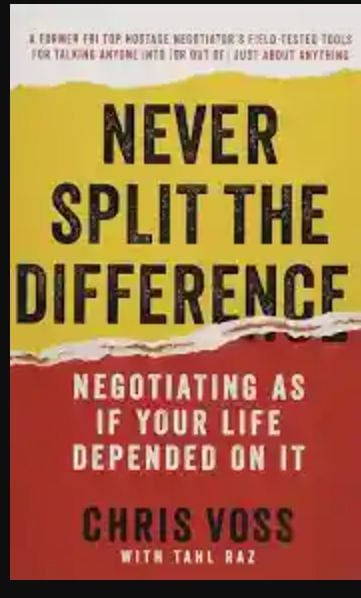
The Big Idea from Never Split the Difference
When a customer hesitates or resists, your first instinct may be to persuade them. The problem is that persuasion before understanding can make resistance worse.
A better approach is to:
Listen
↓
Understand
↓
Label
↓
Ask
↓
Clarify
↓
Discover what is really happening
↓
Determine the appropriate next step
That is where Never Split the Difference comes in. The reason for recommending this book for this step is not to turn you into a professional negotiator.
You will extract the techniques that will help you navigate difficult customer conversations.
The most relevant ideas from Never Split the Difference you are to focus on for this step are:
Tactical empathy
Mirroring
Labelling
Making it safe to say no
Calibrated questions
Summarising
Discovering hidden information
Securing follow-through
What Business Problem Does Never Split the Difference Solve?
It takes care of: The customer is hesitating or resisting, but I don’t know what is really behind the resistance or how to move the conversation forward.
A weak response looks like this:
Customer says: Your price is too high.
Expert in response says: But we’re actually very affordable compared with other providers.
The expert has defended the offer without understanding the concern.
A better response is:
It sounds like the investment is a significant concern.
Then listen. The customer might explain:
It’s not actually the amount. We have already committed this quarter’s budget elsewhere.
Now you know something completely different. The goal is not to have the perfect response to every objection.
The goal is to discover what is actually happening.
Should I read Never Split the Difference now?
Yes, and focus on how to understand resistance, uncover hidden concerns, ask better questions and create clear next steps without becoming defensive or pushy.
Which parts of Never Split the Difference should I focus on for this step? Focus on these:
CHAPTER 2: Be Mirror (IMPORTANT)
Mirroring encourages the other person to continue talking. For example:
Customer:
We’re not ready to move forward yet.
You:
Not ready yet?
Then stop. Let them explain.
The important lesson here isn’t simply the technique. It is the discipline of not rushing to fill silence with your own explanation.
CHAPTER 3: Don’t feel their pain, label it (ESSENTIAL)
This is one of the most useful chapters for Step 6.
Instead of immediately solving the customer’s concern, acknowledge what appears to be happening.
For example:
It sounds like the timing is the main concern, or
It seems like you’re uncertain whether the investment is justified, or
It sounds like you need another person involved before making the decision.
Then allow the customer to respond.
They can:
- Confirm
- Correct
- Clarify
That gives you information.
EVUNN APPLICATION
Resistance → Label → Listen → Understand
Not:
Resistance → Defend → Persuade
CHAPTER 4: Beware Yes, Master No (ESSENTIAL)
A customer saying, “yes, that sounds good”doesn’t necessarily mean they are committed. Sometimes people say yes simply to end a conversation.
A clear no can actually be more useful because it allows the real issue to surface.
Make it safe for the customer to disagree with you.
You want honest information. Not polite agreement.
CHAPTER 5: Trigger the Two Words that Immediately Transform any Negotiation (IMPORTANT)
The two words are that’s right. The principle is simple: summarise before you persuade.
For example:
So, if I’ve understood you correctly, you don’t disagree that the problem needs to be solved. Your concern is whether now is the right time to make the investment.
Then listen. If the customer responds: That’s right, you have evidence that you understand their position.
That creates a stronger foundation for the next step.
CHAPTER 7: Create the Illusion of Control (ESSENTIAL)
Use calibrated questions to help the customer think through the situation rather than telling them what they should do.
For example:
What would need to happen for you to feel comfortable moving forward? Or
How would you like to handle this? Or
What do you think the next step should be? Or
What would make this workable for you? Or
The objective is not manipulation. It is to make the customer an active participant in resolving the decision.
CHAPTER 8: Guarantee Execution (IMPORTANT)
A decision isn’t the same thing as execution.
A customer can say, yes and still never:
Pay
Sign
Schedule
Provide information
Start
Implement
So once a commitment is made, make the next action concrete.
For example:
Great. I’ll send the agreement today. Once it’s signed, we’ll schedule our first session.
Don’t leave commitments vague.
CHAPTER 10: Find the Black Swan (ESSENTIAL)
Sometimes the reason a customer isn’t moving is something you don’t know exists.
You think: The price is too high. But the real issue is: Their budget has been frozen. Or you think: They need more information.But the real issue is: Their partner doesn’t trust the solution.
Don’t assume you know why the customer is hesitating. Investigate.
What parts of never Split the Difference should I skip for Now?
Chapter 1: The New Rules (SKIM)
Useful context, but not essential to completing the execution task.
Chapter 6: Bend Their Reality (SKIM)
Useful for understanding perception, value and fairness.
Chapter 9: Bargain Hard (SKIP FOR NOW)
This is more relevant to formal negotiation and price bargaining.
If yoy later need advanced negotiation skills, you can return to it.
YOUR EVUNN ACTION
FOLLOW UP & HANDLE RESISTANCE
Now return to the opportunities from Step 5 that have not yet moved to a clear decision.
Your objective is not to chase them. Your objective is to determine:
Why hasn’t this opportunity moved forward?
Follow these steps to handle resistance and follow up easily:
1. Review the last Commitment
Return to your Step 5 record. What did the customer last agree to?
For example:
Review the proposal
Speak to a partner
Discuss internally
Provide information
Schedule another meeting
Make a decision
Start the engagement
Then ask:
What was supposed to happen next?
Your follow-up should connect to that commitment.
2. Identify the Unresolved Issue
Ask:
What might currently be preventing movement?
Consider:
- VALUE – They don’t see enough value.
- PRICE – The investment is a concern.
- TIMING – The problem isn’t urgent enough.
- TRUST – They aren’t confident in you or the solution.
- FIT – The offer may not actually be appropriate.
- AUTHORITY – Someone else needs to decide.
- INFORMATION – They still have unanswered questions.
- RISK- They are afraid of making the wrong decision.
- PRIORITY – Something else matters more right now.
- NO REAL NEED – The opportunity may not actually be strong.
Don’t treat these as conclusions. They are hypotheses to investigate.
EVUNN Mindset Checkpoint
Are you following up, or chasing? There is a difference between chasing and following up.
Example of Chasing are: Have you decided? Any update? Just checking in. I haven’t heard back from you.
Examples of following up:
When we spoke, you mentioned that your main concern was X. Has anything changed? Or
You said you wanted to discuss this with your partner. Were you able to do that? Or
You mentioned that timing was the main issue. Is solving this still a priority?
Follow-up has context. It is connected to something the customer actually said or committed to.
And also ask yourself: Am I trying to overcome resistance, or understand it?
Resistance is not necessarily an obstacle standing between you and the sale. It is information.
It may tell you:
- Your offer isn’t clear.
- The value isn’t strong enough.
- The customer isn’t ready.
- The wrong person is involved.
- The timing is wrong.
- The problem isn’t important enough.
- Or the opportunity isn’t real.
If you immediately try to overcome every concern, you may end up selling something the customer doesn’t actually need.
Remember: Don’t fight resistance. Investigate it.
And: A customer saying no is better than a customer saying maybe forever.
Your step 6 output
By the end of this step, you should have an ACTIVE SALES FOLLOW-UP SYSTEM
Your process should now look like:
Presented Offer
↓
Customer Response
↓
Unresolved Concern
↓
Investigation
↓
Response
↓
Next Commitment
↓
Follow-Up
↓
Decision
Your opportunities should now fall into clear categories:
- Ready
- Active
- Nurture
- Needs More Information
- Decision-Maker Required
- Not a Fit
- Lost
Your objective is not to create the biggest possible pipeline. Your objective is to know:
Why hasn’t this opportunity moved forward, what needs to happen next, and whether it is still worth pursuing?
It’s time to understand what’s really stopping the sale.
🔓 Use the EVUNN Execution Toolkit: Follow-Up & Resistance Tracker
Don’t send endless: Just checking in.
Use the EVUNN Follow-Up & Resistance Tracker to understand why an opportunity has stalled, identify the customer’s unresolved concern, plan the next conversation, record commitments and decide whether to continue, nurture or close the opportunity.
The toolkit helps you map:
Last Commitment
↓
Current Status
↓
Customer Concern
↓
What the Concern Really Means
↓
Evidence
↓
Response
↓
Next Commitment
↓
Follow-Up Date
↓
Opportunity Decision
Get the Follow up & Resistance Tracker + every other Stage 1 Toolkit for 12 months, plus access to the EVUNN Doers Community.
₦5,500 today.
Follow the roadmap. Use the tools. Do the work.
What next should I do ?
At the beginning of this step you you knew the customer hasn’t decided yet and you didn’t know what to say next.
At the end of step 6, you leave knowing:
I can identify what is preventing movement, investigate the customer’s concern, respond without becoming defensive, establish the next commitment and know when to continue or stop pursuing the opportunity.
You have now moved through:
Prospect
↓
Conversation
↓
Diagnosis
↓
Opportunity
↓
Offer
↓
Commitment
↓
Resistance
↓
Follow-Up
↓
Decision
Making individual sales isn’t enough. You now need to know whether the system itself is working to consistently give you more sales. You need to know:.
- Which prospects are converting?
- Which conversations are producing opportunities?
- Where are customers getting stuck?
- Which concerns keep appearing?
- Which offers convert?
- Which acquisition channels produce the best customers?
- What should you change?
That is the final step for stage 1
Next? Step 7: Review, Learn and Improve
What is my sales process teaching me, and what should I change to make it work better?