

Customer Buying Journey: Identify What Triggers Customers to Buy | EVUNN
Make Your EVUNN Journey Personal
Not sure which step is right for your business?
This roadmap is part of the EVUNN business-building journey. Tell us what you’re building and where you are right now, and we’ll point you to the roadmap that’s right for your situation – free.
Free |Takes 1 minute
THE PROBLEM: I know who my best-fit customer is, but I don't understand what makes them decide it's time to solve their problem.
Find out what triggers your best fit custoner to buy so you will be in the best position to reach them
Step 2: Define the Customer's Buying Situation
Your Stage 1 access includes all the EVUNN Toolkits you’ll need to do the work. Don’t just read. Use them as you move through each step.
A person can have a problem for months or even years without buying anything to solve it.
Something has to change before they make a move. They may experience a new responsibility, a failed attempt, an unexpected consequence, a deadline, a growing frustration or a new opportunity.
At some point, their current situation becomes difficult enough that they begin looking for a different way forward.
That moment is important because your customer doesn’t simply buy because a problem exists.
They buy when they become motivated to make progress.
So your job in this step is to understand:
What is happening in the customer’s world that creates a reason to seek a solution?
The EVUNN Mindset Shift
You move from My customer has a problem → My customer is trying to make progress.
It is easy to look at your customer through the lens of your expertise. You see: they need training or they need a better system.
But your customer doesn’t experience their world as a service category.
- They experience a situation.
- They are trying to accomplish something.
- They are struggling with something.
- They are trying different ways of dealing with it.
And eventually, they may decide: I need to do something differently.
That is the perspective you need to understand.
Recommended Book for Step 2: Demand-Side Sales
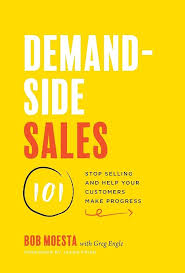
Author: Bob Moesta & Greg Engle
Time Investment: 5+ hours (Audiobook)
Listen to Audiobook with Audible free trial |Buy the Book at the Bookshop
The Big Idea from Demand Side Sales
Customers are trying to make progress from their current situation to a better one.
Demand-side thinking asks you to understand the customer’s world from their perspective, rather than beginning with what you want to sell.
Instead of asking: what service do I provide? Ask:
What progress is this customer trying to make, and what is happening that makes change important now?
This is so valuable for an expertise-based business because your expertise can easily make you focus on your solution before understanding the customer’s motivation to change.
What Business Problem Does The Demand Side Sales Solve?
It solves: I know my customer has a problem, but I don’t understand why they decide to do something about it.
This book helps you understand the difference between: a problem existing and demand for a solution emerging.
Someone can know they have a problem and still do nothing. Your objective is to understand what happens between: I have this problem and I need to find a solution.
Should I Read It Now?
Yes, this is the primary book for Step 2. You are reading it to develop the ability to see the customer’s situation from the demand side.
As you read, keep asking:
What makes this customer move from tolerating their current situation to actively seeking change?
Which Chapters of Demand Side Sales Matter Most to me for this step? Focus on these:
Chapter 1: Two Perspectives on the World: Supply and Demand (ESSENTIAL)
This establishes the fundamental shift between the supplier’s perspective and the customer’s perspective.
Pay particular attention to how demand looks different when you stop asking: What am I selling? and start asking: what is the customer trying to accomplish?
Chapter 3: Solving the Customer’s Struggle (ESSENTIAL)
Focus on understanding:
The customer’s current situation
What they are struggling with
Why their current approach isn’t sufficient
What they are trying to change
Your goal is to understand the struggle behind the purchase.
Chapter 4: Seeing the World Through the Customer’s Eyes. (ESSENTIAL)
This chapter reinforces the perspective you need throughout the EVUNN roadmap: Don’t interpret the customer’s problem entirely through your own expertise.
Try to understand what the situation looks and feels like from the customer’s side.
Chapter 7: Moving from Pushing Products to Creating Pull for Progress (ESSENTIAL)
This helps connect customer motivation to demand. The important lesson for you hereb is: don’t push your solution onto a customer who isn’t ready for change. Understand the progress they are already trying to make.
Read these chapters Selectively
Chapter 2: The Frameworks for Demand-Side Selling
Read this for the author’s broader framework. You don’t need to master the entire sales methodology at this stage.
Take what helps you understand customer demand and move on.
Chapter 5: Mapping Demand-Side Buying to Supply-Side Sales, Marketing, and Customer Success (Read selectively)
It provides useful context for how customer demand connects with the business’s response.
However, the marketing and sales applications become more relevant later in the EVUNN roadmap.
What Should I Skip For Now?
Chapter 6: Connecting the Dots Between Sales, Marketing, and Customer Support (Skip for now)
It is more concerned with connecting demand-side thinking across organizational functions.
That isn’t the immediate problem you’re solving.
You can return to it later.
EVUNN Mindset Checkpoint
Are you trying to convince instead of understand?
At this stage, you may feel tempted to prove that your offer is needed.
Watch for thoughts such as: I already know what they need, I just need to explain my solution better. Your job at this stage is not to convince. It is to understand.
Read The Mom Test by Rob Fitzpatrick if you notice that you are:
Leading customers toward answers you want
Asking hypothetical questions
Looking for validation instead of truth
Treating compliments as evidence
Avoiding difficult customer conversations
This checkpoint reading is optional. Do not interrupt your execution flow unless you actually encounter this resistance.
Your Step 2 Output
By the end of this step, you should have a buying situation profile that contains:
The buyer’s Current Situation
↓
Trigger / Change
↓
Customer Struggle
↓
Desired Progress
↓
Existing Attempts
↓
Reason to Change
↓
And Buying Situation
This becomes the input for Step 3.
It’s time to look beyond who your customer is.
Knowing your ideal customer isn’t enough. You also need to understand what is happening in their life or business when they start looking for a solution.
🔓 EVUNN Execution Toolkit: Buyer Situation Mapper
Don’t guess why customers become ready to buy.
Use the EVUNN Buyer Situation Mapper to map the customer’s current situation, trigger, struggle, desired progress, existing attempts and reason for change so you can identify when and why demand for your solution emerges.
If you don’t identify what triggers the purchase and start marketing, you may talk about your offer when your customer isn’t ready to listen and end with no sales. You also need to know this trigger so you mention it in your marketing to make them act.
Get the Buyer Situation Mapper + every other Stage 1 Toolkit for 12 months, plus access to the EVUNN Doers Community.
₦5,500 today.
Follow the roadmap. Use the tools. Do the work.
What Should I Do Next?
You started Phase 3 knowing: Who your best-fit customer is. You now understand: what causes that customer to become motivated to seek a solution.
That gives you two critical pieces of the market picture:
WHO: Your Best-Fit Customer
WHEN :Their Buying Situation
But there is still another question. When they decide: I need to solve this, they have choices:
- They can do nothing.
- They can do it themselves.
- They can use an existing solution.
- They can hire someone else.
- They can choose your offer.
So the next question is: What would my customer choose instead of my offer?
Next? Step 3: Identify the Alternatives
What is my customer comparing my offer against?