Make Your EVUNN Journey Personal
Not sure which step is right for your business?
This roadmap is part of the EVUNN business-building journey. Tell us what you’re building and where you are right now, and we’ll point you to the roadmap that’s right for your situation – free.
Free |Takes 1 minute
THE PROBLEM: I know what I want to say, but I don't know what to say to make the right customer stop and pay attention.
No matter how great your offer, without the hooks that can get your best fit customers' attention, they won't get the opportunity to know about your offer.
Your Stage 1 access includes all the EVUNN Toolkits you’ll need to do the work. Don’t just read. Use them as you move through each step. Learn as you build your business.
Step 7: Create Attention Hooks
Now, its time to create yiur messaging hooks. At this time, if you have been following and implementing, you now have:
Your Best-Fit Customer
Their Buying Situation
Their Alternatives
Your Position
Your Differentiation
Your Core Message
You know who you want to reach, what problem they have, what they want, why your offer is different and what your core message is.
But none of that guarantees that the right person will notice you. Your customer is constantly exposed to:
Social media posts
Videos
Emails
Advertisements
Articles
Offers
Sales messages
Notifications
You are competing for attention, but EVUNN is not trying to help you get everyone’s attention. You want the right person to stop.
The goal of a hook is not simply:
Look at me.
It is:
If you’re experiencing this, this is for you.
A strong hook creates recognition and makes the right person think:
That’s exactly what I’m dealing with.
or:
I’ve been wondering about that.
or:
I need to understand this.
The EVUNN Mindset Shift
Now, you go from How do I get attention? → How do I earn relevant attention?
Don’t make the mistake of trying to create something that will appeal to everybody because that produces vague messages like: Are you ready to transform your business?
The problem is that almost anyone can relate to it. And therefore, almost nobody feels specifically addressed.
The opposite mistake is creating hooks simply because they are provocative or clever. That may generate attention without generating relevant attention.
Your objective is different.
Don’t chase attention. Create recognition.
Your hook should connect to something your Best-Fit Customer already:
Experiences
Wants
Questions
Fears
Believes
Struggles with
Is trying to accomplish
Is considering before buying
This is why the work you have already done matters. Your hooks should come from the customer research and positioning decisions you have already made, not from random content ideas.
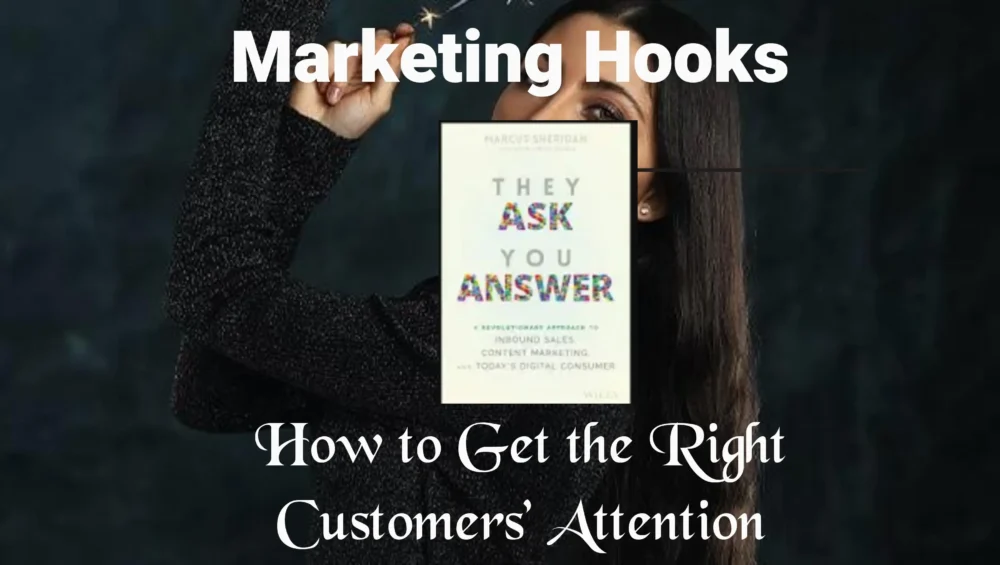
Recommended Book for Step 7: They Ask, You Answer

The Big Idea from They Ask, You Answer
Trust is the ultimate currency in business, and the absolute best way to build that trust is to openly, honestly, and radically address all the questions, fears, and doubts your customers have online.
The questions, concerns and buying issues customers raise can become the foundation for marketing that earns attention and builds trust.
They Ask, You Answer specifically introduces the process of brainstorming the questions customers ask every day.
Note: They Ask, You Answer is not a hook-writing book.
We are using it to teach you that strong hooks come from Real customer questions and concerns.
You will then use those insights to create your own hooks.
What Business Problem Does They Ask, You Answer Solve?
It takes care of: I don’t know what my customers actually want to hear from me.
Many experts start marketing by asking: What should I post? That’s the wrong starting point.
Instead ask:
What is my customer already asking, wondering, worrying about or trying to understand?
Those questions give you raw material for:
Hooks
Content
Headlines
Videos
Articles
Emails
Sales conversations
FAQs
They Ask, You Answer’s early chapters will specifically take you from discovering customer questions to identifying the major categories of questions that influence buying decisions.
Should I Read They Ask, You Answer Now?
Yes, you are not reading this book to build your entire content marketing system now.
You are reading it to learn how to:
Listen for customer questions.
Identify the questions that matter.
Understand the concerns behind those questions.
Turn those insights into useful marketing topics.
Use those topics as raw material for attention.
Which Parts They Ask, You Answer Matter Most for this Step? Focus on these Chapters:
Chapter 6: Brainstorming the Questions You Are Asked Every Day (ESSENTIAL)
This is the most directly relevant chapter for this step. The objective is to identify the questions your customers and prospects actually ask.
Don’t invent questions that sound like marketing questions.
Capture the language people really use.
Chapter 9: The Discovery of The Big 5 (ESSENTIAL)
This introduces the major categories of questions customers want answered. Those become valuable sources of marketing topics and hooks.
Chapter 10: The Big 5, Topic 1: Pricing and Cost (READ)
Pricing questions often attract attention because they involve uncertainty and risk.
Look at how customers think about:
Cost
Value
Affordability
Risk
These can become powerful question and objection hooks.
Chapter 13: The Big 5, Topic 2: Problems (ESSENTIAL)
Your customer already has a problem. Learn how to talk openly about that problem rather than immediately talking about your solution.
This provides material for problem-based hooks.
Chapter 17: The Big 5, Topic 3: Versus and Comparisons (READ)
Customers often want to know: Which option is better for me?
Comparison questions can become excellent hooks because they address an active decision.
Chapter 19: The Big 5, Topics 4 and 5: Reviews and Best in Class (READ)
These help you understand the importance of:
Social proof
Evaluation
Standards
What customers consider best
Use these insights later when creating hooks around credibility and decision-making.
Chapter 21: The Impact of Discussing Competition (SKIM)
This chapter is useful for understanding how customers think about alternatives.
This connects directly to the Alternative Landscape you created in Step 3.
You do not need to turn this into a competitive marketing strategy yet.
Listen to Audiobook with Libro |Buy the Book at the Bookshop
What Should I Skip for Now?
There is a lot in They Ask, You Answer that belongs much later.
For Step 7, you can skip or save for later the following:
Sales-team implementation
Assignment selling
Video strategy
Content-team management
Content marketing culture
Website implementation
Conversational marketing
Self-selection tools
Website priorities
They Ask, You, You Answer later moves heavily into these areas. You don’t need those yet.
Your current objective is much narrower which is to:
Discover what your customer cares enough about to pay attention to, then turn those insights into relevant hooks.
Your EVUNN Action
Build Your Marketing Hook Library
You are not trying to create one perfect headline. You are creating a library of attention hooks that you can use across future marketing. To do that, follow these steps:
1. Bring Forward Your Customer
Return to your Best-Fit Customer and Buying Situation and ask:
What is happening when this person becomes most aware of the problem?
This gives you the context from which your hooks should be created.
2. List Their Real Questions
Write down at least 10 questions your customer is likely to ask.
Start with:
What are they confused about?
What are they worried about?
What are they comparing?
What are they trying to understand?
What are they unsure about buying?
What are they afraid of getting wrong?
What do they want to know before taking action?
Don’t write questions that sound clever. Write questions that sound like something the customer would actually say.
Get the rest of the action steps for this step in EVUNN Premium.
EVUNN Action Steps, Doers Community & Execution Toolkits are for paid users.
Get the Action Steps for this step, plus all Stage 1 Action Steps, access to EVUNN Community and EVUNN Execution Toolkits, with 12 months of access.
EVUNN Mindset Checkpoint
What if people judge me?
Creating hooks means putting your thinking into public view. You may start asking;
What if nobody responds?
What if people criticise me?
Who am I to talk about this?
What if I get it wrong?
If this is the resistance you’re experiencing, don’t confuse fear of visibility with evidence that your message isn’t valuable.
You don’t need to feel completely confident before you begin. You need to be willing to test.
Optional Mindset Reading: Feel the Fear and Do It Anyway by Susan Jeffers
Use this only if fear of visibility, judgment or taking action is preventing you from creating and testing your hooks.
This is not required reading for Step 7. It is an optional mindset checkpoint.
30+ Relevant Attention Hooks
Every hook should connect back to: Your Best-Fit Customer:
→ Their Buying Situation
→ Their Problem
→ Their Desired Outcome
→ Your Core Message
Give your customer a reason to stop scrolling.
You can have a valuable offer and a strong message, but if your customer doesn’t notice it, none of it matters.
🔓 Use the EVUNN Execution Toolkit: Marketing Hook Builder
Stop wondering what to say every time you need to market your offer.
Use the EVUNN Marketing Hook Builder to turn your customer’s real problems, situations, questions, desired outcomes, objections and buying concerns into a structured library of relevant attention hooks.
If you can’t get your best fit customers to pay attention, you will end with no sales no matter how good your offer is.
Get the Marketing Hook Builder + every other Stage 1 Toolkit for 12 months, plus access to the EVUNN Doers Community.
₦5,500 today.
Follow the roadmap. Use the tools. Do the work.
What Do I Do Next?
Now you have a library of relevant attention hooks.
You need to find out exactly where to place your hooks to reach your best fit customers.
Next? Step 8: Choose Where To Reach Them
Where will I find the people this offer is designed for, and which channel should I focus on first?