The Mom test

Customer Discovery: How to Find and Validate Customer Problems | EVUNN

Make Your EVUNN Journey Personal

Not sure which step is right for your business?

This roadmap is part of the EVUNN business-building journey. Tell us what you’re building and where you are right now, and we’ll point you to the roadmap that’s right for your situation – free.

Free |Takes 1 minute


PROBLEM: I have assumptions about my customer's problem, but I haven't tested them with real people.

To be sure a problem is worth your time and resources, you must speak to real people exoeriencibg the problem

Step 5: Customer Discovery


So far, you’ve been working with hypotheses.

You think you know:

  • What problem people have

  • Why they care about it

  • What they experience

  • What progress they’re trying to make

But you don’t know it for sure yet. The only way to find out is to talk to the people experiencing the problem.


The Evunn Mindset Shift

From What I Believe → What I Can Learn

Don’t ask customers to confirm your idea. Don’t try to convince them that your solution is valuable.

Instead ask:

“What can I learn from their real experiences?”

Your goal isn’t to hear yes, I’d buy that. Your goal is to discover what is actually true.


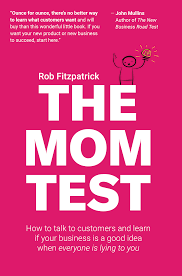
To find out if the problem is real from people with the problem, use this Book. Title: The Mom Test
The Mom test


Author: Rob Fitzpatrick

Time Investment: 5+ hours (Audiobook) 

Listen to audiobook on Libro | Buy at the Bookshop


The Big Idea from Mom Test

Good customer conversations don’t ask people to predict what they might do. They uncover what people have actually experienced and done.

Instead of saying would you pay for help getting more clients?

Ask: Tell me about the last time you struggled to get clients.

The first question produces opinions. The second produces evidence.


What Does This Book Help You Do?

The Mom Test helps you:

  • Avoid askinh leading questions that give you bad rsults

  • Ask about real experiences

  • Separate facts from opinions

  • Identify genuine problems

  • Recognize weak or misleading feedback

  • Keep conversations focused on learning

  • Avoid falling in love with your idea


Should I Read It Now?

Yes. You’ve developed hypotheses. Now you need to test them without accidentally steering people toward the answers you want.

Your objective is simple:

Learn what happened, not what people think might happen.


Which Chapters Matter Most to me at this stage? Focus on these sections:

1.The Mom Test (Essential)

Learn the core principles for having useful customer conversations.

2. Avoiding Bad Data (Essential)

Know how to to recognize unreliable feedback, compliments and hypothetical answers.

3. Asking Important Questions (Essential)

Learn how to ask questions that uncover meaningful information.

4. Keeping It Casual (Essential)

Find out how to have natural conversations rather than formal interrogations.

5. Commitment And Advancement (Essential)

Learn how to distinguish polite interest from genuine commitment.

6. Finding Conversations (Recommended)

Learn how to find people to speak with.

7. Choosing Your Customers (Recommended)

Learn who you should actually be talking to.

8. Running The Process (Essential)

Learn how to turn customer conversations into an ongoing discovery process.

Introduction and Conclusion/Cheatsheet:
Skim for context and review.


Supporting Book: Talking to Humans

talking to humans


Author: Giff Constable

Time Investment: 5+ hours (Audiobook) 

Listen to the Audiobook with Audible free trial |Buy on  Amazon


The Mom Test teaches you how to have better customer conversations. Talking to Humans helps you run the customer discovery process.

It provides practical guidance for:

  • Deciding who you need to learn from

  • Defining what you want to learn

  • Finding interview subjects

  • Conducting effective sessions

  • Making sense of what you discover

  • Avoiding common customer-discovery mistakes

Think of it this way:

The Mom Test → How to ask and listen

Talking To Humans → How to organize and execute the discovery process


Which Parts of Talking to Humans Should You Focus On? Focus on these:

1. Getting Started With Customer Discovery. Understand the purpose and process.

2. Who Do You Want To Learn From? Define the people you need to speak with.

3. What Do You Want To Learn? Turn your hypotheses into learning objectives.

4. How Do You Find Your Interview Subjects? Learn how to find appropriate people to speak with.

5.:How To Ensure An Effective Session? Prepare for and conduct useful conversations.

6. How Do You Make Sense Of What You Learn? Learn how to organize and interpret what you discover.

7. Screwing Up Customer Discovery. Review common mistakes before you make them.

The remaining sections are optional.


Your Step 5 Outcome

By the end of this step (after going through the recommended chapters and implemenring this step with Evunn toolkit), you should have:

  • Conducted conversations with 10 people who actually experience your potential problem

  • Evidence about whether the problem exists in the way you expected

  • Real examples of the customer’s experiences

  • Evidence of what they currently do to deal with it

  • Evidence of the consequences of the problem

  • Evidence of what they have already tried

  • A clearer understanding of which assumptions were supported, challenged or disproved

This is a critical milestone.

At this stage, tou are no longer relying entirely on what you think customers need.

You now have evidence from real people. But you may discover something uncomfortable:

Not every problem you investigated deserves to become a business.

Some may be painful but rarely acted upon. Some may be important but poorly suited to your expertise.

Some may have stronger evidence than others.

Before you create your offer, find out what your customer is actually trying to achieve, not what you assume they want.


🔒 Ready To Run Your Customer Discovery?

Reading about customer interviews won’t give you the evidence.

The EVUNN Jobs-to-be-Done Canvas helps you uncover the real job they need to get done.

Do this before you build. Otherwise, you may end up creating an offer nobody needs.

 

One Payment of ₦5,500 or $4.25 . All Stage 1 Toolkits. Yours For Life.
No monthly subscription. No recurring fees. Just the tools you need to execute


What Should I Do Next?

You’ve now investigated your 3 potential problems from step 1 with real people. 

The question is no longer: What problems exist? It’s which among these 3 problems deserve my attention first to build a busibess around?


Step 6: Problem Prioritization

 In this step, you’ll learn how to evaluate your evidence and choose the problem with the strongest business potential to build a profitable business around 

That takes you from: Assumptions → Evidence → Priorities

Leave a Reply

Your email address will not be published. Required fields are marked *