How to Build a Prospect List | EVUNN
Make Your EVUNN Journey Personal
Not sure which step is right for your business?
This roadmap is part of the EVUNN business-building journey. Tell us what you’re building and where you are right now, and we’ll point you to the roadmap that’s right for your situation – free.
Free |Takes 1 minute
THE PROBLEM: I have a plan in place on the steps to take to get my first customers, but I don't know the specific people to reach out to first
Having a list of your best fit customer prospects makes achieving your first sales easier
Your Stage 1 access includes all the EVUNN Toolkits you’ll need to do the work. Don’t just read. Use them as you move through each step.
STEP 2: Build Your First Prospect List
In Step 1, you created your First-Customer Acquisition Plan.
You identified:
Your Best-Fit Customer
⬇️
Where they may be found
⬇️
Your initial acquisition channel
⬇️
Your customer entry point
⬇️
How you intend to move prospects toward a sale
Knowing your target market is not the same as having actual prospects.
You need to know the specific people you should approach?
This is where prospecting begins.
Your goal is not to build the biggest possible database. Your goal is to identify a focused group of real prospects who are likely to fit your customer profile and have a relevant problem or buying situation.
The EVUNN Mindset Shift
Now you move from I need more leads → I need the right buyers.
Traditional prospecting most easily become a numbers game like:
- Contact more people.
- Send more messages.
- Build a bigger list.
But more prospects do not automatically mean more customers.
If you are approaching people who:
Don’t fit your customer profile
Don’t have the problem
Aren’t in the relevant situation
Don’t have a reason to act
Aren’t appropriate for your offer
then increasing your outreach simply increases wasted effort.
The better question is: Who is most likely to have the problem I solve and have a reason to engage with me?
This is the buyer-first approach that is covered in Gap Prospecting.
Recommended Book for this step - Gap Prospecting
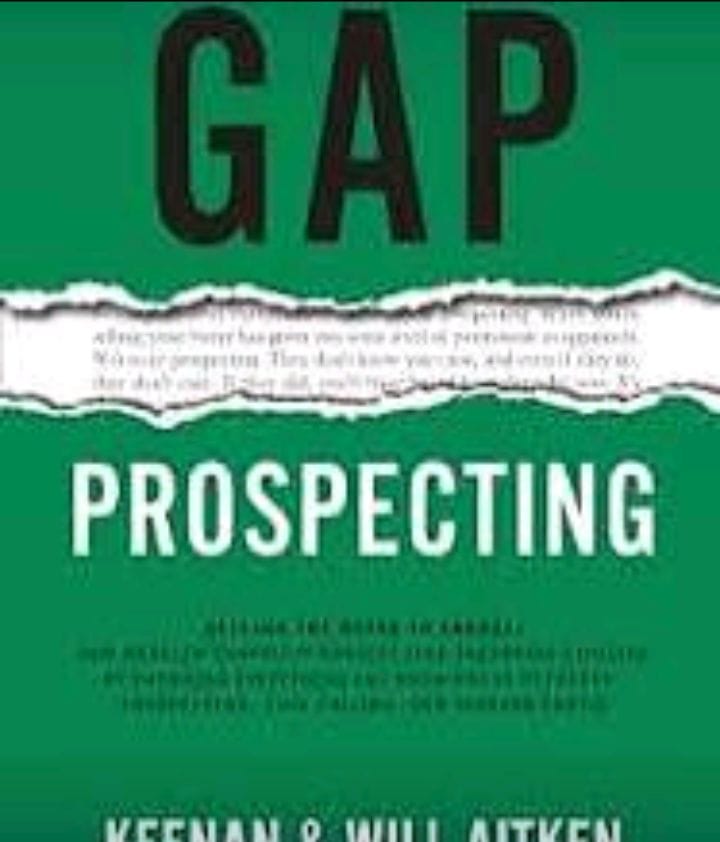
Author: Keenan & Will Aitken
Time Investment: 5+ hours (Audiobook)
Listen to Audiobook with Audible free trial |Buy the Book at the Bookshop
The Big Idea from Gap Prospecting
Effective prospecting starts with the buyer, not with your product, your pitch or the number of people you can contact.
Gap Prospecting challenges traditional prospecting approaches and moves toward a more buyer-centred approach like:
Understand the buyer
↓
Understand the problem
↓
Target the right buyer
↓
Create a relevant reason to engage
You are not reading Gap Prospecting simply to learn how to find leads. You are learning how to identify better prospects.
What Business Problem Does Gap Prospecting Solve?
It handles: I’m contacting people, but I don’t know whether I’m actually targeting the right buyers.
A prospect list can look impressive while being commercially useless. You can have 500 names and still have no meaningful prospects.
The book’s Part II, Put the Buyer First, focuses on understanding the buyer, mapping the problem and targeting the buyer.
Should I Read Gap Prospecting Now?
Yes, but only the relevant chapters.
Your objective is to:
Learn how to identify and target prospects based on their situation and problem rather than simply their demographic or job title.
Which Parts of Gap Prospecting Matter Most for this Step?
PART II: PUT THE BUYER FIRST
Chapter 7: Get to Know Your Buyer (ESSENTIAL)
This is where you deepen your understanding of the person you are trying to reach.
Connect it to the Best-Fit Customer you created earlier.
You should be able to answer:
Who is this buyer?
⬇️
What situation are they in?⬇️
What are they trying to accomplish?⬇️
What might be getting in their way?⬇️
What would make this problem relevant to them now?
The objective is to move beyond: My target market is small business owners.
toward: My prospect is a small business owner who is experiencing a specific situation that makes the problem I solve relevant right now.
Chapter 8: Map the Problem (ESSENTIAL)
You already identified and validated the problem in earlier phases. Now use that understanding when identifying prospects.
Ask:
What observable signs might indicate that this person is experiencing the problem?
For example, the signal might be:
- A recent role change
- A new business launch
- A new responsibility
- A growth challenge
- A stated goal
- A visible operational problem
- A request for help
- A change in circumstances
You are looking for evidence of relevance, not simply demographic similarity.
Chapter 9: Target Your Buyer (ESSENTIAL)
This is the most directly relevant chapter for Step 2. Use it to think about who should actually make it onto your prospect list.
Your objective is not:
Find everyone who could possibly buy.
It is:
Identify the people most worth approaching first.
This becomes the bridge between your Best-Fit Customer and your actual prospect list
What Parts of Gap Prospecting Should I Read Later?
PART I: IT’S BROKEN
These chapters provide useful context about the problems with traditional prospecting.
For this step:
Chapter 1: The Fundamental Challenge (SKIM)
Useful for understanding why prospecting needs to change, but not essential to completing your task.
Chapter 2: The Nine Truthbombs of Prospecting
(SKIM)
Useful context, but you do not need to study every principle before building your first prospect list.
Chapters 3–6 (SKIP FOR NOW)
They provide broader context around the current state and business impact of prospecting, but they are not necessary for this execution step.
What Parts of Gap Prospectibg Should I Save for Step 3?
PART III: THE GOAL OF PROSPECTING
Keep these for the next step:
- Chapter 10: Light Up Your Buyer’s Brain
- Chapter 11: Get Sticky
- Chapter 12: Get Your Mind Right
These become more relevant when you move from:
Who should I approach?
to:How do I approach them in a way that earns attention and starts a conversation?
Your EVUNN Action
BUILD YOUR FIRST PROSPECT LIST
Now turn your Best-Fit Customer into real prospects. This is where the work moves from strategy to execution. Follow the following steps ti impkement step 2:
1. BRING FORWARD YOUR BEST-FIT CUSTOMER
This would be pre-filled for you if you are using the EVUNN Execution Toolkit
Now, go back to the customer profile you created in Phase 3.
Record:
- Who are they?
- What situation are they in?
- What problem are they experiencing?
- What outcome do they want?
- What makes this problem relevant now?
- Who is NOT a fit?
This becomes your prospect qualification filter.
2. DEFINE YOUR PROSPECT CRITERIA
Before searching for people, decide what makes someone worth adding to your list. Build a prospect list qualifier lije this:
Must Fit
The prospect must: …….Strong Fit
The prospect is especially attractive if: ………..Not a Fit
Do not add prospects who: ……….
The goal is to prevent yourself from collecting names simply because they look vaguely similar to your target customer.
Get the rest of the action steps for this step in EVUNN Premium.
EVUNN Action Steps, Doers Community & Execution Toolkits are for paid users.
Get the Action Steps for this step, plus all Stage 1 Action Steps, access to EVUNN Community and EVUNN Execution Toolkits, with 12 months of access.
EVUNN Mindset Checkpoint
Are you building the list because contacting prospects makes you uncomfortable?
Prospecting can create resistance. It is easier to:
- Research
- Organise
- Build spreadsheets
- Refine your profile
- Improve your website
- Create more content
- Search for more prospects
than to actually approach someone, but the prospect list is not the goal. The conversation is.
Your list only needs to be good enough to help you begin.
Optional Mindset Reading:
The War of Art by Steven Pressfield. Listen to audiobook with Audible Free Trial
Use this book only if you notice yourself repeatedly preparing instead of taking the uncomfortable action of approaching prospects.
This is optional. If you are not feeling this resisteance, move on.
YOUR STEP 2 OUTPUT
By the time you are done implementing this step, you should have a FIRST PROSPECT LIST that contains:
Best-Fit Customer Criteria
↓
Prospect Qualification Criteria
↓
Problem Signals
↓
Buying-Situation Signals
↓
Real Prospects
↓
Prospect Information
↓
Priority Ranking
↓
25–50 Initial Prospects
Your objective is not to create a perfect database.
Your objective is to have a focused group of real people you can begin approaching and learning from.
Don’t wait for customers to find you.
You need to find real people who fit the description of your best fit customer who genuinely need what you offer.
🔓Use the EVUNN EXECUTION TOOLKIT – First Prospect List Builder
Don’t build a giant database of random leads.
Use the EVUNN First Prospect List Builder to identify real prospects who match your Best-Fit Customer, capture relevant problem and buying-situation signals, rank prospects by priority and create a focused list ready for outreach.
Get the Prospect List Builder + every other Stage 1 Toolkit for 12 months, plus access to the EVUNN Doers Community.
₦5,500 today.
Follow the roadmap. Use the tools. Do the work.
WHAT Should you Do Next?
You now know exactly who you are going to approach first, why they may be a fit and what makes their situation relevant.
Next you will need to earn their attention and start a genuine conversation. That takes us to step 3.
Next: Step 3 – Start The Conversations
What do I say to a prospect that makes them want to engage rather than ignore me?