

How to Diagnose a Sales Opportunity | EVUNN
Make Your EVUNN Journey Personal
Not sure which step is right for your business?
This roadmap is part of the EVUNN business-building journey. Tell us what you’re building and where you are right now, and we’ll point you to the roadmap that’s right for your situation – free.
Free |Takes 1 minute
THE PROBLEM: I have spoken to potential customers and heard about their problems, but I don't know which problems represent a real opportunity worth solving.
Your pricing can break your business. Before you launch the offer, work out a pricing strategy
Your Stage 1 access includes all the EVUNN Toolkits you’ll need to do the work. Don’t just read. Use them as you move through each step.
STEP 4: Diagnose The Opportunity
In Step 3, you started real customer conversations and should now have customer evidence.
During customer conversations, you need to diagnose if there is a sales opportunity. A customer having a problem does not automatically mean you have a sales opportunity.
Someone can say: I need more customers or I need better marketing or I need to improve my operations, but these statements are only the beginning.
You still need to understand:
- Where are they now?
- Where do they want to be?
- What is preventing them from getting there?
- What is the gap?
- What is the gap costing them?
- Why does closing the gap matter?
- Why do they need to change now?
- And most importantly: Is this gap important enough for the customer to invest in closing it?
This is where diagnosis begins. Your goal is to determine whether there is a valuable customer opportunity worth pursuing.
The EVUNN Mindset Shift
Tbis step takes you from they have a problem → I understand the gap.
Most people who want to start expertise based businesses are often very good at recognising problems.
Once they hear:
I can’t get enough clients.
They immediately think:
I know how to fix that.
Your expertise makes this tempting. You may start solving the problem before you have properly diagnosed it.
The customer may have described a symptom and the real problem may be somewhere else. And even if the problem is real, it may not be important enough to solve.
So the better question is not:
Can I solve this problem?
It is:
What is the gap between where this customer is and where they need to be, and is closing that gap important enough for them to act?
That is the thinking behind Gap Selling. You are moving from:
Problem
↓
Diagnosis
↓
Opportunity
Recommended Book for Step 4: Gap Selling
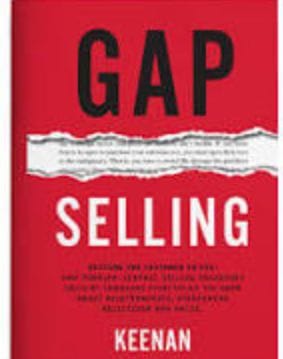
Author: Keenan
Time Investment: 5+ hours (Audiobook)
Listen to Audiobook with Audible free trial |Buy the Book at Amazon
The Big Idea from Gap Selling
Customers do not buy simply because they have problems.
They buy when the difference between their current state and their desired future state creates enough value, pain or urgency to justify change. That difference is the gap.
Your job is not to rush into presenting your solution. Your job is to understand the customer’s:
Current State
↓
Future State
↓
Gap
↓
Impact
↓
Why
↓
Need for Change
This makes Gap Selling the natural primary book for Step 4. You are not reading it simply to learn sales techniques.
You are learning how to diagnose a customer’s situation well enough to determine whether a genuine sales opportunity exists. This makes getting a yes much easier.
What Business Problem Does Gap Selling Solve?
It takes care of: I can identify a customer’s problem, but I don’t know how to determine how serious it is, what is causing it, what it is costing them or whether they have enough reason to act.
A weak sales conversation often looks like this:
Customer:
We need more customers.
Expert:
I can help you with that.
Offer is then presented. But the expert still doesn’t know:
- How many customers the business currently has
- How many it needs
- Why the current number is insufficient
- What is causing the shortfall
- What the shortfall is costing
- What the desired situation looks like
- What happens if nothing changes
- Whether solving it is a priority
A diagnostic conversation goes much deeper. You are trying to understand the business reality behind the statement.
Should I Read Gap Selling Now?
Yes, and while at it, your main objective should be to: learn how to diagnose a customer’s current state, future state, the gap between them, the impact of that gap and whether the customer has a compelling reason to change.
Which Parts of Gap Selling Matter for this Step?
Chapter Three: The Current State (ESSENTIAL)
This is where you establish where the customer actually is today.
Go beyond the customer’s first description of the problem and ask:
- What is happening now?
- How are they currently operating?
- What have they already tried?
- What is working?
- What isn’t working?
- Who is affected?
- How frequently does the problem occur?
- What resources are involved?
- What happens if they continue operating this way?
The objective is to create a specific picture of reality.
Instead of: My business isn’t growing. You want something closer to: Revenue has remained at approximately ₦5 million per year for the last two years despite increasing marketing activity.
Specificity makes diagnosis possible.
Chapter Four: The Future State (ESSENTIAL)
Now understand where the customer wants to go. Ask:
- What are they trying to achieve?
- What would they like to change?
- What would success look like?
- What result do they actually want?
- What would improve if the problem were solved?
- What would they be able to do that they cannot do now?
- Do not substitute your preferred outcome for the customer’s desired outcome.
Your customer may not want better marketing. They may want a predictable flow of qualified clients every month.
The future state must matter to them.
Chapter Six: The Gap Define (ESSENTIAL)
This is the heart of Step 4. Place the customer’s: Current State beside their: Future State. Then ask:
What is preventing them from getting from where they are now to where they want to be?
That difference is the gap.
For example:
Current State:
The consultant relies almost entirely on referrals and has unpredictable monthly revenue.
Future State:
She wants a predictable flow of qualified clients each month.
Gap:
She does not have a repeatable customer acquisition system that consistently generates qualified prospects.
This is much more useful than simply recording: She needs more customers.
You are beginning to understand the actual opportunity.
Chaptet Eight- Discovery: Know Yout Clients Better Than They Know Themselves (ESSENTIAL)
This chapter reinforces the need to keep investigating because the prospect’s first answer is not necessarily the complete diagnosis.
They may describe:
- A symptom
- An assumption
- A consequence
- A visible problem
- Or something they believe is causing the problem
Your job is to investigate and ask:
- What happened?
- Why is that happening?
- What have you tried?
- What changed?
- Who is affected?
- What happens next?
- What is causing the situation?
The goal is not to prove that the prospect is wrong. It is to understand the situation more deeply than the initial problem statement.
Chapter Nine: Is The Gap Worth It? (ESSENTIAL)
A gap can be real without being commercially valuable. Ask:
- How significant is the gap?
- What is it costing the customer?
- What happens if nothing changes?
- How much does solving it matter?
- What would closing the gap make possible?
Why should they act now?
This is where you begin separating:
A problem someone has
from:
An opportunity someone is motivated to solve.
Chapter Ten: Know Your Customer’s Why (ESSENTIAL)
The customer needs a reason to change. You need to understand:
- Why does this matter?
- Why now?
- Why is the current situation no longer acceptable?
- What happens if they don’t change?
- What will improve if they do?
The customer’s why gives context to the gap. Two customers can have the same problem but completely different levels of motivation.
You need to understand what makes the opportunity important to this particular customer.
Chapter Seven: Get Them To Let You Help (IMPORTANT)
This becomes relevant after you have developed enough understanding of the customer’s situation.
You are not trying to force your way into the conversation. You are earning permission to help by demonstrating that you understand the customer’s situation.
The deeper your diagnosis, the more naturally you can move toward a discussion about whether you can help close the gap.
This becomes the bridge into Step 5.
What Parts of Gap Selling Should I Read Later?
Chapter Eleven: How to do a Kickass Demo (SAVE FOR STEP 5)
This becomes more relevant when you are presenting your solution.
Chapter Thirteen: Troubleshooting (SAVE FOR LATER)
Useful when deals begin encountering problems or stalls.
Chapter Twelve: Move Your Deals Through The Pipeline (SAVE FOR LATER)
This is more relevant once you have opportunities moving through your sales process.
PART III: GAP PROSPECTING (SAVE FOR STEP 2 / REVIEW LATER)
Chapters 14–17 deal with prospecting, which we have already addressed in Step 2.
Your EVUNN Action
DIAGNOSE YOUR BEST SALES OPPORTUNITIES
Now return to the prospects you spoke with in Step 3.
You are going to turn your customer evidence into qualified sales opportunities. Do not diagnose every person on your original prospect list.
Start with the prospects who gave you the strongest evidence.
Your objective is:
Evidence → Diagnosis → Qualified Opportunity
Follow the steps below:
1. Select Your Strongest Prospects
Review your Step 3 conversation records. Identify prospects who demonstrated:
- A real problem
- A meaningful impact
- Evidence they have tried to solve it
- A clear desired outcome
- Some level of urgency
- Willingness to continue the conversation
Select your strongest opportunities first.
2. Document The Current State
For each prospect, answer:
- Where are they now?
- What is happening?
- How are they currently handling the situation?
- What have they already tried?
- What is not working?
- Who is affected?
- How often does the problem occur?
- What resources are involved?
- What happens if nothing changes?
Be specific. Do not write: Their business is struggling. Write what is actually happening. For example:
The business generates approximately 80 leads per month but converts fewer than five into paying customers.
Your diagnosis should be based on evidence from the customer, not assumptions.
Get the rest of the action steps for this step in EVUNN Premium.
EVUNN Action Steps, Doers Community & Execution Toolkits are for paid users.
Get the Action Steps for this step, plus all Stage 1 Action Steps, access to EVUNN Community and EVUNN Execution Toolkits, with 12 months of access.
EVUNN Mindset Checkpoint
Are you willing to walk away when the gap isn’t worth solving?
You may want the prospect to become a customer because you may have spent time researching them.
You may also believe strongly in your solution, but if:
- The impact is small
- The customer isn’t motivated
- The urgency is weak
- The desired outcome is unclear
- The customer is satisfied with the current state
- or the gap simply isn’t valuable enough to close,
then you may not have a real sales opportunity. Do not manufacture urgency or exaggerate pain or try to convince someone that a problem matters when it doesn’t matter to them.
Remember:
Your job is not to turn every problem into a sale. Your job is to identify the problems where the gap is valuable enough for the customer to want change.
If you find yourself struggling to accept that some prospects are not worth pursuing, return to the folowing chapters in Gap Selling:
Chapter 9: Is the Gap Worth It? and Chapter 10: Know Your Customers’ Why
The important thing is learning to diagnose honestly.
Your Step 4 Output
By the end of this step, you should have a QUALIFIED SALES OPPORTUNITIES
Your process should now look like:
Customer Conversations
↓
Customer Evidence
↓
Current State
↓
Future State
↓
The Gap
↓
Root Cause
↓
Impact
↓
Customer’s Why
↓
Urgency
↓
Value of Change
↓
Opportunity Status
↓
Qualified Sales Opportunity
Your objective is not to turn every prospect into an opportunity., but to identify the prospects where:
Its time to diagnose if there is a sales opportunity.
🔓 Use the EVUNN Execution Toolkit: Opportunity Diagnosis Canvas
Don’t move from: The customer has a problem. straight to: Here is my solution.
Use the EVUNN Opportunity Diagnosis Canvas to map:
Current State
↓
Future State
↓
The Gap
↓
Root Cause
↓
Impact
↓
Customer’s Why
↓
Urgency
↓
Value of Change
↓
Opportunity Status
The toolkit helps you determine which customer situations represent genuine sales opportunities and which should be investigated further, paused or disqualified.
Get the Opportunity Diagnosis Canvas + every other Stage 1 Toolkit for 12 months, plus access to the EVUNN Doers Community.
₦5,500 today.
Follow the roadmap. Use the tools. Do the work.
What Should you Do Next?
You entered this step with:
This prospect has a problem I may be able to solve.
You arw now leaveing knowing:
I understand where this customer is, where they want to be, the gap between those two states, what is causing it, what it is costing them, why it matters and whether there is a reason to act.
The next question is if the opportunity is real, valuable and worth solving, how do you present your solution so the customer can see how it closes the gap, and make it easy for them to decide?
Next: Step 5: Present & Close The Offer
How do I connect my solution to the customer’s opportunity and move them toward a decision?