
Problem Framing: How to Define the Right Problem to Solve | EVUNN
Make Your EVUNN Journey Personal
Not sure which step is right for your business?
This roadmap is part of the EVUNN business-building journey. Tell us what you’re building and where you are right now, and we’ll point you to the roadmap that’s right for your situation – free.
Free |Takes 1 minute
PROBLEM: I understand the structure of the problem better, but I still don't know exactly which problem I should solve.
To nail the specifc problem you are solving, narrow down the main problem you chose into something more specific using framing
Step 8: Problem Framing
In Step 7, you mapped the problem.
You uncovered the people, situations, behaviours, causes, consequences, workarounds and unmet needs surrounding the problem you chose..
But a problem map can reveal more problems than you started with.
Now you need to narrow your focus. Problem mapping expands your understanding. Problem framing focuses your decision.
Your goal is to turn a broad or confusing problem into a clear, specific problem worth validating.
The Evunn Mindset Shift
From Describing The Problem → Defining The Right Problem
It’s tempting to jump straight to a solution like: they need a coaching program, they need an app, they need a course.
Don’t do that yet. First ask:
“What exactly is the problem we are trying to solve?”
A strong problem frame describes the customer, situation, struggle and desired progress without prescribing the solution.
To narrow down the specific problem you should solve, use this Book. Title: What's Your Problem?
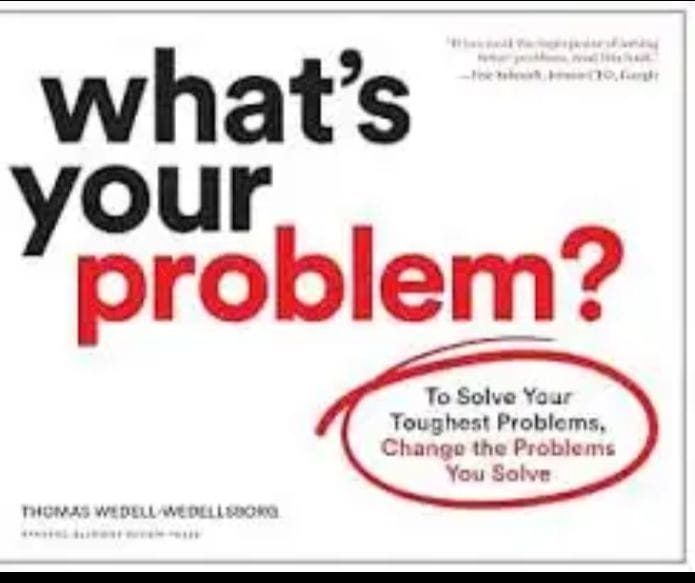
You’ve encountered this book earlier in step 1 of this roadmap.
But you are now returning to the reframing tools inside it that became more valuable after you’ve completed your customer research and problem map.
You are no longer trying to generate possible problems.
You are using evidence to determine whether your current definition of the chosen problem is actually the right one.
What Does This Book Help You Do?
The relevant chapters help you:
Challenge your initial definition of the problem
Look beyond the obvious frame
Examine the problem from different perspectives
Rethink the goal
Identify overlooked possibilities
Separate the problem from your assumptions
Move toward a more useful problem definition
Should I Read it Now?
Yes, but selectively.
You already read the introductory material in Step 1.
Now return to the reframing section with your chosen problem and problem map in front of you.
Your question is no longer: What problems could I solve?
It is: Have I defined this problem correctly?
Which Chapters Matter Most to me right now? Focus on these:
Chapter 2: Getting Ready To Reframe (Essential)
Prepare yourself to question the way you’ve currently defined the chosen problem.
Chapter 3: Frame The Problem (Essential)
This is directly relevant to the work you’re doing in this step.
Chapter 4: Look Outside The Frame (Essential)
Look beyond the obvious interpretation of the problem.
Chapter 5: Rethink The Goal (Essential)
Ask whether you’re solving the right problem, or simply pursuing the goal you’ve assumed matters.
Chapter 6: Examine Bright Spots (Recommended)
Look for situations where the problem doesn’t occur, occurs less severely or has already been overcome.
Chapter 7: Look In The Mirror (Recommended)
Challenge your own assumptions and consider how your perspective may be shaping the problem definition.
Chapter 8: Take Their Perspective (Essential)
Return to the customer’s perspective rather than framing the problem around your expertise.
Chapter 9: Move Forward (Recommended)
Use the reframed understanding to move toward a clearer definition of what should actually be solved.
Chapters 10–11: Overcome Resistance (Optional for now)
These are useful for understanding resistance to reframing but aren’t essential to producing your problem frame.
You’re defining the problem before designing the solution.
Listen to Audiobook on Libro | Buy at the Bookshop
Your Step 8 Outcome
By the end of this step, after going through the chapters and implementing with the EVUNN framing toolkit, you should have:
A clearly defined target person
A specific situation in which the problem occurs
A clear description of the struggle
The progress they are trying to make
Evidence-based obstacles or contributing factors
The consequences of the problem
A distinction between the problem and possible solutions
A reframed problem statement
A list of assumptions that still need to be tested
Your output:
ONE clear problem frame ready for validation.
You have now moved from something is wrong to this is the specific problem we believe is worth solving, for this specific person, in this specific situation.
🔒 Turn Your Research into a Clear Problem Frame
You’ve gathered the evidence, prioritized the opportunity, mapped the problem.
Now turn everything you’ve learnt into one precise problem definition.
The EVUNN Problem Framing Canvas guides you through the questions needed to challenge your assumptions, narrow the problem and create a clear problem frame ready for validation.
Don’t build a solution around a problem you haven’t clearly defined.
One Payment of ₦5,500 or $4.25 . All Stage 1 Toolkits. Yours For Life.
No monthly subscription. No recurring fees. Just the tools you need to execute
What Should I Do Next?
You’ve now defined the problem you believe is worth solving. But there is still one last important question.
Are we right?
A well-written problem statement isn’t proof that the problem is worth building a business around.
It is still a hypothesis. So, a good problem statement isn’t the same as a validated problem.
You still need evidence that the problem is real, important, persistent, actionable & Worth solving
Next? Step 9: Problem Validation
The question now becomes: How can I test whether this problem is important enough to build a business around before I invest heavily in a solution?
This is the final step before you move from problem investigation to business building.