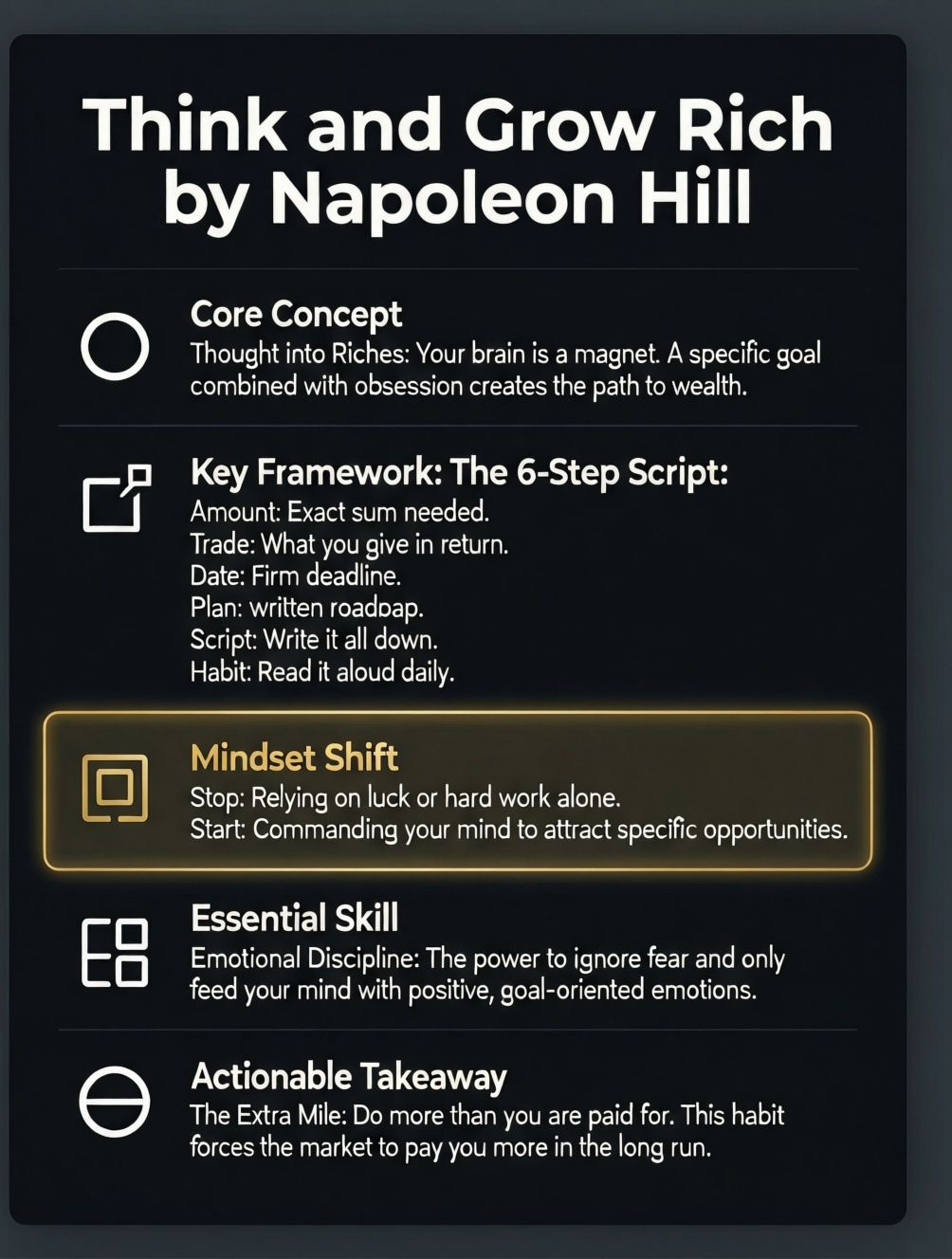
Think and Grow Rich by Napoleon Hill is a timeless guide that teaches the principles of success and wealth-building through clarity of purpose, unwavering faith, and persistent action.
Think and Grow Rich is perfect for:
Aspiring Entrepreneurs: If you’re starting a business or looking to scale one, this book provides mindset principles to achieve financial success.
Professionals Seeking Growth: Whether you’re climbing the corporate ladder or pivoting careers, it helps you clarify goals and take decisive action.
Visionaries: If you have big ambitions but struggle with fear, doubt, or focus, this book guides you to turn those dreams into tangible results.
Self-Development Enthusiasts: Anyone interested in improving their mindset, developing confidence, or mastering habits will find invaluable lessons.
It’s for anyone who wants to unlock their potential, overcome limitations, and create a meaningful, abundant life.
Get the full PDF Think and Grow Rich here. This is a book you want to read over and over again.
Chapter 1: The Power of the Mind
You are about to start a journey that most people never finish. Chapter 1 is the most important part of the book because it changes how you look at your own brain. Napoleon Hill starts with a bold claim: thoughts are things
This is not just a catchy phrase. It means that when you combine a thought with a clear purpose and a burning desire, that thought physically begins to change your world. Most people treat their thoughts like clouds that just pass by. Successful people treat their thoughts like seeds they are planting in a garden.
1. The Story of Edwin C. Barnes
Edwin Barnes is the perfect example of how this works. He was a man with no money and very little education. But he had a definite purpose. He wanted to be the business partner of the great inventor Thomas Edison.
Most people would say that is impossible. He did not know Edison. He had no money to travel to see him. But Barnes did not let his circumstances stop his thought.
He hopped a freight train to get to Edison’s office.
He accepted a low-level job just to be in the same building as the man he wanted to partner with.
He waited for years, keeping his goal alive in his mind every single day.
The Lesson: Barnes did not go to Edison asking for a job. He went there with the mindset that he was already a partner who just hadn’t started yet. In your own career, are you looking for a job, or are you looking for a partnership with your future? The way you see yourself determines the way the world sees you.
2. Three Feet From Gold
This is one of the most famous stories in history for a reason. A man named Darby went out West to mine for gold. He worked hard, found a vein of ore, and started making money. But then, the gold disappeared.
He kept digging for a while, got frustrated, and finally quit. He sold his machinery to a junk man for a few dollars.
The junk man was smarter. He hired an engineer to look at the ground. The engineer found that the gold was only three feet from where Darby stopped digging.
The junk man became a millionaire because he knew how to get expert advice before giving up. Darby learned a hard lesson that he used later in life: Failure is a trickster with a keen sense of irony and cunning. It takes delight in tripping one when success is almost within reach.
3. Opportunity’s Disguise
One of the biggest secrets in this chapter is that opportunity has a habit of slipping in through the back door. It often comes disguised in the form of misfortune or temporary defeat.
When a new dictating machine was invented, Edison’s regular salesmen couldn’t sell it. They thought it was a failure. Barnes saw this failure as his big chance. He stepped in, sold the machine, and finally became Edison’s partner.
If you are facing a setback today, do not look at it as a wall. Look at it as a door you haven’t opened yet. Every failure carries with it the seed of an equivalent success.
A Moment to Challenge Your Assumptions
Most people think that the reason they are not successful is because they lack money, luck, or connections. This is the biggest mistake you can make. In reality, the only thing you truly lack is a burning desire that is backed by a plan.
Challenge: Look at your biggest goal right now. Ask yourself honestly: If someone told me I had to achieve this or I would lose everything I own, would I work harder? If the answer is yes, then you don’t have a burning desire yet. You just have a wish. Wishes do not bring riches. Only a obsessed mind brings results.
My Interpretation: The Mental Blueprint
The Judgement: In today’s fast-paced world, we are taught to pivot every time things get hard. We call it being agile, but often it is just an excuse to quit when we are three feet from gold.
The Advice: Pick your “Edison.” Decide who you want to be or what you want to build and stick to it with dogged persistence . Do not worry about how you look to others while you are working the low-level jobs. As long as you are moving toward your partnership, you are winning.
How to Apply This Today
- Define Your Major Purpose: Write down exactly what you want. Do not be vague. Instead of saying I want to be rich, say I want to earn a specific amount of money by a specific date.
- Find Your Three Feet: If you are currently feeling like quitting a project, stop. Find an expert, a mentor, or a consultant to look at your work before you sell your machinery to the junk man.
- Identify the Back Door: List the three biggest problems you are facing right now. Next to each one, write down one way that problem could actually be an opportunity to do something differently.
Chapter 1 conclusion: The Journey Begins
Chapter 1 is the wake-up call. It tells you that your brain is a magnet. If you fill it with thoughts of poverty, you will stay poor. If you fill it with a definite purpose and the belief that you will win , the universe has no choice but to help you.
Now, stop wishing for luck and start engineering your thoughts. The gold is there. You just have to keep digging that last three feet!
Chapter 2: Desire
If Chapter 1 was the spark, Chapter 2 is the fuel. Napoleon Hill argues that the starting point of all achievement is a burning desire. This is not just a hope or a wish. Everyone wants money and success. But a burning desire is a mental obsession that consumes your thoughts until you find a way to make it real.
You must understand that the universe does not give you what you want; it gives you what you demand with a definite purpose. If your goal is just to get by, you will just get by.
If your goal is to build an empire, you must first build that empire in your mind through desire.
1. The Six Practical Steps
Hill does not leave you guessing. He provides a specific, six step method to turn your desire into its financial equivalent. This is the most practical part of the entire book.
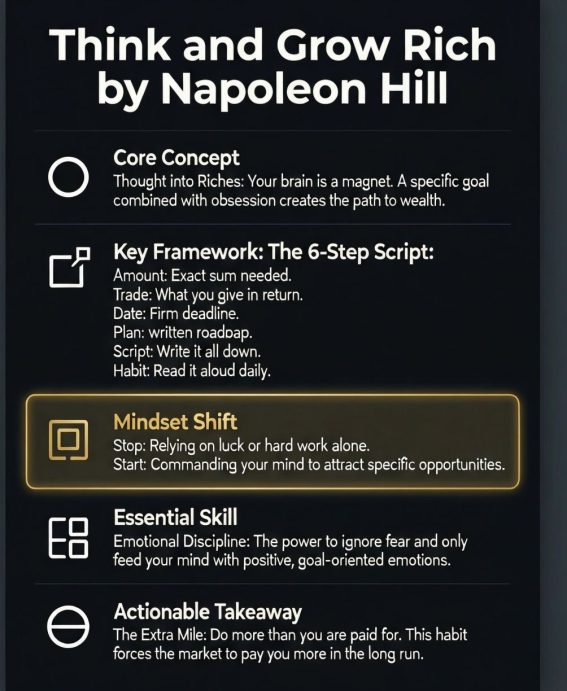
Fix in your mind the exact amount of money you desire. It is not enough to say you want plenty of money. Be definite.
Determine exactly what you intend to give in return for the money. There is no such thing as something for nothing. What service or product will you provide?
Establish a definite date when you intend to possess the money. Without a deadline, a goal is just a dream.
Create a definite plan for carrying out your desire. Start at once, whether you are ready or not, to put this plan into action.
Write out a clear, concise statement of the amount, the time limit, and the plan.
Read your written statement aloud, twice daily. Once just before retiring at night, and once after arising in the morning.
The Lesson: As you read, you must see and feel and believe yourself already in possession of the money. This is how you program your subconscious mind to find opportunities that others miss.
2. The Burning Bridge Strategy
Hill tells the story of a great warrior who landed his troops on enemy shores. To ensure victory, he ordered his men to burn the ships that brought them.
By burning the ships, he left his men with no choice but to win or perish.
They had no way to retreat. Most people fail because they keep a back door open. They have a Plan B in case things do not work out.
If you want to reach a high level of success, you must cut off all sources of retreat. When you realize that you must succeed because there is no other option, your mind operates at a completely different level of power.
3. The Story of the Deaf Boy
Hill shares a very personal story about his own son who was born without the physical equipment for hearing. Doctors said the boy would be a deaf mute for life.
Hill refused to accept this. He planted a burning desire in his son’s mind to hear and speak. He spent years telling the boy stories and building his confidence.
Eventually, through a combination of technology and sheer mental will, the boy gained almost normal hearing and became a successful businessman.
This story proves that desires can overcome physical limitations. Your current situation, your bank balance, or your lack of education are not permanent barriers unless you accept them as such in your mind.
A Moment to Challenge Your Assumptions
Most people think that wishing for something is the same as being ready to receive it. This is the biggest mistake you can make.
You are never ready for a thing until you believe you can acquire it. The state of mind must be belief, not mere hope or wish.
Challenge: Look at the six steps above. Have you actually written down your goal, or are you just telling yourself that you will do it later? If you have not put it on paper, you are still just wishing. The physical act of writing is the first step in turning a thought into a thing.
My Interpretation: The Power of Obsession
The Judgement: In modern culture, we are often told to stay balanced. While balance is good for health, it is rarely the path to massive achievement.
Every person Hill studied was, at some point, obsessed with their goal.
The Advice: Do not be afraid to be obsessed. People might tell you that you are thinking too much about your business or your goal. That is usually a sign that you are on the right track. A lukewarm desire brings lukewarm results. If you want the gold, you have to turn up the heat.
How to Apply This Today
Get Your Index Card: Right now, take a piece of paper and complete the six steps. Write down the amount, the date, the service you will give, and the plan.
- Create Your Morning Ritual: Put that card on your nightstand. Read it out loud the second you wake up. Do not check your phone or look at social media first. Feed your desire before you feed your distractions.
- Find Your Ships to Burn: Identify one safety net that is holding you back from giving 100 percent to your goal. It might be a part time job you hate but keep for comfort, or a relationship that drains your energy. Decide when you are going to burn that ship.
Chapter 2 Conclusion: The Fuel for the Journey
Chapter 2 teaches you that you are the master of your fate because you have the power to control your thoughts.
Riches do not come by luck. They come in response to a definite demand, based upon the application of definite principles.
Chapter 3: Faith
If Desire is the fuel, then Faith is the engine. Napoleon Hill calls Faith the head chemist of the mind.
This is not necessarily about religion. It is about the state of mind that allows you to believe a goal is already achieved before you can actually see it with your eyes.
In business, especially in challenging environments, things will go wrong. Your bank might delay your loan. Your supplier might fail you. If you do not have Faith, you will quit. Faith is what keeps you standing when everyone else says you are dreaming. It is the only known antidote for failure.
1. The Science of Belief
Hill explains that Faith is a state of mind that can be induced or created. You are not born with it; you build it through affirmation or repeated instructions to the subconscious mind.
This is a mental law. If you tell yourself a lie often enough, you will eventually believe it. If you tell yourself you are a failure, your mind will find ways to make you fail.
But if you tell yourself you are a successful leader, your mind will begin to act like one.
Faith is a tool you use to talk to your subconscious.
Your subconscious does not know the difference between a real thought and a fake one.
It will work just as hard to bring you poverty as it will to bring you riches.
The Lesson: You must intentionally feed your mind with thoughts of success. You are the one in charge of the menu. If you leave your mind open to doubt, you are inviting disaster.
2. The Self-Confidence Formula
One of the most practical parts of this chapter is the Self-Confidence Formula. Hill insists that you write this down and sign it. It is a contract with yourself.
The formula requires you to realize that you have the ability to achieve your purpose. You must promise to spend thirty minutes every day imagining the person you intend to become. You must also promise to never stop trying until you have developed enough self-confidence for the attainment of your goal.
The Strategy: Most people wait to feel confident before they start. That is backwards. You start the work first, and the confidence follows the action.
3. The Visualization of Money
Hill talks about the importance of seeing the money in your hands. This sounds like a dream, but it is actually a high level psychological tool.
Think about a builder in Nairobi or Lagos. Before a single brick is laid, he sees the entire skyscraper in his mind. He has Faith that the building will stand. He sees the tenants moving in and the rent being paid.
Because he sees it so clearly, he is able to endure the dust, the heat, and the problems of construction. You must do the same with your bank account and your business growth.
A Moment to Challenge Your Assumptions
Most people think that Faith is something you either have or you do not. This is the biggest mistake you can make.
Faith is a muscle. If you do not use it, it stays weak. If you wait for a miracle to happen before you believe, you will wait forever.
Challenge: Look at your current goals. Do you actually believe you will reach them, or are you just trying to see what happens?
If you have a backup plan in case you fail, you do not have Faith. You have doubt wearing a suit. True Faith does not need a Plan B.
My Interpretation: Using the African Context
The Judgement: In many of our communities, people will mock your big ideas. They will call you a dreamer or tell you to stay humble and keep a small job. This environment can kill your Faith if you are not careful.
The Advice: Protect your Faith like you protect your capital. Do not share your big visions with small-minded people.
They will inject doubt into your subconscious. Surround yourself with people who believe in big things. Faith is contagious, but so is fear.
How to Apply This Today
Write Your Contract: Write a letter to yourself. State that you have the power to achieve your goal and that you will not stop until it is done. Sign it and date it.
The Thirty Minute Mirror: Every morning, look at yourself in the mirror and spend thirty minutes imagining your business as a massive success. See the employees, the satisfied customers, and the impact you are making.
Identify the Doubt Killers: Find one person who is already where you want to be. Talk to them. Seeing that someone else has done it will strengthen your belief that it is possible for you too.
Chapter 3 Conclusion: The Bridge to Power
Chapter 3 teaches you that Faith is the only agency through which the power of the universe can be harnessed. It is the bridge between your physical reality and your mental potential.
Now that you have the engine of Faith running, we will move to Chapter 4 to discuss Auto-Suggestion, which is the method you use to keep that engine fuelled every single day.
Keep believing, because your mind is already working on the solution!
Chapter 4: Auto-Suggestion
If Chapter 3 was about building Faith and Chapter 2 was about Desire, then Chapter 4 is the bridge between the two. Napoleon Hill calls Auto-Suggestion the agency of control over the subconscious mind.
Think of your subconscious mind as a piece of fertile land in the countryside. If you do not plant specific seeds in that land, weeds will grow. Most people are unsuccessful because they let the weeds of doubt, poverty, and fear grow wild. Auto-Suggestion is the process of manually planting the seeds of wealth and success into your mind until they take root.
1. The Communication Tool
Auto-Suggestion is simply self-suggestion. It is how you communicate between your conscious mind, where you think, and your subconscious mind, where you act.
You must understand that the subconscious mind acts on any order given to it in a spirit of absolute Faith. It does not care if the order is positive or negative. If you tell yourself that you are too poor to start a business in Lagos or Nairobi, your subconscious will make sure you stay poor. But if you give it a definite command for riches, it will begin to show you the plans to get them.
The Lesson: You are the gatekeeper of your own mind. Nothing can enter your subconscious without your permission through the five senses. You must learn to shut the door on negative thoughts and only let in the ones that match your burning desire.
2. The Power of Emotion
A common mistake people make with this chapter is just reading words like a robot. Hill warns that plain, unemotional words do not influence the subconscious mind.
The subconscious only understands the language of feeling or emotion. When you read your written statement of desire, you cannot just say the words. You must feel the excitement of having that money. You must see yourself providing the service you promised.
If you want to own a fleet of transport trucks, you must feel the steering wheel in your hands.
If you want to own a tech hub, you must hear the sound of the keyboards and the talk of your developers.
Without emotion, your words are like seeds thrown on a concrete floor. They will never grow.
3. The Night and Morning Ritual
Hill gives a very specific instruction for using Auto-Suggestion. You are to read your written statement twice a day.
First, do it at night just before you go to sleep. This is when your conscious mind is quiet, and the door to your subconscious is wide open. Second, do it in the morning the moment you wake up. This sets your mental frequency for the entire day.
By doing this, you are creating a mental blueprint. Eventually, your subconscious will accept this blueprint as a fact. Once that happens, it will start giving you flashes of inspiration and ideas for how to actually get the money. When these ideas come, you must act on them immediately.
A Moment to Challenge Your Assumptions
Most people think that they can just think positively for five minutes and then spend the rest of the day complaining and still get results. This is the biggest mistake you can make.
Auto-Suggestion is not a part-time job. It is a total mental takeover. If you spend five minutes saying you are rich and then eight hours telling your friends how hard the economy is, you are sending conflicting orders.
Challenge: For the next twenty four hours, try to catch yourself every time you say something negative about your future or your money. You will realize how often you are accidentally using negative auto-suggestion against yourself. The economy in your head is more important than the economy in the streets.
My Interpretation: The Discipline of the Mind
The Judgment: In our culture, we often talk about our problems to get sympathy from others. We complain about the price of fuel or the lack of electricity. While these problems are real, talking about them constantly is a form of mental suicide.
The Advice: Stop seeking sympathy for your struggles. When you complain, you are commanding your subconscious to give you more things to complain about. Instead, use that same energy to speak about your vision. Be the person who talks about solutions while everyone else is busy describing the problems.
How to Apply This Today
Find a Quiet Place: Go somewhere where you will not be disturbed. Close your eyes and repeat your written statement.
Visualize the Physical Cash: Do not just think of a number. See the actual currency. See the bundles of notes in your hands. Feel the texture of the paper. This physical visualization is what triggers the subconscious.
Place Your Statement Everywhere: Put a copy of your goal on your bathroom mirror, on your car dashboard, and as the wallpaper on your phone. You need constant visual auto-suggestion to keep your mind focused on the prize.
Chapter 4 Conclusion: The Master of the Subconscious
Chapter 4 shows you that you are not a victim of your environment. You are the master of your fate because you can influence your own subconscious mind.
Chapter 5: Specialized Knowledge
There are two kinds of knowledge in this world. The first is general knowledge, which is what you mostly learn in school.
It is broad, but for the purpose of accumulating riches, it is often useless. The second is specialized knowledge, which is organized and intelligently directed through practical plans of action to a definite end.
A major mistake people make is thinking that knowledge is power. Knowledge is only potential power. It becomes actual power only when it is organized into a plan of action and directed to a definite end.
This is why many highly educated professors are broke, while people with little formal schooling, like Henry Ford, become billionaires.
1. The Fallacy of Formal Schooling
You do not need to be a walking encyclopedia to be successful. In fact, an educated man is not necessarily one who has an abundance of general or specialized knowledge. An educated man is one who has so developed the faculties of his mind that he may acquire anything he wants, or its equivalent, without violating the rights of others.
Henry Ford was once called an ignorant pacifist by a newspaper. During the trial, he was asked many general knowledge questions, like who was Benedict Arnold.
Ford got tired of the questions and pointed out that he had a row of electric push buttons on his desk. He said that by pushing the right button, he could summon men who could answer any question he desired.
- He did not need to carry the facts in his mind.
- He knew how to organize the knowledge of others.
- He was an educated man because he knew where to get the knowledge he needed and how to turn it into a plan.
The Lesson: Do not let a lack of a university degree stop you. Your job is not to know everything. Your job is to know what you need and where to get it.
2. How to Purchase Knowledge
If you do not have the specialized knowledge needed for your business, you can buy it. In Africa, this might mean hiring a consultant from a different city, taking an online course, or partnering with someone who understands the technical side of your industry.
Successful people never stop acquiring specialized knowledge related to their major purpose.
- They use night schools.
- They use correspondence courses.
- They use libraries and the internet.
The minute you stop learning, you stop growing. You must realize that you are paying for the specialized knowledge anyway, either in the form of tuition or in the form of the money you lose by not knowing what you are doing.
3. The Idea is the Spark
Specialized knowledge is abundant and cheap. What is rare is the imagination to organize that knowledge into a plan that serves people.
Hill tells the story of a man who worked in a grocery store. He noticed that people were struggling to find what they wanted. He used his specialized knowledge of the grocery business and combined it with an idea for a new kind of store.
That idea became a massive chain that made him a fortune. He did not invent groceries; he just organized the knowledge of how to sell them more efficiently. The knowledge was the tool, but the idea was the master.
A Moment to Challenge Your Assumptions
Most people think that once they finish school, their education is over. This is the biggest mistake you can make.
The world is changing too fast for you to rely on what you learnt five or ten years ago. If you are not a student of your industry, you are a dinosaur.
Challenge: Look at your business or your job. What is one specific piece of specialized knowledge you lack that, if you had it, would double your income? Identify it today. Real education begins the day you leave the classroom.
My Interpretation: The Expert Network
The Judgement: In our modern economy, being a generalist is a recipe for being underpaid. The person who knows a little bit about everything is always at the mercy of the person who knows everything about one thing.
The Advice: Stop trying to do your own taxes, your own legal work, and your own coding if those are not your strengths.
Buy that specialized knowledge from others so you can focus on the big picture strategy. You win by being the conductor of the orchestra, not by trying to play every instrument yourself.
How to Apply This Today
- Audit Your Knowledge: List the specific skills required to reach the financial goal you wrote down in Chapter 2. Put a checkmark next to the ones you have and a circle around the ones you need to acquire.
- Build Your Master Mind: Identify three people who have the specialized knowledge you lack. Reach out to them this week. Whether you hire them or just buy them a coffee, get their knowledge into your circle.
- Enroll in the University of Life: Buy one book or sign up for one course today that specifically teaches you a skill you need for your plan. Do not wait for a better time. The cost of education is high, but the cost of ignorance is much higher.
Chapter 5 Conclusion: The Tool of Achievement
Chapter 5 teaches you that specialized knowledge is the tool you use to build your dreams. It is not something to be feared or worshipped; it is something to be acquired and used.
Chapter 6: Imagination
If Desire is the seed and Specialized Knowledge is the tool, then Imagination is the workshop where they are combined to create a plan. Napoleon Hill argues that man can create anything which he can imagine.
Everything you see around you, from the phone in your hand to the skyscraper in the city, was once just a thought in someone’s imagination.
In business, your imagination is your greatest asset. It is the faculty that allows you to see a solution where others only see a problem. It is how you turn a simple idea into a billion dollar industry.
1. The Two Types of Imagination
Hill breaks imagination down into two distinct categories. You must understand both to be successful.
- Synthetic Imagination: This is the most common form. It does not create anything new. Instead, it works with the old concepts, ideas, or plans and arranges them into new combinations. Most people use this to improve an existing business or product. If you look at how a taxi business was turned into a ride hailing app, that is synthetic imagination at work.
- Creative Imagination: This is where the big breakthroughs happen. It is through this faculty that the finite mind of man has direct communication with Infinite Intelligence. This is the source of all hunches and inspirations. It works only when your conscious mind is stimulated by a burning desire.
The Lesson: Your imagination might be weak right now because you have not used it. It is like a muscle. If you do not exercise it, it withers. But you can revive it through use. Action is the only way to strengthen your mental workshop.
2. The Story of the Enchanted Kettle
Hill tells a famous story about the origin of Coca-Cola. An old druggist had a secret formula for a drink. A young man saw the potential in that formula. He did not invent the drink; he bought the formula and the enchanted kettle for five hundred dollars.
The young man used his imagination to see that the world needed this drink. He created a plan to market it and distribute it. The formula was just a piece of paper. The kettle was just a pot. It was the imagination of the man that turned those physical things into a global empire.
In your own life, you might already have the formula or the tools you need. You are just one idea away from your fortune. The value of the formula was nothing compared to the value of the idea that put it to work.
3. The Idea is the Master
Ideas are the only things that have no fixed price. A person with a great idea can command any amount of money. Specialized knowledge is easy to find. Capital is everywhere. But a definite idea backed by a plan is the rarest commodity in the world.
Hill insists that ideas can be transmuted into cash through the power of a definite purpose plus a definite plan. You do not wait for a lucky break. You use your imagination to create your own luck.
A Moment to Challenge Your Assumptions
Most people think that imagination is only for artists, poets, or writers. This is the biggest mistake you can make.
The most successful entrepreneurs are the ones with the most vivid imaginations. If you cannot imagine yourself as a success, you will never be one. Challenge: Sit in silence for fifteen minutes today. Do not look at your phone. Try to imagine your business five years from now. If you cannot see the details, your imagination is rusty. You cannot build what you cannot see.
My Interpretation: The African Innovation
The Judgment: In Africa, we are often told to follow the path that has already been walked. We are told to get a safe job or copy a business that is already working. This kills the creative imagination.
The Advice: Do not just copy what is working in the West or in the shop next door. Use your synthetic imagination to adapt those ideas to our specific local challenges. Use your creative imagination to solve problems that are unique to our environment. Innovation is simply imagination applied to a real world problem.
How to Apply This Today
The Idea Journal: Carry a small notebook or use a notes app on your phone. Every time you see a problem in your community, write down one way it could be solved. Do not worry if the idea is bad. Just exercise your imagination muscle.
- The Combination Test: Take two unrelated things in your life and try to combine them into a business idea. For example, combine mobile phones and vegetable farming. This is how you develop your synthetic imagination.
- Draft Your Blueprint: Go back to the six steps from Chapter 2. Use your imagination to fill in the details of the plan in step four. Be as specific as possible. The more detail you add, the more real the goal becomes to your subconscious mind.
Conclusion: The Workshop of the Soul
Chapter 6 teaches you that your imagination is the limit of your achievement. It is the place where your desire takes shape and becomes a plan. Your life is the physical manifestation of your mental workshop.
Chapter 7: Organized Planning
You have the desire, the faith, and the imagination. But up until now, your success is still just a mental concept. Chapter 7 is where the rubber meets the road. Napoleon Hill tells us that no individual has ever achieved great success without a practical, organized plan.
This is the process of taking the ideas from your imagination and crystallizing them into action. If your first plan fails, you do not give up on the goal.
You simply build a new plan. Most people mistake a failed plan for a failed goal. A plan is just a map; if the map is wrong, you get a better map, you do not stop the journey.
1. The Power of the Master Mind
The first step in organized planning is realizing that you cannot do it alone. You must ally yourself with a group of people who have the skills, experience, and education that you lack. Hill calls this the Master Mind group.
In an African business context, this might be a group of trusted mentors, a lawyer, an accountant, or even a fellow entrepreneur who understands the local market.
- You should meet with your Master Mind group at least twice a week.
- There must be perfect harmony between you and every member.
- You must provide an advantage or compensation to the group members for their cooperation.
The Lesson: You are the sum of the people you surround yourself with. If your inner circle is lazy or fearful, your plans will be weak. If your circle is ambitious and organized, your success is almost guaranteed. Your Master Mind is the battery that powers your vision.
2. The Difference Between a Leader and a Follower
Hill explains that there are two types of people in the world: Leaders and Followers. There is no shame in being a follower at the start, but you must be an intelligent follower who learns from the leader.
He lists the essential qualities of leadership, and they are very practical:
- Unwavering Courage: Based on knowledge of self and occupation.
- Self-Control: If you cannot control yourself, you cannot control others.
- A Keen Sense of Justice: Without it, you will lose the respect of your team.
- Definiteness of Decision: No one follows a leader who is unsure.
- Doing More Than Paid For: This is the hallmark of a great leader.
The Strategy: Most people want the title of CEO but do not want the responsibility. Leadership is not a right; it is a service. If you want people to follow your plan, you must demonstrate that you are worthy of their trust through demonstrated competence.
3. The Causes of Failure
This is perhaps the most famous part of the chapter. Hill lists 30 major causes of failure. It is like a medical checkup for your career. Some of the most common ones in our community include:
- Lack of a well defined purpose: Not knowing what you want.
- Procrastination: Waiting for the right time. The time will never be right.
- Lack of persistence: Quitting at the first sign of trouble.
- Caution to the extreme: Being too afraid to take a risk.
- Wrong selection of associates: Partnering with people who drain your energy.
A Moment to Challenge Your Assumptions
Most people think that they should start a business only when they have all the money and all the answers. This is a mistake.
Planning is an evolving process. Your first plan will likely be imperfect. The goal is to start with the best plan you have and then refine it as you go.
Challenge: Look at your current plan. Is it actually written down on paper, or is it just a vague idea in your head? If it is not on paper, it is not a plan; it is a wish. The world only rewards plans that move from the mind to the physical world.
My Interpretation: The Infrastructure of Success
The Judgment: In many of our markets, things are unpredictable. The electricity might go off, or a new government policy might change the rules overnight. This makes organized planning even more vital, not less.
The Advice: Build contingency plans. Do not just have Plan A. Have Plan B and Plan C ready. Being organized means you are never surprised by the challenges of the environment. Organization is the bridge between a dream and a reality.
How to Apply This Today
- Form Your Inner Circle: Identify two people this week who can help you with your goal. They should be people you respect and who have skills you do not have. Invite them to join your Master Mind group.
- The Failure Audit: Go through the list of the causes of failure. Be brutally honest with yourself. Which one of these is holding you back? Write it down and create a plan to fix it.
- Write the Step-by-Step: Take your major goal and break it down into ten small, actionable steps. Do not focus on the end; focus on what you need to do tomorrow morning at 8:00 AM.
Chapter 7 Conclusion: The Architect of Your Future
Chapter 7 teaches you that success is an engineered event. It does not happen by accident. You are the architect of your life, and the plans you draw today will determine the building you live in tomorrow.
Chapter 8: Decision
If Organized Planning is the map, then Decision is the moment you step on the gas. Napoleon Hill analyzed over twenty five thousand men and women who had experienced failure. He found that lack of decision was near the head of the list of the thirty major causes of failure.
In business, procrastination and indecision are silent killers. Most people wait until they have all the information, all the money, and all the support before they make a move. Successful people do the opposite. They reach decisions promptly and change them slowly, if at all.
The world has a habit of making room for the man whose words and actions show that he knows where he is going.
1. The Habit of Prompt Decision
Hill found that every one of the several hundred millionaires he studied had the habit of reaching decisions promptly. They did not sit on the fence. They looked at the facts available, made a choice, and moved forward.
Conversely, people who fail to accumulate money reach decisions very slowly, if at all, and they change these decisions frequently and quickly.
If you are constantly changing your mind about your business idea or your career path, you are leaking mental energy.
- Indecision is a habit that starts with small things.
- If you cannot decide what to eat or what to wear, you will struggle to decide on a million dollar investment.
- Speed is a competitive advantage. In cities like Lagos or Nairobi, the person who decides and acts today wins over the person who plans to decide next week.
The Lesson: You do not need more time; you need more courage. Make a decision with the information you have right now.
You can adjust the sails later, but you cannot steer a boat that is not moving.
2. The Danger of Opinions
One of the biggest obstacles to making a firm decision is the influence of other people. Hill warns that opinions are the cheapest commodities on earth. Everyone has a flock of opinions ready to be wished upon anyone who will accept them.
If you are influenced by the opinions of others when you reach decisions, you will not succeed in any undertaking.
- Friends and relatives, while they may mean well, often handicap you through their own fears and ridicule.
- Keep your own counsel.
- Reach your own decisions and follow them.
- Do not tell the world what you are going to do. Show the world instead.
The Strategy: Be deaf to the critics. Most people who give advice have not achieved what you are trying to achieve. If you listen to a broke person’s opinion on money, you will remain broke. Close your ears to the noise and keep your eyes on the goal.
3. The Courage of the Declaration of Independence
Hill uses the signing of the Declaration of Independence as the ultimate example of the power of decision. The men who signed that document knew they could be hanged for treason. It was a decision that required immense personal courage.
That single decision changed the course of history and gave birth to a nation. Your decisions might not change the world, but they will change your world.
Every great achievement started with a decision that carried a risk. If there is no risk, there is likely no great reward. The amount of wealth you accumulate will be in direct proportion to the courage of your decisions.
A Moment to Challenge Your Assumptions
Most people think that they are being careful when they delay a decision. This is the biggest mistake you can make.
Delaying a decision is actually a decision to stay exactly where you are. It is a decision to let time pass you by.
Challenge: What is the one thing you have been thinking about doing for the last three months? Is it starting a new marketing campaign? Is it firing a lazy employee? Is it investing in a new piece of equipment? Decide right now. Yes or No. Do not say maybe. A maybe is just a slow no that wastes your time.
My Interpretation: The Decision to Win
The Judgement: In our environment, many people rely on luck or wait for a sign from above. While faith is important, God gives you the power of choice. Waiting for luck is a sign of a weak mind.
The Advice: Decide that you are going to be successful regardless of the government, the exchange rate, or the competition.
When you make a firm decision to win, your brain actually starts to see opportunities that were invisible to you when you were indecisive. Success is a choice, and it starts with a decision.
How to Apply This Today
- The Two Minute Rule: This week, try to make every small decision in under two minutes. Train your brain to be decisive and fast.
- The Circle of Silence: Stop asking everyone for their opinion on your business plans. Choose one or two trusted mentors from your Master Mind group and talk only to them. Silence is a sign of strength.
- The Hard Choice: Identify the one decision you have been avoiding because it is uncomfortable. Make that decision today. Write it down and take the first step to act on it immediately.
Chapter 8 Conclusion: The Mark of a Leader
Chapter 8 teaches you that decision is the hallmark of leadership. A leader knows where they are going and is not afraid to say so. Commit to your path and do not look back.
Chapter 9: Persistence
Decision is the spark that starts the engine, while Persistence is the battery that keeps it running when the weather gets cold. Napoleon Hill defines persistence as the sustained effort necessary to induce faith.
In the journey toward riches, you will face opposition. You will face family members who do not understand your vision and a market that does not seem to care about your product.
Most people are good starters but poor finishers. They are often like the man who was three feet from gold; they quit just when success is about to arrive. Persistence is a state of mind, and like any other state of mind, it can be cultivated.
1. The Test of Persistence
Hill noticed that most successful people had to face temporary defeat before they reached their goals. The difference between a winner and a loser is that the winner stays on his feet until the defeat turns into victory.
There is no substitute for persistence. It cannot be replaced by any other quality.
- It is to the individual what carbon is to steel.
- It turns a weak desire into a powerful, unstoppable force.
- Lack of persistence is one of the major causes of failure.
The Lesson: You will know if you have enough persistence the moment things go wrong. If you find yourself making excuses or looking for a way out when the first obstacle appears, you have not yet developed this quality.
You must push through the “no” until you hear the “yes.”
2. The Eight Factors of Persistence
Persistence is not just about being stubborn. It is based on definite causes. Hill lists eight factors that you must develop:
- Definiteness of Purpose: Knowing exactly what you want.
- Desire: The intensity of your want.
- Self-Reliance: Belief in your own ability to carry out a plan.
- Definiteness of Plans: Organized knowledge and thinking.
- Accurate Knowledge: Knowing that your plans are sound.
- Cooperation: Working with your Master Mind group.
- Will Power: The habit of focusing your thoughts on your goal.
- Habit: Persistence is the direct result of habit.
The Strategy: If you find that you lack persistence, look at this list. Usually, it is because your Desire is weak or your Plan is not clear. You cannot be persistent about something you only half-heartedly want. Strength comes from a clear mind and a hungry heart.
3. The Four Steps to Develop Persistence
You do not need great intelligence or a special education to be persistent. You only need to follow these four simple steps:
- A definite purpose backed by a burning desire for its fulfilment.
- A definite plan, expressed in continuous action.
- A mind closed tightly against all negative and discouraging influences.
- A friendly alliance with one or more persons who will encourage you to follow through with both plan and purpose.
These four steps are the secret to the success of every great leader. They are the same steps used by the builders of the great cities across Africa. They did not build in a day. They built through years of daily, persistent action.
A Moment to Challenge Your Assumptions
Most people think that persistence is a natural trait that you are born with. This is the biggest mistake you can make.
Persistence is a habit. You build it by doing the hard thing even when you do not feel like it. Challenge: Think about the last time you quit something. Why did you quit? Was it because it was truly impossible, or was it because you were tired of the effort? The next time you want to quit, tell yourself you will do just one more hour, one more call, or one more day. Success is often found just on the other side of your desire to stop.
My Interpretation: The Power of the Long Game
The Judgement: In our current get rich quick culture, persistence is a lost art. People want the mansion and the car in three months. When it does not happen, they move to the next scheme.
The Advice: Stop jumping from one idea to another. Pick a lane and stay in it. It takes time for the seeds you planted in Chapters 1 through 8 to grow.
The biggest rewards in life are reserved for those who refuse to leave the field. Be the person who is still standing when everyone else has gone home.
How to Apply This Today
- The Persistence Audit: Go back to your Six Steps from Chapter 2. Are you still doing them every morning and night? If you stopped, start again today. Persistence begins with the small habits.
- Identify Your Critics: Make a list of the people who discourage you. Spend less time with them. Surround yourself only with your Master Mind group members who believe in your persistence.
- Commit to the One More Rule: Today, when you finish your work, do one more task that moves you toward your goal. This small act of going the extra mile builds the muscle of persistence.
Chapter 9 conclusion: The Soul of Success
Chapter 9 teaches you that persistence is what separates the dreamers from the achievers. It is the quality that makes you failure-proof.
Chapter 10: Power of the Master Mind
No person can achieve great power and success without the help of others. Napoleon Hill defines the Master Mind as the coordination of knowledge and effort, in a spirit of harmony, between two or more people, for the attainment of a definite purpose.
Think of it like a battery. A single battery provides a small amount of electricity, but if you connect a group of batteries together, the total energy is much greater than just the sum of the individual parts.
In business, when you connect your mind with the minds of others, you gain access to a third mind that is far more powerful than your own.
1. The Two Features of the Master Mind
The Master Mind works on two levels. You must understand both if you want to scale your business in a competitive market like Johannesburg, Nairobi, or Accra.
- The Economic Feature: This is the most obvious benefit. When you surround yourself with experts, you get their advice and their specialized knowledge. If you are a great salesman but a terrible accountant, you need a Master Mind partner who loves numbers. This allows you to work faster and avoid expensive mistakes.
- The Psychic Feature: This is the spiritual or mental side. Hill explains that when two minds come together, they create an invisible, intangible third force which may be likened to a third mind. You will notice that when you sit with a group of high level thinkers, you suddenly get ideas that you never would have had while sitting alone at your desk.
The Lesson: You do not need to be the smartest person in the room. You just need to be the one who organizes the smartest people in the room. Power is organized effort.
2. How to Build Your Circle
Many people in our communities try to do everything themselves because they are afraid of being cheated or because they want all the credit. This is a recipe for staying small.
To build a true Master Mind, you must:
- Select people who have what you lack.
- Meet with them at least twice a week.
- Maintain perfect harmony. If there is even one person in the group who is jealous or dishonest, the power of the group will vanish.
- Create a win-win. You must offer something of value to the members of your group in exchange for their cooperation.
The Strategy: Your Master Mind group is your personal board of directors. They are the people who will hold you accountable and push you to be better. If you are the most successful person in your circle, your circle is too small.
3. The Source of Power
Power is essential for the accumulation of money. Plans are inert and useless without the power to transform them into action.
Hill points out that Andrew Carnegie’s entire fortune was built on the Master Mind principle. Carnegie did not know much about the technical side of making steel. He was not a chemist or an engineer.
But he surrounded himself with a group of about thirty men who knew exactly how to make and sell steel. His genius was his ability to keep those thirty men working together in harmony.
A Moment to Challenge Your Assumptions
Most people think that they should only partner with people they like or their childhood friends. This is not how it works
A Master Mind is not a social club. It is a business alliance. You do not need people who agree with you; you need people who challenge you and bring skills you do not have.
Challenge: Look at your closest friends. Do they inspire you to grow, or do they just talk about gossip and sports? If they are not helping you move toward your definite purpose, they are not your Master Mind.
You may need to change your circle to change your life. Loyalty to a dead end friendship is a form of self-sabotage.
My Interpretation: The Collective Intelligence
The Judgment: In Africa, we have a long tradition of community and helping one another. But in business, we sometimes lose that because we become overly protective.
The Advice: Trust is the currency of the Master Mind. You must be brave enough to share your vision with a few trusted people so they can help you build it. You can go fast alone, but you can only go far together. Do not let the fear of “village people” or competitors stop you from building the team you need to win.
How to Apply This Today
- Identify Your Gaps: Write down three skills your business needs right now that you do not have. Is it digital marketing? Is it legal compliance? Is it operations?
- The Recruitment List: Think of three people you know who are experts in those areas. They do not have to be your employees. They can be mentors or peers. Reach out to one of them today and ask for a fifteen minute meeting to discuss an idea.
- Establish the Harmony Rule: If you already have a team, have a meeting today about Unity of Purpose. Make sure everyone understands that the success of the group is the only way the individuals will succeed.
Chapter 10 conclusion: The Multiplier of Success
Chapter 10 teaches you that your personal power is limited, but your collective power is infinite. When you master the principle of the Master Mind, you stop working like a labourer and start working like a builder. The bigger the dream, the bigger the team you need to build it.
Chapter 11: The Mystery of Sex Transmutation
Do not let the title of this chapter confuse you. This is not a chapter about biology. It is a chapter about energy management. Napoleon Hill argues that the human mind responds to stimuli, and the strongest of all human stimuli is the desire for sex.
Transmutation means the act of changing one element or form of energy into another. In the context of success, sex transmutation is the process of diverting the mind from thoughts of physical expression and channeling that same powerful energy into creative and productive action.
1. The Energy of Achievement
The energy behind sex is the same energy behind creativity, courage, and persistence. When this energy is used purely for physical pleasure, it is spent. But when it is harnessed and redirected, it becomes a powerful force for achievement.
Hill discovered that most great leaders, such as Napoleon Bonaparte and Abraham Lincoln, were men who had highly developed sexual natures but learned how to channel that drive into their work.
- This energy gives you a magnetic personality.
- It gives you the “extra spark” in a sales pitch or a negotiation.
- It provides the stamina to work longer hours than your competitors.
The Lesson: You have a limited amount of vital energy every day. If you waste it on temporary distractions, you will not have enough left to build your empire. The most successful people are those who have mastered their own desires.
2. The Genius is a Transmuter
Hill defines a genius as someone who has discovered how to increase the vibrations of thought until they can communicate with sources of knowledge not available through the ordinary five senses.
This usually happens through creative imagination. By stimulating the mind through the transmutation of energy, a person can reach a state where they get hunches or flashes of inspiration.
- This is why many successful entrepreneurs in our cities seem to have a sixth sense about where the market is going.
- They are operating at a higher mental frequency because they have focused their vital energies on their definite purpose.
The Strategy: You do not need to be born a genius. You become one by learning to control and direct your strongest emotions. Energy that is scattered is weak; energy that is focused is a laser that can cut through any obstacle.
3. The Power of a Supportive Partner
Hill notes that many of the most successful men in history were inspired by the influence of a woman. This is a form of the Master Mind principle at work.
A supportive partner helps you stay focused and provides the emotional stability needed to handle the stress of business. Conversely, a distracting or negative relationship can drain your creative energy and lead to failure.
The person you choose to share your life with will either be the wind in your sails or the anchor that holds you back.
A Moment to Challenge Your Assumptions
Most people think that sex is something to be ashamed of or something to be pursued without limit. This is not true.
Sex is a natural, powerful force. It should neither be feared nor wasted.
The mistake is in thinking that the only use for this energy is physical.
Challenge: Look at your habits. Do you spend your evenings chasing temporary pleasures or consuming content that drains your mental focus? Try redirecting that same drive into your business for the next thirty days. You will be shocked at how much more creative and energetic you become. Self-discipline is the highest form of self-love.
My Interpretation: The Discipline of the Greats
The Judgment: In our modern world, we are surrounded by constant sexualized imagery and distractions through social media. This is a trap designed to keep you average.
The Advice: Protect your creative energy. Treat your focus like your most valuable business asset. When you feel a surge of strong emotion or desire, do not just act on it. Use that heat to write a business plan, solve a problem, or close a deal. Turn your passion into your profit.
How to Apply This Today
- The Energy Audit: For one week, track how much time you spend on distractions versus how much time you spend on your definite purpose.
- Practice Mental Redirection: The next time you feel a burst of strong emotional energy, immediately sit down and work on your most difficult task for twenty minutes. Channel the force.
- Evaluate Your Circle: Ensure your intimate relationships are built on harmony and mutual ambition. If a relationship is constantly draining your peace of mind, it is also draining your bank account.
Chapter 11 conclusion: The Creative Force
Chapter 11 teaches you that you are a powerhouse of energy. You just need to learn how to flip the switch and direct that power toward your dreams. Controlled passion is the engine of greatness.
Chapter 12: The Subconscious Mind
The subconscious mind is the connecting link between the finite mind of man and Infinite Intelligence. Napoleon Hill describes it as a mental filing cabinet where every thought, impression, and sensory perception is recorded and stored.
You cannot entirely control your subconscious mind, but you can voluntarily hand over to it any plan, desire, or purpose which you wish to be transformed into its physical or monetary equivalent.
Think of the subconscious as a fertile field. If you do not consciously plant the seeds of your burning desire, it will grow whatever seeds happen to fall into it by chance.
1. The Power of Emotionalized Thought
The subconscious mind is more susceptible to influence by thoughts mixed with feeling or emotion than by those originating purely in the reasoning portion of the mind. In fact, there is evidence that only emotionalized thoughts have any influence on the subconscious.
This is why simply saying “I am rich” does not work if you feel poor while saying it. The subconscious acts on the feeling rather than the words. To make this work in your business, you must learn to tap into the seven major positive emotions:
- Desire: The starting point.
- Faith: The belief in attainment.
- Love: The softening and creative force.
- Sex: The energy of transmutation.
- Enthusiasm: The spark that moves others.
- Romance: The spirit of adventure.
- Hope: The expectation of success.
The Lesson: You must be the guard at the gate of your mind. You must feed your subconscious these positive emotions daily so that there is no room for the seven major negative emotions, like fear, jealousy, or greed, to take root. Your subconscious cannot distinguish between a positive and a negative thought; it merely processes what you feed it.
2. The Connecting Link
Hill explains that the subconscious mind is the only medium through which prayer or definite demands can be communicated to the source of all power. It is the bridge between your physical effort and the spiritual power of the universe.
In an African context, where many of us have strong spiritual foundations, this chapter makes perfect sense. It tells us that our internal spirit is connected to our external results.
If your internal blueprint is one of lack and struggle, no amount of hard work will make you a millionaire. You must reprogram the blueprint at the subconscious level first.
The Strategy: When you are working on a plan, visualize it as already finished. Feel the satisfaction of the completed project. This emotional signal tells your subconscious to start looking for the people, tools, and opportunities needed to make the vision real. The subconscious works twenty four hours a day, even while you sleep.
3. The Habit of Positivity
You cannot expect to influence your subconscious mind if you only talk to it once a week. It must become a daily habit.
Hill insists that you must deliberately discourage negative thoughts. You cannot prevent them from entering your mind, but you can refuse to give them your attention.
A thought has no power unless you give it your focus. By constantly feeding your mind with your written statement of purpose, you are essentially “crowding out” the thoughts of failure and poverty.
A Moment to Challenge Your Assumptions
Most people think that their subconscious mind is just for dreaming or memory. It’s not.
Your subconscious is actually your primary engine for wealth. It controls your heartbeat, your breathing, and your habits. If you have the habit of being late or the habit of wasting money, that is a subconscious program.
Challenge: Look at your bank statement from the last month. It is a physical printout of your subconscious beliefs about money. If you do not like what you see, stop trying to change your math and start trying to change your mind. Your outer world is a mirror of your inner program.
My Interpretation: The Inner Architect
The Judgement: We often focus too much on the external hustle. We think that working eighteen hours a day is the only way to win.
While hard work is necessary, it is the direction of that work by the subconscious that creates true wealth.
The Advice: Spend time every single day in silence. Let your subconscious talk to you. Often, the best business idea or the solution to a major problem will come to you in a moment of quiet, not in a moment of stress. Trust your gut feelings, as they are often messages from your subconscious mind.
How to Apply This Today
- The Emotion Anchor: When you read your goal statement tonight, do not just read it. Bring up a memory of a time you felt incredibly successful or happy. Anchor your goal to that feeling.
- The Media Fast: For the next three days, do not watch the news or listen to talk shows that focus on “how bad things are.” Protect your subconscious from the negativity of the crowd.
- The Sleep Command: Right before you close your eyes to sleep, give your mind a specific problem to solve. Say to yourself: “My subconscious is now finding the solution to my marketing problem.” Expect to wake up with an idea.
Chapter 12 conclusion: The Secret Partner
Chapter 12 teaches you that you are never working alone. You have a silent partner that is more powerful than any employee or consultant you could ever hire. Learn to trust and program this partner, and the path to riches will reveal itself.
Chapter 13: The Brain
If the Subconscious Mind is the filing cabinet, then your Brain is the broadcasting and receiving station for the energy of thought. Napoleon Hill explains that every human brain is capable of picking up vibrations of thought which are being released by other brains.
This sounds like science fiction, but think about it in terms of a radio. If you want to hear a specific station in Nairobi, you must tune your radio to that exact frequency.
If you are tuned to the frequency of fear and poverty, you will only pick up thoughts and opportunities that match that state. To grow rich, you must tune your brain to the frequency of success.
1. The Three Principles of the Brain
Hill connects three major principles to explain how the physical brain functions as a powerful communication tool:
- The Subconscious Mind: This is the sending station. It broadcasts your burning desire out into the world.
- The Creative Imagination: This is the receiving set. It picks up ideas, hunches, and inspirations from the ether or from the minds of others.
- Auto-Suggestion: This is the dial you use to tune the station. It is how you keep your brain focused on the right frequency.
The Lesson: Your brain is a physical organ, but it works with spiritual energy. When you are in a meeting or a negotiation, your brain is not just hearing words. It is sensing the vibrations of the people across the table. This is why some people “feel” like winners before they even open their mouths.
2. The Power of the Group Mind
Hill explains that when the three principles above are coordinated, you can literally pull ideas out of the air. This happens most effectively during Master Mind meetings.
When a group of people sits together with a definite purpose, their brains begin to function as a single unit. This is why brainstorming is so effective:
- One person’s thought triggers a vibration in another person’s brain.
- This creates a chain reaction of ideas.
- Suddenly, a solution appears that none of the individuals could have found alone.
The Strategy: To make your brain a better receiver, you must clear out the static. Static is caused by worry, doubt, and negative emotions.
A stressed brain is a noisy radio that cannot pick up the signal of opportunity. You must maintain a calm, focused mind to hear the “broadcasts” of Infinite Intelligence.
3. The Ether of Thought
Hill believed that the space between us is not empty. It is filled with a sea of energy that carries the vibrations of every thought ever conceived.
In a business context, this means that the solution to your problem already exists. It is currently floating in the ether. Your job is to make your brain sensitive enough to catch it.
You do this through intense focus on your goal. When you are obsessed with a problem, your brain becomes a powerful magnet for the specific thought-vibrations that contain the answer. The ideas you need are literally all around you; you just need to tune in.
A Moment to Challenge Your Assumptions
Most people think that their brain is only for thinking and remembering facts. This is the biggest mistake you can make.
Your brain is a biological transceiver. It is constantly sending and receiving energy. If you surround yourself with people who complain about the economy in South Africa or Nigeria, your brain will pick up those vibrations of failure.
Challenge: Look at the five people you spend the most time with. What “station” are they playing? If they are playing the Station of Poverty, your brain is receiving that signal all day long. You cannot be a success while your brain is receiving the vibrations of failure. Change your environment to change your frequency.
My Interpretation: The Mental Internet
The Judgement: We use the internet to connect our computers, but we forget that our brains are naturally connected.
Long before email, successful people were using their mental receiving sets to find partners and close deals.
The Advice: Treat your brain like high-tech equipment. You would not pour dirty water on your laptop, so do not pour “dirty” thoughts or negative media into your brain.
Keep your mental hardware clean and your software updated through daily study and positive association.
How to Apply This Today
- Tune Your Station: First thing tomorrow morning, spend ten minutes in total silence. Do not think about your to-do list. Just focus on the feeling of being successful. This sets your frequency for the day.
- The Master Mind Broadcast: In your next team meeting, do not just talk about tasks. Spend fifteen minutes “broadcasting” the vision of the company’s future. Get everyone’s brains on the same vibration.
- Filter the Input: Unfollow any social media accounts that make you feel anxious or small. Replace them with accounts that broadcast wisdom and achievement. You are responsible for what your receiving station picks up.
Chapter 13 conclusion: The Command Centre
Chapter 13 teaches you that your head is not just for wearing a hat. It is a sophisticated piece of technology designed to connect you to the resources of the entire world. Master the broadcasting power of your brain, and the world will start responding to your signal.
Chapter 14: The Sixth Sense
We have reached the apex of the philosophy. Napoleon Hill calls the Sixth Sense the door to the temple of wisdom. This principle is the culmination of all the previous chapters. You cannot truly understand or apply the Sixth Sense until you have mastered the first thirteen steps.
The Sixth Sense is that portion of the subconscious mind which has been referred to as the Creative Imagination.
It is the faculty through which the finite mind of man communicates with Infinite Intelligence. It is the internal compass that provides you with warnings of approaching dangers and notifies you of opportunities in time to embrace them.
1. The Invisible Counselors
One of the most fascinating parts of this chapter is Hill’s practice of the Invisible Counselors. Because he wanted to develop his own character, he created an imaginary council in his mind consisting of nine men whose lives and works he admired most, including Emerson, Paine, Edison, Darwin, and Lincoln.
Every night, before going to sleep, he would close his eyes and see these men sitting with him at a council table:
- He would ask them for specific advice on his problems.
- He would imagine them answering him based on their known characters.
- Through this practice, he was able to tap into the collective wisdom of history to guide his own decisions.
The Lesson: You do not need to invent everything from scratch. You can borrow the mindsets of the greatest people who ever lived. By vividly imagining how a successful mentor would handle your current business crisis, you trigger your Sixth Sense to give you the answer.
2. The Arrival of Inspiration
The Sixth Sense is not something you can force. It is something that comes to you when your mind is relaxed and tuned to a high frequency.
In your business life, you might call this a hunch or a gut feeling:
- You are about to sign a contract, but something feels wrong.
- You meet a potential partner, and even though their papers look good, your “spirit” does not settle.
This is your Sixth Sense at work. It is processing millions of bits of data that your conscious mind cannot see and giving you a direct signal.
The Strategy: Most people ignore their hunches because they cannot explain them with logic.
This is a mistake. Logic is limited to what you have already seen; the Sixth Sense is connected to everything that is possible. Learn to trust the quiet voice inside you.
3. The End of Fear
The Sixth Sense will never function while your mind is filled with fear, doubt, or indecision. These negative emotions act as a thick fog that blocks the signal.
The purpose of the first thirteen chapters was to prepare your mind to be fearless. Once you have a burning desire, a definite plan, and a master mind group, you stop being a victim of circumstances.
You start to walk with a sense of divine protection. You realize that as long as you are tuned into the right frequency, you will be guided to the right people and the right places at the right time.
A Moment to Challenge Your Assumptions
Most people think that the Sixth Sense is a miracle or something only for spiritual people. This is the biggest mistake you can make.
The Sixth Sense is a biological and mental faculty that every human being possesses. The only reason most people do not use it is that they are too busy listening to the noise of the world.
Challenge: When was the last time you sat in total silence for thirty minutes without a phone, a book, or a person talking to you? If you never give yourself silence, you are effectively unplugging your Sixth Sense. You cannot hear the wisdom of the universe if you are constantly making noise.
My Interpretation: The Entrepreneur’s Intuition
The Judgement: In our fast paced African markets, things change quickly. Data and statistics are often outdated by the time you read them. In this environment, your intuition is your most valuable competitive advantage.
The Advice: Cultivate your “inner council.” Pick three people you deeply respect, even if they are dead or people you have never met. When you face a hard choice this week, ask yourself: “What would they do?” Then, listen to the first answer that pops into your head.
That is the Sixth Sense speaking to you. Wealth is not just about what you know; it is about what you sense.
How to Apply This Today
- Build Your Council: Identify five Invisible Counselors. Write their names down and read a brief biography of each so you understand how they think.
- The Quiet Hour: Schedule twenty minutes today to sit in a dark room with your eyes closed. Do not try to solve a problem. Just listen to your mind.
- Act on the Hunch: The next time you get a strong feeling to call someone or check on a specific part of your business, do it immediately. Test your Sixth Sense and see how often it is right.
Chapter 14 conclusion: The Door is Open
Chapter 14 teaches you that you have a source of wisdom that goes far beyond books and classrooms. You are now equipped with the full philosophy of success. The Sixth Sense is the lighthouse that guides you into the harbor of your greatest riches.
Chapter 15: The Six Ghosts of Fear
You have reached the final gate. You have the tools, the plans, and the mental connection to Infinite Intelligence. But before you can put this philosophy into permanent action, you must face the final boss: Fear.
Napoleon Hill argues that fear is nothing more than a state of mind, but it is a state of mind that can paralyze your progress and destroy your ability to think.
There are six basic fears that every human being suffers from at one time or another. Hill calls them “ghosts” because they are not real; they are shadows created by the imagination. However, if you do not banish these ghosts, they will haunt your bank account and your peace of mind forever.
1. The Fear of Poverty
This is the most destructive of the six fears. It is the fear that stops you from quitting a job you hate or investing in your own business. It is a state of mind that attracts failure instead of success.
In our communities, the fear of poverty is often passed down through generations:
- It shows up as a poverty consciousness where you always look for the cheapest option rather than the best value.
- It makes you hoard your money instead of circulating it to create growth.
- You cannot attract riches while you are focused on poverty.
The Lesson: To kill this fear, you must make a firm decision that you will accumulate wealth and that you will not accept poverty as your destiny. Riches come to those who demand them, not to those who fear the lack of them.
2. The Fear of Criticism and Ill Health
- The Fear of Criticism: This is the fear of “what will people say.” It kills more dreams than any other factor. It stops you from starting that YouTube channel or opening that new shop because you are afraid of being mocked by your neighbors or family.
- The Fear of Ill Health: This is the fear that you will get sick or grow old and be unable to enjoy your life. It is often caused by worrying about things you cannot control.
The Strategy: You must become immune to the opinions of others. Their criticism cannot put money in your pocket, so do not let it take money out. As for your health, a mind filled with purpose and positive emotion is the best medicine. Most illness begins in a mind that is stressed and fearful.
3. The Fear of Loss of Love, Old Age, and Death
- Loss of Love: This fear leads to jealousy and a lack of self-confidence.
- Old Age and Death: These fears are a waste of mental energy because they are inevitable parts of life.
Hill argues that the only way to conquer these fears is to fill your mind with a burning desire for achievement. When your mind is busy building a legacy and serving others, there is no room for the “ghosts” of the future to haunt you.
Live so fully in the pursuit of your purpose that you have no time to fear the end.
A Moment to Challenge Your Assumptions
Most people think that they are just being realistic when they worry about the future or the economy. This is the biggest mistake you can make.
Worry is just negative imagination. It is using your powerful brain to create a future that you do not want.
Challenge: Look at your worries from the last month. How many of them actually happened? Most likely, 90 percent of what you feared never came to pass. You are wasting your creative energy on ghosts. Stop being a victim of things that do not exist.
My Interpretation: The African Warrior Mindset
The Judgement: We live in a world that profits from our fear. The news, the politicians, and even some friends want you to stay afraid so you are easier to control.
The Advice: Be a rebel. Decide today that you are finished with fear. When the ghost of poverty or criticism knocks on your door, answer it with your written plan and your burning desire.
Fear and Faith cannot occupy the same mind at the same time. You must choose which one stays.
How to Apply This Today
- The Fear Audit: Write down which of the six ghosts is bothering you the most today. Is it the fear of what your auntie will say? Is it the fear of the currency devaluing? Name the ghost to take away its power.
- The Mental Door Lock: Every time a fearful thought enters your head, immediately replace it with a thought of your major goal. Do not try to fight the fear; just replace it.
- Declare Your Independence: Tell yourself out loud: “I am the master of my fate. I am the captain of my soul. I refuse to be ruled by ghosts.” Say it until you believe it.
Chapteer 15 conclusion: The Beginning of Your New Life
Chapter 15 is the end of the book, but it is the beginning of your real journey. You now have the full map to turn your thoughts into things. The only thing that can stop you now is you.
You have the Desire, the Faith, and the Plan. You have the Master Mind and the Sixth Sense. Now, go out into the world and build the life you have engineered in your mind. The gold is there. You have the tools. Now, start digging
1. The Script: Programming Your Morning and Night
The Concept
Your brain is a computer that runs on the code you give it. If you do not write the code, the world will write it for you.
What to do
Create a written Statement of Intent and read it aloud twice daily. This uses Auto-Suggestion to force your subconscious to focus on one target.
Step-by-Step
Define the Cash: Write the exact amount you want. A lot is not a number.
Define the Trade: State what you will give in return.
Set the Deadline: Choose a specific date.
Write the Script: Combine these into a 3 sentence paragraph.
Start Today (10 mins): Open the Notes app on your phone or grab a piece of paper. Write one sentence: By [Date], I will have [Amount] in my possession, which I will earn by [Your Service]. Read it aloud once before you sleep tonight.
When/Where: Read it standing up, in front of a mirror, immediately after waking up and immediately before closing your eyes at night.
Timeframe and Progress
Weeks 1 to 2: You will feel silly. Progress is simply not forgetting to do it.
Month 1: You will start noticing coincidences, such as an article, a person, or an idea related to your goal.
The Beginner’s Trap
Mistake: Reading it silently in your head. The vibration of your own voice is what triggers the brain.
How to overcome: Set a recurring alarm on your phone labeled The Script.
Avoid: Changing the amount or the date every week. This confuses your subconscious. Stick to one target for at least 90 days.
Metric: A simple X on a wall calendar for every day you read it twice. Aim for a 30 day streak.
The Commitment: Are you willing to look crazy to yourself for 5 minutes a day to change your bank account?
2. The Expert Audit: Identifying Your Knowledge Gaps
The Concept
You do not need to know everything; you just need to know exactly what you do not know.
What to do
Map out the Specialized Knowledge required for your goal and find where to buy or borrow it.
Step-by-Step
List the Skills: Look at your goal. What technical skills are required?
The Source Hunt: Find three sources for each skill.
Start Today (15 mins): Go to LinkedIn or Google. Search for the top person in your desired field in your city. Follow them and look at what certifications or skills they list in their bio.
When/Where: Saturday morning at a quiet cafe or your kitchen table. Use a dedicated Success Notebook.
Timeframe and Progress
Week 1: You have a Learning Map.
Month 2: You have completed one short course or read two books on the topic. Progress is being able to explain the basics to a child.
The Beginner’s Trap
Mistake: Going back to university for a 4 year degree you do not need.
How to overcome: Focus on Just in Time learning, which means only learning what you need for the next step of your plan.
Avoid: Reading general business books. They feel productive but do not give you the specialized edge you need.
Metric: Number of Knowledge Units completed that directly relate to your specific trade.
The Commitment: Will you stop being a generalist and commit to becoming a specialist in one high value area?
3. The Idea Workshop: Exercising the Imagination
The Concept
Your imagination is a muscle. If you do not use it to solve problems, it will only use its energy to create worries.
What to do
Use Synthetic Imagination to combine existing ideas into new solutions for your local market.
Step-by-Step
Problem Spotting: Every time you hear someone complain, write it down.
The Mash-up: Take a solution from a different industry and apply it to that complaint.
Start Today (15 mins): Write down the 3 biggest annoyances you faced today. Next to each, write: What if a successful company handled this?
When/Where: During your daily commute or while waiting in line. Use the Keep Notes app on your phone.
Timeframe and Progress
Weeks 1 to 4: Most ideas will be bad. Progress is having 20 bad ideas written down.
Month 3: You will find one idea that actually feels hot and viable.
The Beginner’s Trap
Mistake: Waiting for a brand new idea that nobody has ever had.
How to overcome: Realize that almost all wealth is built on improving or combining existing ideas.
Avoid: Sharing your ideas with realistic friends who will tell you why they will not work.
Metric: A weekly tally of Problem-Solution pairs in your notebook. Aim for 10 per week.
The Commitment: Are you ready to stop complaining about problems and start viewing them as unpaid invoices?
4. The Inner Circle: Starting a Master Mind
The Concept
You cannot win alone. You need a battery pack of other minds to keep your energy high.
What to do
Form a group of 2 to 3 people who are also committed to growth.
Step-by-Step
Select for Character: Choose people who are positive and ambitious, not just your fun friends.
Set the Rhythm: Agree to meet for 1 hour, once a week or once every two weeks.
The Agenda: 15 mins on progress, 15 mins on a current challenge, 15 mins on brainstorming, 15 mins on goals for next week.
Start Today (10 mins): Identify two people you know who always seem to be working hard or studying. Send them a WhatsApp: I am looking to start a small, serious group to keep each other sharp on business goals. Interested in a 20 min chat?
When/Where: A fixed digital call or a quiet corner in a restaurant every Tuesday evening.
Timeframe and Progress
Month 1: Establishing Harmony. Progress is everyone showing up on time.
Month 3: You start sharing contacts, resources, and shortcuts.
The Beginner’s Trap
Mistake: Turning the meeting into a gossip or drinks session.
How to overcome: Use a timer. When the timer goes off, the meeting is over.
Avoid: Including Energy Vampires, which are people who only talk about their problems and never their solutions.
Metric: Attendance consistency. A successful Master Mind is one that actually meets for 4 consecutive weeks.
The Commitment: Are you willing to stop being the smartest person in your group and join a group that stretches you?
5. The Three Feet Audit: Cultivating Persistence
The Concept
Most people quit right before the breakthrough. Persistence is the ability to stay when the honeymoon phase of an idea ends.
What to do
Create a Defeat Protocol to handle the inevitable moments when things go wrong.
Step-by-Step
Anticipate the Wall: Acknowledge that in Week 3 or 4, you will want to quit.
The Pivot Rule: If a plan fails, you change the plan, not the goal.
Start Today (10 mins): Write down one time in the past you quit something. Write down what would have happened if you had stayed for just 3 more months.
When/Where: In your Success Notebook on a Sunday evening during your weekly review.
Timeframe and Progress
Days 1 to 30: High energy.
Days 31 to 60: The Dip. Progress is simply doing the work even when you feel zero motivation.
Day 90: You have outlasted 90% of the people who started at the same time as you.
The Beginner’s Trap
Mistake: Thinking that feeling tired means the plan is bad.
How to overcome: Only make decisions about your goal when you are in a high energy state, never when you are frustrated.
Avoid: Shiny Object Syndrome, which is quitting your current plan to start a new one because the new one seems easier.
Metric: Number of Rejections or Failures logged. If you are not getting rejected, you are not playing big enough.
The Commitment: When the first major obstacle hits next week, will you quit or will you build a new plan?