
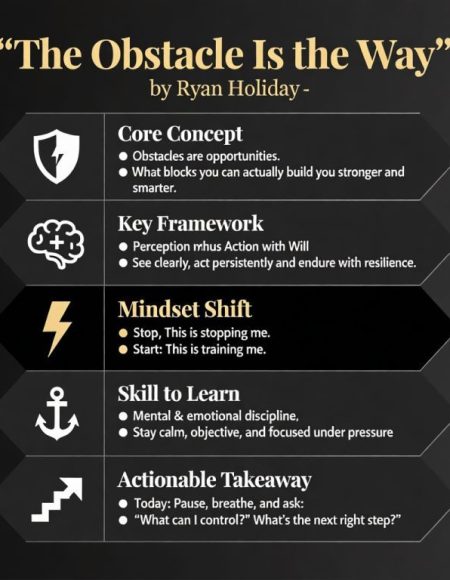
The Obstacle Is the Way teaches that the challenges you want to avoid are often the very things that will make you stronger, wiser, and more capable, if you learn how to face them correctly.
Who should read The Obstacle is the Way and why?
This book is best for people who keep running into resistance, setbacks, or pressure and want a calm, practical way to deal with it, not hype, not shortcuts, not empty motivation.
Below are the types of readers who will benefit most, and exactly what they’ll gain.
1. People Going Through a Difficult Season
(Career problems, financial stress, personal setbacks, uncertainty)
Why this book helps:
- It teaches how to stay calm instead of panicking
- It shows how to move forward even when things feel blocked
- It replaces why me? thinking with what now? thinking
What they’ll learn:
- How to stop making problems worse emotionally
- How to find a path forward when options seem limited
- How to endure without losing self-respect or hope
2. Entrepreneur, Founders & Side-Hustlers
Why this book helps:
- Business is full of rejection, delays, and failure
- The book teaches resilience, persistence, and problem-solving
- It helps founders stop quitting too early
What they’ll learn:
- How to turn setbacks into strategy
- How to act with limited resources
- How to keep going when results are slow
3. Professionals & Career Builders
(Employees, managers, leaders, freelancers)
Why this book helps:
- Workplaces are full of pressure, politics, and unfair situations
- The book teaches emotional discipline and professionalism
What they’ll learn:
- How to respond calmly to criticism
- How to grow under difficult bosses or environments
- How to build a strong reputation through consistency
4. Leaders, Managers & Decision-Makers
Why this book helps:
- Leadership means making hard decisions under pressure
- This book trains mental toughness and clarity
What they’ll learn:
- How to stay steady in chaos
- How to make decisions without emotional bias
Athletes, Creatives & High-Performers
Why this book helps:
- Performance always comes with failure, setbacks, and self-doubt
- The book teaches discipline and long-term thinking
What they’ll learn:
- How to use failure as training
- How to persist through boredom and repetition
- How to separate effort from outcome
5. People Interested in Philosophy
Why this book helps:
- It introduces Stoicism without complex language
- It shows philosophy as a tool for living, not theory
What they’ll learn:
- How ancient ideas apply to modern problems
- How to build emotional control and mental strength
- How to live intentionally instead of reactively
Who This Book May NOT Be For
This book might not be ideal if someone:
- Wants quick hacks or overnight success
- Expects life to be fair all the time
- Avoids responsibility for their actions
- Wants motivation without discipline
- This book is about inner work, not external shortcuts.
Why This Book Matters
The Obstacle Is the Way matters because it teaches a timeless truth:
- Life doesn’t get easier you get stronger, smarter, and more capable.
For anyone who wants to stop being overwhelmed by difficulty and start using it as fuel, this book is a powerful guide.
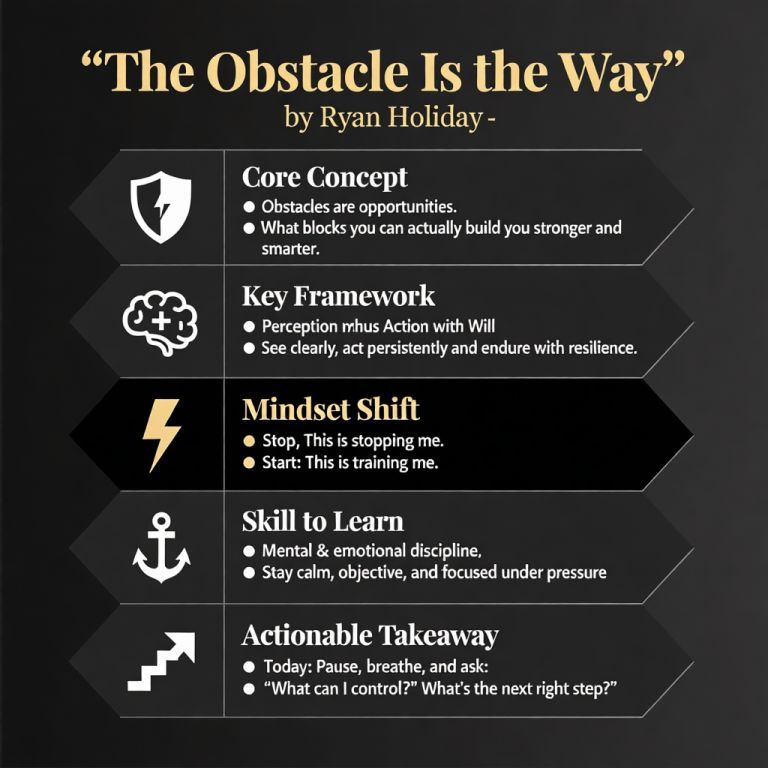
This book is divided into parts parts 1-3 (perception, mind and will)
PART 1: PERCEPTION
Treat Part 1 as a software update for your brain. In this Part, Napoleon focused on Perception. This is the filter through which you see the world. If the filter is dirty, the world looks like a mess. If the filter is clear, you see a path where everyone else sees a wall.
The Discipline of Perception
Think about John D. Rockefeller. In 1857, the economy didn’t just dip; it collapsed. People were jumping out of windows. Rockefeller was eighteen. Instead of panicking, he looked at the chaos and decided it was a school. He realized that while everyone else was emotional, he could be rational and use the event to learn how the market works.
When you get a piece of bad news, like your car breaking down or a client leaving, your brain wants to scream. That is your first impression. The discipline here is to refuse to accept that first impression. You have to tell yourself that the event is just an event. It is neutral. You are the one who decides if it is a tragedy or a lesson.
Recognize Your Power
This is where the story of Rubin Hurricane Carter comes in. He was a top boxer thrown into prison for a crime he didn’t commit. He couldn’t control the bars, but he realized he owned his mind. He told the guards he wouldn’t eat their food or wear their uniform because he wasn’t a prisoner; he was a man in a cell. He used that opportunity to study law and got freedom for himself.
You might feel trapped in a job or a bad relationship. You might think you have no power. But you always have the power to choose your response. If you stop seeing yourself as a victim of your circumstances, you suddenly find the energy to start changing them. Perception is the one thing they can never take from you unless you give it away.
Steady Your Nerves
Ulysses S. Grant was the king of this. During the Civil War, shells would explode right next to him, and he wouldn’t even flinch. He just kept writing his orders. He knew that getting worked up didn’t solve the problem. It just made him less effective.
In your daily life, this is about refusing to be intimidated. When a deadline is looming and your boss is breathing down your neck, your nerves want to fry. Steadying them means looking the problem in the eye and saying, I see you, but you don’t scare me. It is incredibly practical because it keeps your brain online when you need it most.
Control Your Emotions
NASA has a rule for astronauts: don’t panic. Panic leads to mistakes, and in space, mistakes lead to death. They train for every possible disaster so that when one happens, it’s just another procedure.
Most of us live in a state of constant emotional reaction. We are offended, we are scared, we are annoyed. This is a massive waste of energy. To apply this, you need to develop an inner citadel. When something goes wrong, ask yourself: Does getting angry fix the engine? Does crying help the budget? If the answer is no, then set the emotion aside and get to work.
Practice Objectivity
There is a concept in Japanese swordsmanship about the observing eye and the perceiving eye. The perceiving eye sees a giant sword coming to kill you. The observing eye just sees a piece of metal moving at a certain speed.
Objectivity is about removing the I from the story. When your friend has a problem, you give great advice because you aren’t emotional about it. When it’s your problem, you’re a mess. To use this, describe your situation as if it’s happening to a stranger. Instead of saying, I am failing, say, This person needs to adjust their strategy. It strips away the drama and reveals the solution.
A Moment to Challenge Your Assumption
Let’s pause. Most people think that being objective means being cold or heartless. They think they need to stop feeling entirely.
That is a huge mistake.
You aren’t a robot. You will feel things. The goal isn’t to kill your emotions; it’s to stop letting them drive the car. People often wait until they feel better before they act. If you wait to feel confident, you might wait forever.
The real skill is feeling the fear or the anger and acting objectively anyway. Don’t wait for the feeling to change; change your perception of the feeling.
Alter Your Perspective
The general Pericles once used his cloak to hide the sun during an eclipse to show his men that darkness is just a shadow, not an omen. He changed their perspective.
You can do this with anything. If you lose your job, you can see it as a disaster, or you can see it as a forced pivot to the career you actually wanted. If you are stuck at home, you aren’t trapped; you are in a monastery of focus.
You aren’t lying to yourself; you are choosing the most functional way to look at reality.
Is It Up To You?
This is the most important lesson in the whole book. You have to draw a circle around what you control and ignore everything outside it.
You don’t control the economy. You don’t control what people say behind your back. You don’t control the weather. You control your effort and your choices. If you spend your day worrying about things outside that circle, you are literally throwing your life away. Focus 100% of your power on the small slice of reality that you actually own.
Live in the Present Moment
Think about the founders of FedEx or Disney. They started during economic depressions. If they had looked at the global catastrophe, they never would have started. They focused on the next delivery and the next drawing.
When you are overwhelmed, it’s usually because you are living in the future. You are imagining a million things that might go wrong. Narrow your focus. Can you handle the next ten minutes? Yes. Can you handle the next hour? Yes. The present moment is always manageable.
It’s the future that kills us.
Think Differently
Steve Jobs didn’t accept that things couldn’t be done. He believed the world was malleable. He had what people called a reality distortion field.
Thinking differently means being unconventional. If the front door is locked, you don’t keep banging on it. You look for the side window. You look for the roof. Most people get stopped by an obstacle because they think there is only one way to solve it. If you are willing to be a little weird, you’ll find that most walls have doors if you look hard enough.
Finding the Opportunity
During WWII, Eisenhower saw the German attack as an opportunity to trap them. He didn’t see a threat; he saw a meat grinder for his enemy.
Every problem you have contains a hidden gift. If you have a difficult boss, they are giving you a free course on how to handle difficult people. If you are broke, you are learning how to be lean and creative. This is the hardest part to apply, but it’s the most powerful.
You aren’t just surviving the obstacle; you are using it to get better.
How to Implement This
Here is how you actually put this to work today:
The Three-Second Pause: When something goes wrong, don’t say anything for three seconds. Breathe. This keeps the emotional part of your brain from taking over.
The Fact List: Write down your problem. Now, cross out every word that is an opinion or a feeling. If you wrote, My mean boss sent a nasty email, cross out mean and nasty. You are left with: My boss sent an email. That is neutral data.
The Consultant Trick: If your best friend came to you with this exact problem, what would you tell them to do? Follow that advice yourself.
My Opinion
I think the chapter on Is It Up To You? is the real secret here. We live in a world that wants us to be outraged about everything. But most of what we see on the news or social media is completely outside our control.
The most practical thing you can do for your mental health and your success is to ruthlessly audit your attention. If you can’t influence it or stop it, delete it from your mind. It sounds harsh, but it’s the only way to keep your perception sharp enough to handle the things that actually matter.
Part 1 isn’t about being happy; it’s about being effective. Once you see the world as it is, you stop being a passenger and start being the driver.
PART 2: ACTION
If Part 1 was about the software of your mind, Part 2 is about the hardware in motion. We are moving from the head to the hands. This is the discipline of Action.
Action is the solution to the problems we identified through our perception. You can have the clearest vision in the world, but if you don’t get off the couch, the obstacle stays right where it is. Action requires a specific kind of energy, persistence, and a total lack of ego.
The Discipline of Action
Holiday starts by pointing out a hard truth: it does not matter what happened to you or why it happened. All that matters is what you are going to do about it. We often waste weeks asking Why me? when we should be asking What now?
The great orator Demosthenes is the hero here. He wasn’t born a genius; he was a sickly boy with a stutter who was robbed of his inheritance. He didn’t just think his way out of it. He acted. He practised speaking with pebbles in his mouth. He ran up hills while reciting poetry to strengthen his lungs until he became the greatest speaker of his time . He manufactured oratory through action.
Get Moving
The biggest obstacle to action is the fear of starting. We wait for more data, more money, or more confidence. But General Erwin Rommel didn’t wait. He succeeded in the desert because he understood that movement creates its own opportunities. If you stay still, you are a target. If you move, you are a threat.
In your life, this might look like that business idea you’ve been sitting on for a year. You don’t need a 50-page business plan. You need to make one sales call. Courage is not the absence of fear; it is the physical act of starting anyway. Momentum is a powerful force, but you have to be the one to kickstart the engine.
Practice Persistence
Persistence is the art of not being rattled by the first ten times you fail. Ulysses S. Grant spent a year trying to take Vicksburg. He tried digging canals, he tried frontal assaults, and he tried moving his navy through swamps. Everything failed.
But Grant didn’t go home. He didn’t even get frustrated. He just treated each failure as data on what didn’t work. Eventually, he found a bold, indirect path that worked.
If you are trying to lose weight or get a promotion and you hit a wall, don’t scream at the wall. Just look for a different way around it. Persistence is just energy applied over and over until the obstacle breaks.
Iterate
Failure is the best teacher you will ever have, but only if you are willing to learn. Holiday uses the example of a ship captain who finds the rocks in a harbor by hitting them with the hull. It’s painful, but now he knows exactly where the rocks are.
If you launch a product and nobody buys it, that isn’t a disaster. It is a tuition payment. You just learnt what the market doesn’t want. Most people quit here because their ego is bruised. To apply this, you have to be okay with looking stupid in the short term so you can be right in the long term. Stop trying to be perfect and start trying to be less wrong every day.
Follow the Process
When an obstacle is huge, like a massive debt or a complex degree, it feels impossible. That is because you are looking at the whole thing. Coach Nick Saban tells his players to ignore the scoreboard. He tells them to focus only on the next block, the next play, the next five yards.
This is the Process. It is the daily, boring work that leads to the win. If you have to write a book, don’t think about 300 pages. Think about the next paragraph. The process removes the emotional weight of the goal and leaves you with a task you can actually finish.
Do Your Job, Do It Right
We often think we are too good for the work we are doing. We want the title without the toil. But Andrew Carnegie started as a bobbin boy. He didn’t complain that it was beneath him; he became the best bobbin boy the mill had ever seen.
Every task is an opportunity to practice your excellence. If you are making coffee, make the best coffee possible. If you are filing papers, do it with precision. When you excel at the small things, you build the muscle for the big things. Excellence is a habit, not an act.
A Pause to Challenge Your Assumption
Let’s stop here for a second. Most people think that Action means being a steamroller. They think they need to work 20 hours a day and bash their head against the wall until it breaks.
That is a mistake.
Exhaustion is not the same as effectiveness. If you are working yourself to death but not making progress, you are just being busy, not active. Real action is deliberate and strategic. Sometimes the most powerful action you can take is to stop, step back, and find a better way. Don’t confuse movement with progress.
What’s Right Is What Works
Pragmatism is your best friend. Samuel Zemurray was told he couldn’t build a bridge to move his bananas because it was illegal. So he built two long piers and put a temporary pontoon between them. He told the authorities it wasn’t a bridge; it was just some wharfs.
He didn’t care about the rules of the game; he cared about getting the fruit to the ship. In your life, stop asking what the “right” way is and start asking what the effective way is. If the standard path is blocked, find a side door. Results are the only thing that matters.
In Praise of the Flank Attack
Sometimes, attacking an obstacle head-on is suicide. If you are a small startup, you don’t try to outspend Google on ads. That is a frontal assault. You use a flank attack. You find the niche they are ignoring and you own it.
George Washington didn’t beat the British by winning every battle; he beat them by not losing his army and attacking them when they were tired and drunk on Christmas. He used creativity over force. If you are stuck, stop pushing. Look for the opening they didn’t see coming.
Use Obstacles Against Themselves
This is the martial art of life. Gandhi used the power of the British Empire to destroy it. He used their own laws and their own media against them. He didn’t fight them; he let them overextend themselves until they collapsed.
If someone is attacking you or a situation is pushing against you, sometimes the best move is to step aside and let it pass. Use the momentum of the problem to solve the problem. If a project is falling apart, maybe use the chaos to reorganize the whole department. Let the fire burn away the dead wood.
Channel Your Energy
Arthur Ashe was a black man in the white-dominated world of tennis. He had every reason to be angry, but he knew that anger would make him lose his focus. Instead, he channeled that energy into a clinical, cold discipline that terrified his opponents.
Adversity is like a physical weight. You can let it crush you, or you can use it to build muscle. When you feel a surge of frustration or unfairness, don’t vent it. Channel it into your work. Turn that “I’ll show them” energy into a finished project.
Seize the Offensive
When a crisis hits, most people hide. But the best leaders use the chaos to make moves they couldn’t make in normal times. Barack Obama used a campaign scandal to give a historic speech on race that actually helped him win. He took a negative and used the spotlight to create a positive.
A crisis is a terrible thing to waste. When things go wrong, the rules change. People are looking for direction. That is your moment to step up and take the lead. Don’t just fix the leak; use the opportunity to replace the whole pipe.
Prepare for None of It to Work
This is the Reverse Clause. You must do your absolute best while knowing that you still might fail. It sounds like a contradiction, but it’s the key to mental health.
If you understand that the outcome is not entirely in your control, you don’t get crushed when things go south. You just adjust and go again. This is the ultimate form of action: acting with total commitment but zero attachment to the result.
How to Implement This
Here is your Action checklist:
The Next Play: Forget about the end of the year. What is the one thing you need to do in the next hour to move forward? Do that with 100% focus.
The Pivot Test: If you’ve been stuck on a problem for more than three days, your current approach is wrong. Try a flank attack. Look for an indirect solution.
Ship It: Stop waiting for it to be perfect. Launch the version 1 of your project today. Use the “hits” from the market to iterate and improve.
My Opinion
I think Part 2 is where most people fail. It’s easy to have a Stoic perspective while you’re sitting in a chair, but it’s hard to keep it when you’re actually out there failing.
The idea of The Process is the single most important thing in this section. We live in a world of instant gratification, and “The Process” is the antidote. If you can learn to love the boring, daily work of your craft, you become essentially unstoppable. Most of your competition will quit because they don’t see results in the first week. If you can stay in “The Process,” you will eventually be the only one left standing. Action isn’t about being a hero for a day; it’s about being disciplined for a decade.
PART 3: WILL
Since Perception and Action were the disciplines of the mind and the body, Part 3 is the discipline of the heart and the soul. We are entering the realm of the Will.
The Will is your internal power. It is the one thing that never has to be affected by the outside world. While Action is what you do when you have leverage, Will is what you rely on when your leverage is gone. It is about endurance, humility, and resilience.
The Discipline of the Will
The Will is not just about being stubborn. It is about preparedness. Holiday defines it as the internal strength that allows us to stand tall even when our actions fail and our perceptions are being tested to the limit. It is the strength that says, I can bear this.
Think of Abraham Lincoln. He didn’t just deal with a war; he dealt with crippling depression, the death of his children, and a country tearing itself apart. He couldn’t just “act” his way out of the sadness. He had to rely on his Will to endure the weight of the world without snapping. You build Will in the quiet moments so that it’s there for you during the great depressions of your life.
Build Your Inner Citadel
You are not born with a strong Will; you build it. The Stoics called this the Inner Citadel. It is a fortress inside you that no enemy can scale. You build it through self-discipline and by putting yourself through small, controlled struggles.
In your life, this might mean taking a cold shower, fasting for a day, or waking up early to run when it’s raining. These aren’t just for fitness; they are reps for your soul. By choosing to be uncomfortable now, you ensure that when life forces discomfort on you later, you won’t collapse. You have already been there.
Anticipation (Thinking Negatively)
Most people tell you to stay positive. Holiday tells you to practice the Pre-Mortem. This is the art of thinking about everything that could go wrong before you start.
If you are launching a project, don’t just visualize the success. Imagine the lead developer quitting, the budget being cut, and the client hating the result.
This isn’t being a pessimist; it is being invincible. If you have already played out the disaster in your mind, you won’t be shocked when it happens. You’ll be the only person in the room with a plan while everyone else is in a state of shock.
The Art of Acquiescence
This is one of the hardest ideas to swallow. It means accepting the things you cannot change. We waste so much energy fighting things that are already facts. If it’s raining, it’s raining. If you lose a limb, you’ve lost a limb.
Thomas Jefferson had to deal with constant, agonizing migraines. He didn’t whine about the unfairness; he accepted them as a part of his life and worked around them. Acceptance isn’t giving up; it is agreeing with reality so you can stop wasting energy on resentment and start using it on what’s next.
Love Everything That Happens: Amor Fati
This goes a step beyond acceptance. Amor Fati means a love of fate. You don’t just tolerate the bad stuff; you embrace it.
Think of Thomas Edison. When he was 67, his entire laboratory burned to the ground. Decades of work and millions of dollars went up in flames. He didn’t cry. He told his son to go get his mother because she’d never see a fire this big again. The next day, he started rebuilding. He loved the challenge more than he loved the lab. When you love everything that happens, nothing can truly be an obstacle because everything is fuel.
Perseverance
There is a massive difference between persistence and perseverance. Persistence is trying to crack a safe until it opens. Perseverance is the long game. It is the ability to keep going even when there is no safe to crack.
Perseverance is about staying power. It’s the story of the explorer Ernest Shackleton, whose ship was crushed by ice in the Antarctic. He didn’t just try one “action” to get home. He spent two years leading his men across ice and ocean, failing and pivotting, until every single one of them was safe. Perseverance is the Will to endure for as long as it takes.
A Pause to Challenge Your Assumption
Let’s stop here because people always get this wrong. They think a strong Will means being a “tough guy” who doesn’t feel pain.
That is a lie.
A strong Will doesn’t mean you don’t feel the sting of a breakup or the fear of bankruptcy. It means you don’t let the pain change your character or quit. A mistake people make is trying to suppress their feelings until they explode. Real Will is acknowledging the pain and saying, This hurts, but it is not enough to stop me from being who I am. It’s about elasticity, not rigidity.
Something Bigger Than Yourself
When you are suffering, the quickest way to find strength is to help someone else. This is what the Stoics called the cosmopolitan outlook. If you are struggling with a health issue, help someone else who is sick. If you are broke, give your time to someone in need.
By focusing on others, you shrink your own problems. It is much harder to feel sorry for yourself when you are busy being useful. This is a practical shift in perception that fuels your Will. You aren’t just fighting for you anymore; you are fighting for your family, your team, or your community.
Meditate on Your Mortality
This is the famous Memento Mori. Remember that you will die. Most people find this depressing, but it is actually the ultimate clarifier.
If you knew you were going to die in a year, would you really be upset about that rude email or that traffic jam? Probably not. Death makes the “obstacles” of life look small and ridiculous. It reminds you that time is the only thing you truly own, and wasting it on being upset is the only real failure.
Prepare to Start Again
The book ends with a cycle. Once you overcome one obstacle, another will be waiting. That is the nature of life. You don’t “beat” life; you just get better at the game.
The goal is to become someone who welcomes the next hurdle because you know it will make you even stronger. You have the perception to see it, the action to move it, and the will to endure it.
How to Implement This
Here is your Willpower audit:
The Pre-Mortem: Tonight, look at your biggest goal for tomorrow. Write down three things that could go totally wrong. Now, write down exactly how you will respond to each one.
The “It’s Fine” Practice: The next time something minor goes wrong (you spill coffee, your internet goes out), say out loud, It’s fine. Don’t complain. Practice accepting reality instantly.
The Service Shift: If you feel overwhelmed today, stop what you are doing and do one small, kind thing for someone else. Watch how your own stress levels drop.
My Opinion
Part 3 is the most spiritual part of the book, and honestly, it’s the part that sticks with you when life gets really dark. Amor Fati is a concept that sounds insane until you actually try it. The moment you stop wishing things were different and start loving the challenge of the “now,” you become untouchable.
I think the biggest mistake we make in modern culture is seeking a life without obstacles. We want it to be easy. But Holiday shows us that the easy life is the weak life. The Will is like a muscle that only grows when it has something heavy to lift. Don’t pray for fewer problems; pray for a stronger Will. Once you have that, you realize that the obstacle isn’t in your way, the obstacle is the way.
Conclusion -The Final Step: The Obstacle Becomes the Way
The book ends by reinforcing the core mantra: The impediment to action advances action. What stands in the way becomes the way. Ryan Holiday explains that you are now part of an elite lineage of thinkers and doers, from Marcus Aurelius to Steve Jobs, who didn’t just tolerate problems but used them as fuel.
You have learnt that an obstacle is not a sign to stop; it is a call to find a new path. If you have a wall in front of you, you don’t just stare at it. You use it to learn how to climb.
The Cycle of Life
One mistake people make is thinking that once they “beat” an obstacle, they are done. They expect a smooth road.
That is a dangerous assumption.
In reality, life is just one obstacle after another. As soon as you solve one, the next one appears. But here is the secret: you are getting better at the game. Each time you use your Perception to stay cool, your Action to pivot, and your Will to endure, you are becoming a more capable version of yourself. You aren’t looking for an easy life; you are looking for a challenging life that you are equipped to handle.
The Final Realization
The ultimate goal of the book is to make you impossible to discourage. When you realize that every “bad” thing is actually a “good” opportunity in disguise, you stop being afraid of the future.
You start to look at challenges with a bit of a smirk, thinking, I wonder how I’m going to use this one?
You no longer see yourself as a victim of fate. You are the architect of your own response. Whether it is a global pandemic, a personal tragedy, or a simple mistake at work, you have the tools to turn that lead into gold.
How to Implement This Final Mindset
To keep these ideas alive long after you finish the book, use these final tips:
Teach It to Others: The best way to master the Discipline of Perception is to explain it to a friend who is struggling. When you help them see their “catastrophe” as neutral data, you reinforce the habit in yourself.
Review the Examples: When you feel yourself slipping into a “why me” mindset, go back to the stories of Grant, Rockefeller, or Carter. Use their lives as a North Star to remind you of what a human being is capable of enduring.
Practice Amorphous Growth: Like water, learn to be fluid. If you can’t go through, go around. If you can’t go around, go under. If you can’t move it, use it as a foundation. Never stop moving.
My Opinion
I think the most profound part of the conclusion is the reminder that this is a practice. You don’t read Stoicism; you do Stoicism. It’s like going to the gym. You don’t get strong by reading a book about weights; you get strong by lifting them.
The world is always going to be messy, unfair, and unpredictable. That isn’t going to change. What changes is your relationship with the mess. If you take away only one thing from this entire book, let it be this: you are never truly stuck as long as you have your mind, your energy, and your will. The way through the problem is inside the problem. Now, go find it.
Here is how to implement the principles in The Obstacle is the Way
Don’t try to master all of these at once; pick the first one, get it right, and then move to the next.
Here is your practical implementation manual.
1. The Fact-Filtering Protocol
This is the foundational skill for Perception. Most of our stress comes from the stories we tell ourselves about a problem, not the problem itself.
What to Do: Strip away every emotion and adjective from a situation until only the raw, neutral data remains.
The Step-by-Step Action:
- Identify the Trigger: When you feel a spike of anxiety or anger, stop.
- Open Your Notes App: Create a note titled Neutral Facts.
- The Adjective Audit: Write one sentence about what happened. Now, delete every judgment word (e.g., unfair, disaster, rude, idiot).
- Rewrite: Re-state the situation as if you were a security camera describing a scene.
Start Today Action (10 Mins): Think of one thing that annoyed you today. Open your phone notes right now and write it down. Then, rewrite it using only nouns and verbs. (e.g., My boss is a jerk for the late email becomes I received an email at 6:00 PM.)
Timeframe & Progress:
- Early Results (Days): You will notice your heart rate stays lower when bad news hits.
- Progress Looks Like: You catch yourself before you say, This is a disaster.
Challenges & Mistakes:
- Challenge: Feeling like you are lying by not acknowledging how much it hurts.
- The Fix: Remind yourself that describing the pain doesn’t solve it. The facts do.
- Avoid: Spending an hour venting in a journal. Venting often reinforces the drama rather than stripping it away.
Tracking Metric: Frequency: How many times per week did you successfully rewrite a tragedy into a fact?
Commitment Question: Can you agree to describe your next problem in five words or less?
2. The Circle of Control Audit
This prevents the energy leak of worrying about things you can’t change.
What to Do: Ruthlessly separate your problems into two piles: things you can influence and things you can’t.
The Step-by-Step Action:
- The Brain Dump: Every Sunday night at 8:00 PM, write down every single thing currently worrying you.
- The Filter: Draw a circle. Put the things you can directly change (your effort, your speech, your schedule) inside. Everything else (the economy, other people’s opinions, the weather) goes outside.
- The Delete Key: Physically cross out everything outside the circle.
- Schedule: Pick one item inside the circle and put a 30-minute block on your calendar tomorrow to work on it.
Start Today Action (15 Mins): Take a piece of paper. Draw two columns: My Business and Not My Business. List five current worries. Move them into the correct columns. Throw the Not My Business list in the trash.
Timeframe & Progress:
- Early Results (1 Week): You will feel a significant weight lifted off your shoulders.
- Progress Looks Like: When a news story or a rumor upsets you, you instinctively ask, Is this in my circle? and stop caring if the answer is no.
Challenges & Mistakes:
- Challenge: Thinking that if you care enough about something outside your circle, it will change.
- The Fix: Realize that every minute spent on an external is a minute stolen from an internal you could have fixed.
- Avoid: Researching problems you can’t fix (like global politics) under the guise of being informed.
Tracking Metric: Observable Outcome: How many outside the circle topics did you decline to argue about this week?
Commitment Question: Are you willing to be uninformed about things you can’t change so you can be effective at the things you can?
3. The Three-Second Gap (Nerve Control)
This is the Ulysses S. Grant method. It’s about building a physical buffer between a stimulus and your reaction.
What to Do: Train your nervous system to pause before reacting to any external pressure.
The Step-by-Step Action:
- Set a Panic Trigger: Identify a sound that usually stresses you out (a Slack notification, a specific ringtone).
- The Rule of Three: When that sound occurs, you are forbidden from touching your device for three slow breaths.
- The Physical Check: During those three seconds, unclench your jaw and drop your shoulders.
- Respond: Only after the three seconds do you engage with the task.
Start Today Action (10 Mins): Change your phone’s notification sound to something new. Every time it goes off for the next hour, practice taking one deep breath before looking at the screen.
Timeframe & Progress:
- Early Results (2 Weeks): You will feel less jittery throughout the work day.
- Progress Looks Like: People start noticing that you seem calm when things get hectic.
Challenges & Mistakes:
- Challenge: The biological urge to react feels like an emergency.
- The Fix: Remind yourself that 99% of emergencies can wait three seconds.
- Avoid: Apologizing for taking a moment to think. Silence is a sign of strength, not confusion.
Tracking Metric: Consistency: Out of 10 notifications, how many times did you maintain the pause?
Commitment Question: Will you commit to three seconds of silence before responding to the next person who annoys you?
4. The Next Smallest Step Method (The Process)
This moves us into Action. It stops you from being paralyzed by the size of an obstacle.
What to Do: Shrink your world down to the immediate 10 minutes in front of you.
The Step-by-Step Action:
- Identify the Mountain: Pick a project you’ve been procrastinating on because it feels huge.
- Define the Molehill: Ask, What is the smallest, most boring unit of work for this? (e.g., Not write the report, but open a Word doc and type the title.)
- Set a Timer: Set a timer for 10 minutes.
- Work the Process: Do only that tiny task. Ignore the score or the final result.
Start Today Action (20 Mins): Go to that one area of your house or office that is the messiest. Don’t clean the room. Spend 15 minutes only organizing one single drawer or shelf. Stop when the timer goes off.
Timeframe & Progress:
- Early Results (Days): You will break the cycle of procrastination.
- Progress Looks Like: You stop asking, How am I going to finish this? and start asking, What is the next step?
Challenges & Mistakes:
- Challenge: Feeling like the small step is too small to matter.
- The Fix: Understand that the goal