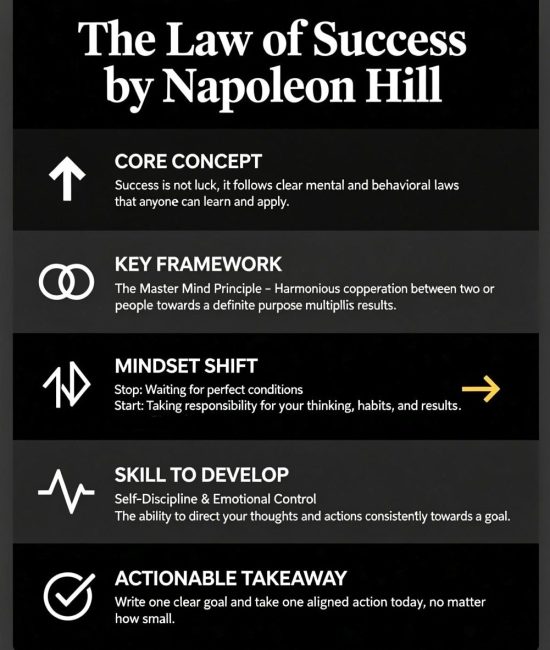

The Law of Success is a comprehensive blueprint for achievement that teaches you how to organize your thoughts and actions through sixteen specific laws to gain the power and cooperation necessary to transform a definite mental purpose into its physical equivalent.
Who Should Read The Law of Success and Why?
Here are the types of people who will find it most useful:
- The Talented Drifter: You are someone with a lot of skills and high intelligence, but you feel like you are spinning your wheels. You start three different projects in a year and finish none of them because something newer and more exciting comes along. This book will benefit you by forcing you to pick a Definite Chief Aim. It provides the structure you need to stop wasting your energy and finally start seeing your efforts compound into real results.
- The High Performer Who Has Hit a Ceiling: You work harder than everyone else, you are the first one in the office, and you do a great job, yet you keep getting passed over for the biggest opportunities. You likely have the technical skills but lack the Master Mind or the Pleasing Personality required to lead others. This book will show you that success is 85 percent psychology and 15 percent technical skill. You will gain the ability to get people to cooperate with you rather than just working for you.
- The Aspiring Entrepreneur with No Capital: You have a great idea but you are paralyzed because you think you need a huge bank loan or a rich relative to start. Hill’s lessons on The Habit of Saving and Imagination are designed specifically for people in this spot. You will learn how to build your own capital through discipline and how to use synthetic imagination to create a business model that uses the resources you already have instead of waiting for resources you don’t.
Who This Book Is Not For Right Now
This book is not ideal for anyone looking for a quick fix or a get rich quick scheme. If you are in a state of active crisis where you need to find rent money by Friday, the Law of Success will likely frustrate you. It focuses on long term character development and building habits over months and years. It requires a level of patience and deep study that isn’t possible if you are in survival mode. If you aren’t ready to sit down, take notes, and change your actual behavior, this will just feel like a heavy history book rather than a life changing tool.
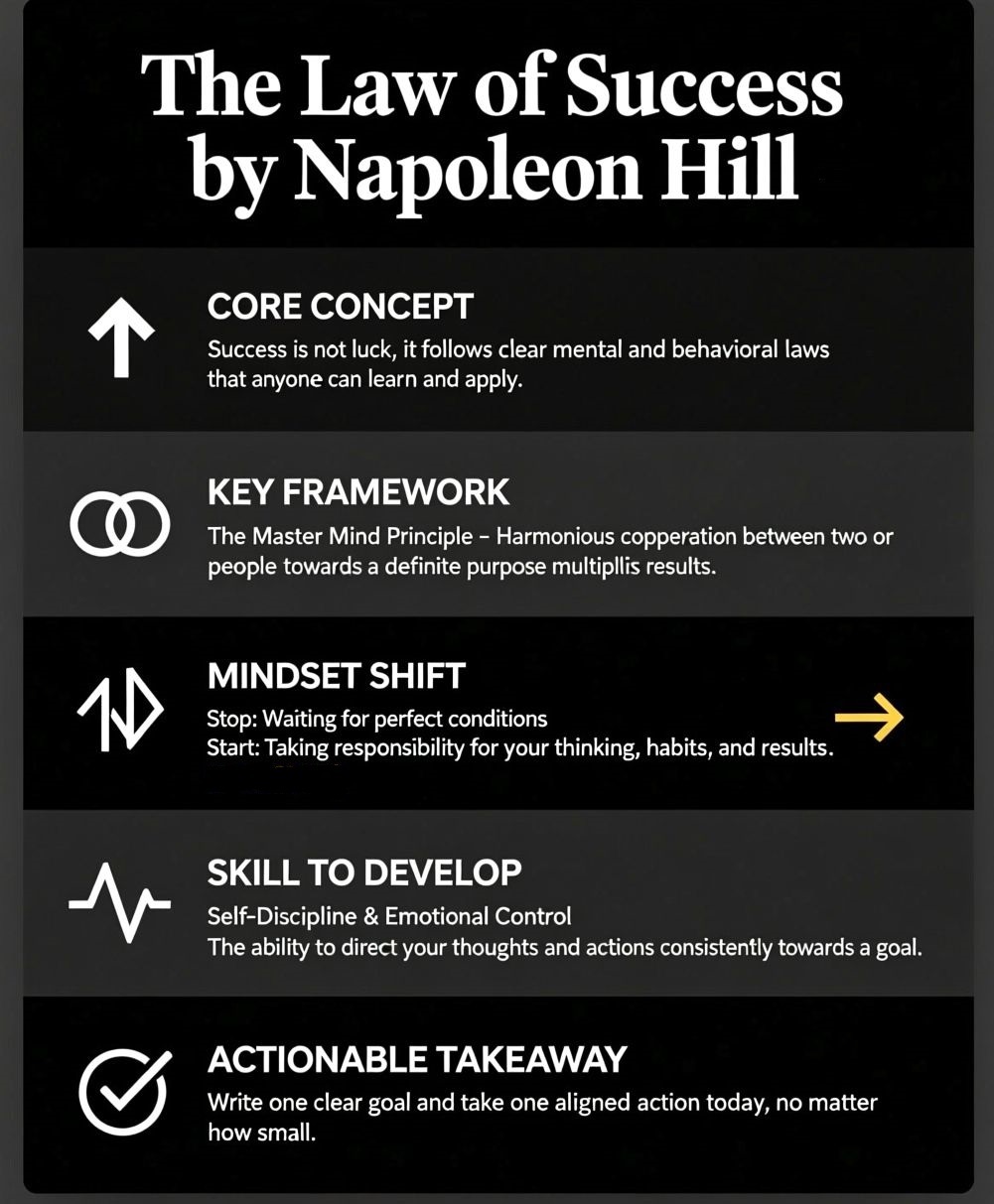
Introduction
Hill spent twenty years studying people like Henry Ford and Andrew Carnegie. He wanted to know why some people build empires while others just scrape by. He found that success isn’t about luck. It is about Power, and he defines power as Organized Knowledge.
Most people are walking around with a head full of facts, but they haven’t organized them into a weapon. That is what we are going to fix.
The Secret of the Master Mind
The biggest concept Hill introduces is the Master Mind. You need to understand this deeply. He says that no one can achieve great success alone. It is mathematically impossible. A Master Mind is created when two or more people coordinate their knowledge and effort in a spirit of perfect harmony for a specific purpose.
Think of it like a chemical reaction. When you mix certain elements, you get a new substance that is totally different from the originals.
When you align your mind with someone else’s toward one goal, you create a third mind. This third mind is more powerful than the two individuals combined. It is like plugging your brain into a larger power grid.
A Practical Warning: The key word here is harmony. If there is ego, jealousy, or friction, the Master Mind dies immediately. This is why most business partnerships fail. You can’t just hire people. You have to find people who share your vision so closely that your minds literally “blend.” It is hard to find, but it is the only way to reach the top tier of success.
The Chemistry of Thought and Vibration
Hill gets into some ideas that sounded like science fiction in 1928. He talks about vibrations and the ether. He argues that every thought you have sends out a vibration. Your brain is a broadcasting station.
If you think thoughts of poverty and failure, you are literally tuning your “radio” to the failure frequency. You will attract people and circumstances that match that frequency.
Think about a time you met someone and immediately liked them, even though they hadn’t said much.
Or think about someone who makes you feel uneasy for no reason. Hill says you are sensing their mental vibrations. If you want to use this, you have to guard your thoughts like a hawk. If you let yourself dwell on “what if I fail,” you are broadcasting a signal that invites failure to happen. It is as practical as choosing the right frequency on a walkie-talkie.
A Moment to Challenge Your Thinking
Before we go further, I want to challenge a mistake you are probably making right now. You likely think you need more education to succeed.
You think you need another degree or a certification.
Hill tells us that the word education comes from the Latin word educo, which means to draw out from within. Real education isn’t about cramming facts into your head. It is about developing the mental faculties you already have. You don’t need more stuff in your brain. You need to learn how to use what is already there.
Stop being a student who just collects information and start being an architect who uses it.
The Physics of Success: Electrons and Energy
Hill dives into the science of atoms and electrons to prove a point. He says that everything in the universe is made of the same energy. The only difference between a block of wood and a human brain is the rate of vibration. This is his way of saying that there are no solid walls between you and what you want.
If you can organize your thought energy through a Definite Chief Aim, you can influence the material world. It sounds heavy, but look at Henry Ford. He didn’t have money or a fancy education.
He had an organized thought. He focused that energy so intensely that the material world, the steel, the rubber, the glass, had no choice but to organize itself around his vision. You must treat your goals as physical realities that just haven’t solidified yet.
The Two Paths: Efficiency vs. Drifting
Hill gives a great example of how to apply this to your current job. Most people hate their work and do as little as possible. They are drifters. They think they are winning by getting paid for doing nothing.
Hill says that is a death sentence. To get out of a bad job, you have to become extraordinarily efficient. By doing more than you are paid for, you create a credit in the universe.
You attract the attention of people who have the power to help you. If you are a drifter, you stay stuck. If you are an organizer of effort, you become too big for your current position, and the world is forced to move you up.
Personal Analysis and the Ten Famous Men
Toward the end of the introduction, Hill analyzes ten famous men, including Abraham Lincoln and Jesse James.
He uses a Personal Analysis Chart. He shows that even “villains” like Jesse James had the qualities of success, but they directed them toward destructive ends.
This is a huge takeaway for you. Success laws are neutral. They work for the saint and the sinner. They are like electricity. You can use it to light a home or to execute a criminal. Your job is to use these laws with Tolerance and the Golden Rule.
If you don’t, your success will eventually collapse under its own weight because you will lose the harmony of the people around you.
The Acres of Diamonds
Hill tells the story of a man who sold his farm to go look for gold, only to have the new owner find a massive diamond mine right on that same land. The lesson?
There is a gold mine in your present occupation.
You probably think you need to move to a new city or start a new career to find success. You don’t. You need to apply Accurate Thinking to where you are right now. Look at your current tools and your current network. How can you organize them differently?
Most people fail because they are looking at the horizon instead of looking at their own feet.
The Final Visit: Sailing On
The introduction ends with a focus on Decision and Persistence. Hill quotes a poem about Christopher Columbus. Every day his crew wanted to turn back, and every day he said, Sail on!
He points out that successful people reach decisions quickly and change them slowly, if at all. Failures reach decisions slowly and change them every five minutes. You are playing a game of checkers with Time.
If you hesitate, Time will wipe you off the board. Make a move. Even if it is the wrong move, the experience will give you the knowledge to make the next move better. The only unforgivable sin in this philosophy is standing still.
This introduction is your permission slip to stop waiting. Organize what you know.
Find your Master Mind. And for heaven’s sake, decide what you want. If you do those three things, the sixteen lessons that follow will be like putting fuel on a fire that is already burning.
Lesson 1: Definite Chief Aim
95 percent of people fail simply because they never actually apply what’s in this chapter. They wander through life like a boat without a rudder, hoping they will eventually bump into a tropical island instead of a jagged rock.
Hill argues that your mind is a powerhouse, but that power is useless if it is scattered. You need to take all your energy and focus it into a single, sharp point. Hill breaks down how you actually do that and why it works.
The Psychology of the Magnet
Here is the science behind it. Your subconscious mind is a servant that takes orders from your conscious mind. When you fix a Definite Chief Aim in your head, you are giving your subconscious a blueprint.
Once that blueprint is accepted, your mind starts acting like a magnet. It begins to tune in to opportunities, people, and ideas that align with that goal. These are things you would have walked right past before.
Think about when you decide to buy a specific car, let us say a red Jeep. Suddenly, you see red Jeeps everywhere. They were always there, but your brain was filtering them out because they weren’t important.
A Definite Chief Aim forces your brain to stop filtering out the path to your success.
The Concrete Examples: Ford and Woolworth
Hill uses Henry Ford as the ultimate example. Ford did not just want to be successful or make cars. He had a Definite Purpose: to build the best popular priced automobile on earth.
That specific focus allowed him to ignore everyone who said it was impossible. He did not drift. He drove straight toward that one target.
Then there is F.W. Woolworth. He was a poorly paid clerk, but he obsessed over a specific idea. He wanted a chain of stores selling items for five and ten cents. He did not just try out retail. He held that one image in his mind until he had more millions than he could count.
These men werent smarter than you. They were just more definite.
A Moment to Challenge Your Assumption
I want to stop you right here because I know what you are thinking. You are thinking, I already have a goal. I want to be rich.
This is the mistake most people make. Being rich is not a Definite Chief Aim. It is a wish. It is blurry. If you tell your subconscious you want to be rich, it does not know what to do with that.
Do you want a million dollars? Do you want a high paying job? Do you want a successful business? Definiteness requires a number, a date, and a plan for how you will give value in exchange for that money. If it is not specific enough to be written down in one sentence, it is not a chief aim yet.
How to Actually Use This Today
If you want to move from understanding to using, you have to follow Hills specific instructions. Do not just think about them. Do them.
- Write it down: You must put your Definite Chief Aim in writing. There is something about the physical act of writing that signals to your brain that this is a command rather than a wish.
- The Morning and Night Ritual: Read your written aim aloud at least once a day, preferably right before bed and right when you wake up. This is Auto-suggestion. You are stamping the image onto your subconscious until it becomes your dominating thought.
- The Law of Increasing Returns: Start doing more than you are paid for right now in your current job or business. This creates a magnetic pull that brings your aim toward you faster.
Practicality vs Difficulty
In my opinion, the most practical part of this lesson is the written statement. It forces you to be honest with yourself. If you cannot write it down, you do not know what you want. It strips away the excuses and leaves you with a target.
The hardest part? Persistence. Most people start this for three days and then forget. Hill warns that Time is a master worker, but it requires you to be steady. You have to keep saying Sail on! even when you do not see land yet. It is easy to be definite when things are going well. The trick is staying definite when you hit temporary defeat.
So, what is your Definite Chief Aim? Do not move on to Lesson Two until you can tell me exactly what it is, when you will have it, and what you are going to give the world to earn it.
Now that you have your Definite Chief Aim written down and you have started commanding your subconscious to find a way, we have to deal with the biggest obstacle standing in your path. It is not the economy. It is not your boss. It is Fear.
Lesson 2: Self Confidence
Lesson Two is all about Self-Confidence. This is the fuel that keeps the engine of your definite aim running when the road gets steep.
Hill argues that most of us are carrying around mental anchors that we did not even put there ourselves. These anchors are the six basic fears. If you do not pull them up, you will never leave the harbour. This lesson is about how to develop a pleasingly aggressive belief in yourself that makes other people want to follow you.
The Six Ghosts of Fear
Hill identifies six basic fears that haunt almost every human being at some point. He calls them ghosts because they are usually just shadows in the mind with no real substance. You need to look at this list and be brutally honest about which ones are slowing you down:
- The Fear of Poverty: This is the most destructive one. It paralyses the faculty of reason and kills off ambition.
- The Fear of Old Age: The worry that you will be useless or a burden later in life.
- The Fear of Criticism: This keeps you from starting that business or sharing that idea because you are afraid of what the neighbours will think.
- The Fear of Loss of Love: The jealousy and possessiveness that ruins harmonious relationships.
- The Fear of Ill Health: Worrying yourself into actual sickness.
- The Fear of Death: The ultimate fear that creates a sense of hopelessness.
A Personal Judgement: In today’s world, I think the Fear of Criticism is the sneakiest one. We live in a world of social media where everyone is a critic. If you are waiting for universal approval before you move toward your aim, you will be waiting forever. Self-confidence means being okay with being misunderstood for a while.
The Self-Confidence Formula
Hill does not just tell you to be confident. He gives you a Self-Confidence Formula. This is a specific set of instructions that you must sign and repeat daily. It is essentially a contract with yourself. It forces you to acknowledge that you have the ability to achieve your purpose and that your thoughts will eventually crystallize into physical reality.
Think about a professional athlete. They do not just show up to the game and hope they feel confident. They use visualization and affirmations. They see the ball going in the net a thousand times in their mind before they ever touch the court.
That is what this formula does for your career and your life. You are training your brain to expect success.
A Moment to Challenge Your Assumption
I need to address a common mistake here. People often confuse Self-Confidence with Arrogance. They think being confident means acting like a loudmouth or putting others down to look big.
That is the opposite of what Hill is teaching. Arrogance is actually a mask for deep insecurity. True self-confidence is quiet. It is a calm certainty. It shows up in your posture, the way you look people in the eye, and the fact that you do not feel the need to brag about your plans.
If you have to tell everyone how great you are, you do not actually believe it yet. The truly confident person lets their results do the talking.
The Power of Suggestion and Social Standing
Hill tells a fascinating story about a man who was failing in business. He looked defeated. His clothes were messy. His shoulders were slumped. No one wanted to invest in him because he broadcasted failure.
Hill told him to go out and buy a high quality suit, get a haircut, and walk as if he had a million dollars in the bank.
It sounds superficial, but it worked. Why? Because of Social Suggestion. When you look and act like a success, people start treating you like one. When they treat you like a success, your internal confidence grows. It becomes a positive feedback loop.
You should try this tomorrow. Dress one level better than you think you need to. Walk a little faster. Speak a little more clearly. Notice how the world moves out of your way.
How to Apply Lesson Two Right Now
If you want to actually use this, you cannot just nod your head. You have to take action:
- Dissect Your Fears: Pick one of the six fears listed above that hits you the hardest. Write down exactly what you are afraid of. Once it is on paper, it usually looks much smaller and less scary.
- Adopt the Formula: Create your own statement of belief. State that you know you have the power to reach your aim and that you will never stop until you get there. Read it aloud twice a day.
- Control Your Environment: Stop hanging out with people who criticize you or feed your fears. Confidence is contagious, but so is doubt. Surround yourself with people who are also moving toward a definite aim.
The bottom line of Lesson Two is that the world believes in you only as much as you believe in yourself.
You are the one who sets the price tag on your own soul. If you set it low, the world will not pay a penny more. If you set it high and back it with Self-Confidence, the world will eventually pay your price.
Lesson 3: Habit of Saving
Now that you have defined your aim and built the self confidence to pursue it, in lesson 3, Hill talks about the fuel that keeps your dream from crashing into reality which is is the Habit of Saving.
I know what you are thinking. This sounds boring. You want to hear about making millions, not clipping coupons. But stay with me. This lesson is not about being cheap. It is about Capital and Power.
Hill argues that you cannot be truly successful or free if you are a slave to your debts or your next paycheck. Without the habit of saving, you are constantly playing defence. To win, you must be able to play offence.
This lesson teaches you how to build a financial foundation that allows you to take risks when everyone else is afraid.
The Law of Habit
The core of this lesson is the Law of Habit. Hill explains that the human mind is a creature of habit. If you get into the habit of spending every cent you earn, you are literally wiring your brain for poverty. It does not matter how much money you make. There are people earning six figures who are more broke than a janitor because they have a spending habit instead of a saving habit.
Think about a snowball at the top of a hill. It takes effort to pack that first bit of snow together.
That is your initial savings. But once you get it rolling, it starts to grow on its own. It picks up more snow just by moving. That is how Capital works. If you never pack that first ball, you will never have the avalanche of wealth you are looking for.
The Concrete Example: The $25,000 Opportunity
Hill tells a story about a man who had a brilliant business idea that required $25,000 to start. He was a great salesman and a hard worker, but he had never saved a dime. He went to every bank and every friend he knew. Even though the idea was solid, no one would lend him the money. Why? Because his personal history showed he could not manage his own money.
Contrast that with someone who has saved even a small amount. That person broadcasts Reliability. Having money in the bank gives you a different vibration. You walk into a room with more leverage when you do not desperately need the other person’s money just to pay your rent.
Saving gives you the power to say no to bad deals and wait for the great ones.
A Moment to Challenge Your Assumption
I want to stop you here because most people make a huge mistake when they hear this. They say, I will start saving once I start making more money.
That is a trap. If you cannot save when you are making $2,000 a month, you will not save when you are making $20,000 a month. You will just buy a more expensive car and a bigger house.
The Habit of Saving is about the percentage, not the amount. It is about training your brain to live on less than you produce. If you wait for a raise to start saving, you are letting the world dictate your financial future instead of taking control of it yourself.
The Practical Formula for Distribution
Hill suggests a very specific way to distribute your income. He does not want you to just hide money under a mattress. He wants you to Organize it. He suggests a breakdown like this:
- Savings: 20 percent of your income.
- Life Necessities: 50 percent (rent, food, clothes).
- Education: 10 percent (books, courses, self-improvement).
- Recreation: 10 percent.
- Life Insurance: 10 percent.
A Personal Judgement: These specific numbers might feel impossible if you are currently in debt. Do not get hung up on the 20 percent figure right away. The Habit is what matters. If you can only save 1 percent right now, do it. The goal is to prove to your subconscious that you are the master of your money, not the other way around.
How to Apply Lesson Three Today
You can start this today without making a single extra dollar. Here is how:
- The Personal Audit: Look at your bank statement from last month. Highlight everything that was a want instead of a need. You will be shocked at how much Power you are leaking through small, useless purchases.
- Automate the Habit: Set up a transfer so that a small portion of your pay goes to a savings account before you ever see it. If you have to think about saving, you will eventually fail. Make it automatic.
- Change Your Association: Stop thinking of saving as taking something away from yourself. Start thinking of it as buying your freedom. Every dollar you save is a soldier that works for you.
The lesson here is simple but deep. Independence begins with the habit of saving. It provides you with the peace of mind necessary to think accurately and the capital necessary to act decisively. You cannot build a skyscraper on a foundation of sand.
Build your foundation with the Habit of Saving, and the rest of the sixteen lessons will have a place to stand.
Lesson 4: Initiative and Leadership
You have your aim, the confidence to chase it, and the savings to back your play. Now we get to the spark plug of the whole system. Hill focuses on Initiative and Leadership in this lesson. This is the quality that separates the people who make things happen from the people who wonder what happened.
If the previous lessons were about preparing the soil, this lesson is about the act of planting the seeds.
Hill defines initiative as the habit of doing the right thing without being told. It sounds simple, but it is incredibly rare.
Most people are waiting for a set of instructions. Leaders are the ones who write the instructions. This lesson is about how to move from the middle of the pack to the very front by adopting a pleasingly aggressive spirit of action.
The Two Types of People
Hill breaks the world down into two groups. There are those who perform their work for a fixed salary and nothing more.
Then there are those who perform their work with the spirit of a leader, doing more than is expected and constantly looking for ways to improve the business.
The first group stays at the same level for forty years. The second group eventually owns the business or starts their own. Leadership is not a title you are given.
It is a mental attitude you adopt long before you have any formal authority. You have to lead yourself before you can lead a single other person.
The Concrete Example: The Power of Suggestion
Hill tells the story of a young man working in a department store. Instead of just waiting for customers, he spent his downtime re-organizing the shelves and finding ways to make the displays more attractive. He did not ask for permission. He just did it. When the manager noticed, the young man did not ask for a raise. He suggested a new way to track inventory.
Because he showed Initiative, he became indispensable. He was thinking like an owner while he was still a clerk. This is how you climb. You do not wait for the promotion to do the work of the higher role.
You do the work of the higher role until the organization realizes they cannot afford to keep you in the lower one. You force the promotion through your actions.
A Moment to Challenge Your Assumption
I want to pause here because most people think leadership is about being the loudest person in the room or giving orders.
That is a major misunderstanding. Real leadership is about Service and Cooperation. If you look at the greatest leaders Hill studied, like Lincoln or Carnegie, they did not rule by force.
They led by making other people feel like part of a grand vision. If you try to lead by being a tyrant, your Master Mind will collapse because you have destroyed the harmony.
True initiative is about finding a problem that needs solving and solving it in a way that benefits everyone involved, not just yourself.
The Punishment of the Leader
Hill warns you about something very practical. When you start showing Initiative, you will be criticized. People in the first group, the drifters, do not like it when someone starts moving faster than them. It makes them look bad. They will call you a brown-noser or tell you that you are wasting your time.
You must expect this. Hill calls it the tax you pay for being a leader. If you have the Self-Confidence from Lesson Two, you will realize that their criticism is actually a sign that you are winning. Do not let the opinions of people who have no Definite Chief Aim slow you down. A leader must be willing to stand alone until the crowd realizes where they are going and decides to follow.
How to Apply Lesson Four Today
You can start practicing initiative in the next ten minutes. Here is how:
- The Extra Mile Task: Identify one task in your job or your business that everyone hates or ignores. Do it. Do it perfectly and do it without being asked.
- Eliminate Procrastination: Procrastination is the opposite of initiative. For one full day, the moment you think of something that needs to be done, do it immediately. Do not put it on a list for later. Do it now.
- Assume Responsibility: Next time a problem arises in your circle or at work, do not say that is not my job. Say I will take care of it. Taking responsibility is the fastest way to gain Power.
Leadership is the organized use of initiative. When you take the initiative and back it with a plan, you create a vacuum that pulls other people into your orbit. People are desperate for someone who knows where they are going and is actually moving.
Be that person. Stop waiting for the green light. The light only turns green once you start moving toward it.
Lesson 5: Imagination
You have the drive, the confidence, the capital, and the leadership to get moving. Now Hill teaches about the workshop of your mind. Lesson Five focuses on the Imagination. Hill calls this the most marvellous, miraculous, and inconceivably powerful force the world has ever known.
It is the faculty through which you create a mental blueprint of your Definite Chief Aim before it becomes a physical reality.
Most people think imagination is just for poets or children. They think it is about daydreaming. Hill argues the opposite. He says imagination is a tool of engineering. It is the ability to take old ideas, old objects, or old facts and rearrange them into new combinations. Nothing has ever been created by man that was not first a picture in his imagination.
The Two Types of Imagination
Hill breaks this down into two distinct functions. You need to know which one you are using:
- Synthetic Imagination: This is the one you will use most often. It does not create anything brand new. It simply rearranges existing ideas or plans into new shapes. It is like building a new house out of old stones.
- Creative Imagination: This is rarer. It is the direct link to Infinite Intelligence. It is where hunches and inspirations come from. It works when the conscious mind is stimulated by a great desire.
A Practical Insight: Do not wait for a lightning bolt of Creative Imagination to hit you. Start with Synthetic Imagination. Look at what is already working in your industry and ask yourself how you can combine it with something from a completely different industry.
Innovation is usually just a new mix of old ingredients.
The Concrete Example: Clarence Saunders
Hill tells the story of Clarence Saunders, the man who imagined the Piggly Wiggly self-service grocery store. Before him, you went to a counter and a clerk picked your items for you. It was slow and expensive. Saunders used his imagination to see a store where customers did the walking and the picking themselves.
He did not invent the grocery store. He did not invent the shelf. He simply used Synthetic Imagination to rearrange the process. That one shift in mental imagery revolutionized an entire industry and made him a fortune. He saw the solution in his mind before he spent a single dollar on a lease.
A Moment to Challenge Your Assumption
I want to stop you here because there is a mistake people make when they try to use their imagination.
They think they need a brand new idea that the world has never seen before.
This is a trap that leads to paralysis. You do not need to be the next Thomas Edison. You do not need to invent the light bulb. You just need to imagine a better way to use what already exists. If you spend all your time waiting for a revolutionary idea, you will never act.
Use your imagination to solve a small friction in your current business or job. Small improvements, imagined and executed, are worth more than a thousand brilliant ideas that never leave your head.
How to Stimulate Your Imagination
Hill says that the imagination is like a muscle. If you do not use it, it becomes weak and flabby. If you want to use this lesson to actually change your life, you have to put it to work:
- The Blueprint Exercise: Take your written Definite Chief Aim. Sit in a quiet place and close your eyes. Spend ten minutes seeing yourself already in possession of that goal. What are you doing? Who are you talking to? What does the room look like? Make the mental picture as vivid as a movie.
- The Problem Solver: Write down the biggest problem you are currently facing. Now, force yourself to write down twenty different ways to solve it, no matter how crazy they seem. This forces your Synthetic Imagination to start digging through its old files.
- Look for the Gap: Study your competitors. Imagine you are their customer. What is the one thing they are missing? What is the one thing they do that is annoying? Imagine a version of their business where that problem is gone.
The Judgement on Daydreaming
Here is my honest take on this. Imagination is dangerous if you do not back it with Lesson One (Definite Purpose) and Lesson Four (Initiative). If you just imagine all day, you are just a dreamer. Hill is very clear that imagination is the first step, not the last.
You use your imagination to create the plan, but then you must put the plan into action. The plan may be flawed. In fact, it probably will be. But when you hit a wall, you use your imagination again to find a way over, under, or around it.
Imagination is the navigator, but Action is the engine. Do not let one exist without the other.
Lesson 6: Enthusiasm
Now, you have your plan designed in the workshop of your imagination. Enthusiasm is the electricity that brings that plan to life. Hill defines this as a state of mind that inspires and arouses a person to take action.
Without enthusiasm, you are like a high end car with no gasoline. You look great standing still, but you are not going anywhere.
Enthusiasm is more than just acting happy. It is a vital force that you can generate at will. It is contagious. When you are truly enthusiastic about your Definite Chief Aim, it shifts your physical vibration.
People can feel it when you walk into a room. It turns a boring sales pitch into an irresistible opportunity and a simple request into a command that people want to obey.
The Power of the Spoken Word
Hill explains that enthusiasm is often broadcast through your voice. He points out that it is not just what you say, but how you say it.
If you speak with a dull, flat tone, you are broadcasting a lack of belief. But when you speak with enthusiasm, your words take on a magnetic quality. They penetrate the subconscious of the listener.
Think about a time you heard a speaker who was so passionate that you found yourself agreeing with them before you even fully understood their logic. That is the power of Enthusiasm.
It bypasses the critical, skeptical part of the brain and goes straight to the emotions. If you want to lead people, you must learn to color your words with this energy.
The Concrete Example: The Salesman and the Watch
Hill tells a story about two salesmen selling the exact same watch for the exact same price. The first salesman knew every technical detail about the gears and the springs. He was logical and accurate, but he was cold. He sold very few watches.
The second salesman did not know half as much about the mechanics, but he was enthusiastic about what the watch represented. He talked about the pride of ownership, the punctuality it would bring, and the beauty of the craft. He sold ten times more than the first man. He was not selling a tool for telling time. He was selling his own emotional belief in the product. People do not buy products; they buy the enthusiasm the seller has for the product.
A Moment to Challenge Your Assumption
Hey, I want to stop you here because there is a major mistake people make when they try to use this. They think they have to wait to feel enthusiastic before they can act.
This is the wrong way around. You do not wait for the feeling to arrive. You create the feeling through action. Hill says that if you act enthusiastic, you will become enthusiastic. It is a physiological trick. If you slump your shoulders and whisper, you will feel tired. If you stand tall, breathe deeply, and speak with force, your brain has no choice but to follow your body.
Enthusiasm is a choice, not a mood that happens to you.
Enthusiasm as a Social Lubricant
Hill calls enthusiasm the fulcrum that makes your Pleasing Personality work. It removes the friction from social interactions.
When you are enthusiastic, people want to help you. They want to be around your energy because most people are bored and drifting. If you bring the fire, they will come to watch you burn.
A Practical Judgement: It is important to distinguish between controlled enthusiasm and wild, uncontrolled shouting. If you are just loud and obnoxious, you will push people away.
Real enthusiasm is like a deep, glowing fire, not a flickering candle. It is steady. It is backed by the Self-Confidence of Lesson Two and the Definite Purpose of Lesson One. If you do not control it, it burns out. If you do control it, it lights the way for everyone around you.
How to Apply Lesson Six Today
You can turn on your enthusiasm right now. Here is the process:
- Mix Enthusiasm with Your Aim: Take your written Definite Chief Aim and read it aloud with as much passion as you can muster. Do not just mumble it. Proclaim it. Do this until you feel a physical shift in your energy.
- The Enthusiastic Greeting: For the next twenty four hours, every time someone asks you how you are doing, do not say fine. Say Wonderful! or Excellent! and mean it. Watch how their facial expression changes in response to your energy.
- Environment Check: Enthusiasm is dampened by Negative Suggestion. If you are surrounded by people who complain, their low vibration will sap your strength. Use your Initiative to find a more enthusiastic environment or a Master Mind group that feeds your fire.
Enthusiasm is the steam that makes the locomotive move. You can have the best tracks and the most beautiful engine, but without the pressure of Enthusiasm, you will stay in the station forever.
Start the fire today. Act as if you are already the person you want to be, and soon enough, the feeling will become a permanent habit.
Lesson 7: Self-Control
Hill calls self control the balance wheel of the entire success philosophy. If enthusiasm is the steam that makes the engine go, self-control is the governor that keeps it from spinning out of control and exploding.
Most people think self-control is just about resisting a piece of cake or not losing your temper. Hill sees it much more strategically. It is the ability to direct your thoughts and emotions toward a given end, rather than being a slave to every passing impulse or provocation.
Without this, your Definite Chief Aim will be forgotten the moment something shiny or frustrating comes along.
The Mastery of the Tongue
A huge part of self-control is what Hill calls The Tongue. He warns that more damage has been done to personal success through the lack of control over speech than almost anything else. Successful people do not gossip. They do not lash out in anger. They do not brag about their plans before they are executed. They are masters of silence.
When you are provoked, your natural instinct is to strike back with words. Hill says that the moment you lose your temper, you have handed over your Power to the other person.
You are now reacting to them, which means they are the leader and you are the follower. Self-control allows you to remain the master of the situation by choosing your response based on your long-term goals, not your short-term feelings.
The Concrete Example: The Corporate Rivalry
Hill tells the story of a man who was passed over for a promotion he deserved. A colleague who was less qualified got the job through office politics. The man’s first impulse was to storm into the president’s office, quit, and tell everyone exactly what he thought of them. That would have been a total lack of Self-Control.
Instead, he used this lesson. He stayed quiet. He continued to do his work better than ever. He treated the man who got the promotion with perfect courtesy. By doing this, he maintained his Pleasing Personality and his dignity.
Eventually, the other man failed because he lacked the skills, and the company president approached our hero to offer him an even higher position. Because he controlled his impulse to quit in a huff, he won the long game.
A Moment to Challenge Your Assumption
Let’s pause and think about this. Most People think that having self-control means suppressing your emotions or becoming a cold, emotionless robot.
That is a misunderstanding. You do not suppress your emotions; you transmute them. Hill says you should have deep, powerful emotions, including anger and sexual energy, but you must channel that energy into your Definite Chief Aim. Think of a river. If it overflows its banks, it destroys everything. If you build a dam and a turbine, that same water creates electricity. Self-control is the dam that turns your raw emotional energy into Organized Power.
Self-Control and the Power of Thought
Hill goes deep into the idea that you cannot control your environment until you can control your own mind. Your mind is like a garden. If you do not consciously plant the seeds of your Definite Chief Aim, the weeds of doubt, fear, and worry will grow automatically. Self-control is the act of daily weeding.
A Personal Judgement: This is the hardest lesson to apply because it never ends. You do not just achieve self-control and keep it forever. You have to win the battle with yourself every single morning.
In my experience, people who struggle with this usually lack a strong enough Lesson One. If your aim is weak, your self-control will be weak. You need a goal so big that it makes the temporary impulse to slack off or get angry look ridiculous by comparison.
How to Apply Lesson Seven Today
You can start training your self-control muscle right now with these steps:
- The 10 Second Rule: Next time someone says something that makes you angry, wait ten seconds before you speak. Use that time to ask yourself: Will what I am about to say move me closer to my Definite Chief Aim? If the answer is no, stay silent.
- Filter Your Speech: For one whole day, do not complain about anything, not the weather, not the traffic, not your boss. This forces you to monitor your thoughts and choose your words carefully.
- Schedule Your Day: Self-control starts with your time. Set a specific time to work on your aim and do not let social media or distractions break that appointment. Being the master of your Schedule is the first step to being the master of your Fate.
Self-control is the difference between a person who is driven by circumstances and a person who drives their own life. It protects your reputation, preserves your energy, and ensures that your Enthusiasm is used for construction, not destruction. Become the master of yourself, and you will soon find that the world is much easier to manage.
Lesson 8: The Habit of Doing More than Paid for
This is the lesson that turns average workers into indispensable leaders and struggling entrepreneurs into market giants.
Most people work with a mental stopwatch. They calculate exactly how much effort their salary is worth and they make sure not to provide a single ounce more.
Hill calls this the Service for Pay mentality. He argues that if you want to be paid more, you must first make yourself worth more by providing more service than you are currently being compensated for.
It is the only way to create a vacuum that forces the universe to pay you what you are actually worth.
The Law of Increasing Returns
Hill bases this lesson on a biological principle called the Law of Increasing Returns. Think about a farmer. If he plants one grain of corn, he does not get one grain back. He gets a whole ear of corn with hundreds of grains. But he has to plant the seed first. He cannot stand over the empty soil and demand a harvest before he does the work.
Success works the same way. When you do more than you are paid for, you are planting seeds. You are creating a legal obligation for the world to reward you. Even if your current boss is too blind to see your value, the Law of Increasing Returns ensures that someone else will.
By doing more, you are developing a skill set and a reputation that eventually becomes so valuable that you can set your own price.
The Concrete Example: The Young Clerk and the President
Hill tells the story of a young man working as a clerk for a large corporation. While everyone else left at five o’clock on the dot, this young man stayed late to help the president of the company with a special project.
He did not ask for overtime. He did not ask for a promotion. He simply saw a need and filled it.
A few months later, when a high-level executive position opened up, the president did not look at the senior managers who had been there for twenty years. He looked at the young man who had already proven he was willing to go the Extra Mile. Because the young man had provided more service than he was paid for, he bypassed decades of corporate climbing in a single move. He made himself the only logical choice for the job.
A Moment to Challenge Your Assumption
You are thinking, If I do more than I am paid for, my boss will just take advantage of me.
This is the mistake that keeps people poor. You are not doing the extra work for your boss; you are doing it for Yourself. Every time you do more than you are paid for, you are strengthening your own Initiative, your own Skill, and your own Self-Confidence.
You are becoming a better version of yourself. If your current employer does not recognize it, your new capacity will eventually attract an employer who will, or it will give you the strength to start your own business. You are never wasting effort; you are investing in your own human capital.
The Psychology of the Extra Mile
When you do more than you are paid for, you change your Mental Attitude. Most people work because they have to. This creates a feeling of resentment and drudgery. But when you choose to do more, you are working because you want to. This shifts you from a position of a slave to a position of a Master.
This attitude is Contagious. It affects your Pleasing Personality. People like doing business with someone who goes out of their way to be helpful. It creates Goodwill, which is the most valuable asset any business or individual can own.
In a world where most people are trying to do as little as possible, the person who goes the extra mile stands out like a lighthouse in the dark.
How to Apply Lesson Eight Today
You can start using the Law of Increasing Returns right now with these steps:
- The Daily Extra: Identify one thing today that is not in your job description but would help your team or your customers. Do it without being asked and without mentioning it to anyone.
- Change Your Inner Narrative: Stop saying I am not paid enough to do this. Start saying I am becoming the type of person who is worth ten times my current salary.
- Audit Your Value: Ask yourself: If I were the owner of this company, would I be happy with the amount of service I am providing? If the answer is no, you are in the Danger Zone of failure.
The habit of doing more than paid for is the only way to escape the Fixed Salary Trap. It builds the character and the reputation necessary for Leadership.
It is the secret of the world’s most successful people. They did not get to the top by doing what was required; they got there by making themselves indispensable through the service they rendered. Start planting your seeds today, and the harvest will take care of itself.
Lesson 9: Pleasing Personality
In the previous lesson, Hill showed the need to go the extra mile and provide more service than you are paid for. In this lesson, he focuses on the wrapper everything else comes in. Hill defines having a pleasing personality as the fulcrum that allows you to use all your other qualities with the least amount of friction.
You can be the smartest person in the room with the best ideas, but if people do not like you, they will not help you. And as we learnt in the introduction, you cannot succeed without the cooperation of others.
A pleasing personality is not something you are born with. It is a Masterpiece that you paint yourself. It is a collection of habits, many of which we have already touched on, like Self-Control and Enthusiasm. This lesson is about how to package yourself so that people are naturally drawn to you and want to open doors for you.
The Ingredients of Character
Hill lists several traits that make up a pleasing personality. It is not just about smiling. It is about the vibration you broadcast to the world. Here are the big ones:
- A Positive Mental Attitude: No one wants to be around a cynic.
- Flexibility: The ability to adapt to different people and environments without losing your Self-Control.
- Sincerity: If you are faking it, people will sense the lack of harmony.
- A Keen Sense of Justice: People must believe that you are fair.
- The Habit of Using Pleasant Words: Words are the tools of your personality.
Think about a time you met someone who just made you feel important. They listened more than they talked.
They seemed genuinely interested in your goals. That person has mastered this lesson. They are not using a trick; they have developed a Genuine Interest in other people. That is the most attractive trait a human being can possess.
The Concrete Example: The Salesman and the Grudge
Hill tells a story about a salesman who was brilliant at his job but had a sharp tongue. He loved to win arguments. He would prove his customers wrong and walk away feeling superior, but he would walk away without a sale. He had no Pleasing Personality because his ego was more important than his Definite Chief Aim.
Once he studied this lesson, he learned to yield on small points to win on big ones. He stopped trying to be right and started trying to be liked and trusted. His sales tripled almost overnight.
He realized that a pleasing personality is the oil that keeps the machinery of human relationships from grinding to a halt. When the friction is gone, the progress is fast.
A Moment to Challenge Your Assumption
If you think having a pleasing personality means being a people pleaser or a doormat, you have got it all wrong.
Hill is not telling you to agree with everyone or to let people walk over you. In fact, he says a pleasing personality must be backed by Initiative and Decision. It is about Tact. It is the ability to say no without making an enemy.
It is the ability to lead people without them feeling like they are being pushed. A doormat is not pleasing; a doormat is weak. A leader with a pleasing personality is Magnetic.
The Mirror of the Soul
Hill argues that your personality is a reflection of your Dominant Thoughts. If you are full of resentment, it will show in your eyes and the tone of your voice, no matter how much you smile. You cannot have a pleasing personality on the outside if you have a hostile mind on the inside. This is why Lesson Seven (Self-Control) is so vital. You have to control the thoughts to control the personality.
A Personal Judgement: This is one of the most practical lessons because it gives you immediate feedback.
If people are constantly avoiding you or arguing with you, the problem is not them. It is your Personality Vibration. You are the common denominator in all your failed interactions. The moment you change your internal attitude, the way people treat you will change as if by magic.
How to Apply Lesson Nine Today
You can start retooling your personality right now with these steps:
- The Listening Challenge: In your next three conversations, try to talk only 20 percent of the time. Ask questions. Listen for the other person’s Definite Aim. Notice how much they like you afterwards.
- The Compliment Habit: Find one thing you genuinely admire about every person you talk to today and tell them. It must be Sincere. Flattery is a lie, but a compliment is a recognition of truth.
- Watch Your Posture: Your body speaks before your mouth opens. Stand tall. Look people in the eye. Broadcast Self-Confidence and Friendliness simultaneously.
A pleasing personality is the Fulcrum of your success. It allows you to leverage your knowledge and your effort to move mountains.
When people like you, they want you to succeed. When they want you to succeed, they become part of your Master Mind. Stop fighting the world and start attracting it.
Lesson 10: Accurate Thinking
In this lesson, Hill talks about the quality that ensures you are actually moving in the right direction. The quality of Accurate Thinking. Hill defines this as the ability to separate facts from mere information and to organize those facts into two categories: the important and the unimportant.
Most people are not thinkers; they are merely recipients of whatever opinions happen to be floating around them. They believe what they read in the newspapers or what they hear from their neighbours without ever putting it to the test of logic.
Accurate thinking is the mental filter that prevents you from building your Definite Chief Aim on a foundation of rumours and lies.
The Two Great Classes of Facts
Hill explains that to be an accurate thinker, you must treat your mind like a filing cabinet. When a piece of information comes in, you have to ask yourself two questions. First: Is this a Fact or just an Opinion? Second: If it is a fact, is it Important to my specific purpose?
An accurate thinker knows that most facts are irrelevant to their success. If you spend all your time memorizing trivial data or worrying about things you cannot control, you are wasting your Thought Energy.
You must focus only on the facts that provide you with Power to achieve your aim. Everything else is just noise.
The Concrete Example: The False Rumour
Hill tells the story of a business that was almost ruined because the owner listened to a rumour that his competitor was about to slash prices to drive him out of business.
Without verifying the fact, the owner panicked. He started making desperate, irrational decisions. He cut his own prices so low that he couldn’t pay his staff, and he broadcasted a Fear Vibration to his customers.
If he had been an Accurate Thinker, he would have investigated the source. He would have looked for evidence. He eventually found out the rumour was started by a disgruntled former employee. The competitor had no intention of changing prices. Because the owner failed to separate Information from Fact, he nearly destroyed what he had built. Accurate thinking is your best defense against Fear.
A Moment to Challenge Your Assumption
Here is a mistake we all make every single day. We think that our Opinions are facts.
This is a massive hurdle to success. Most of what you think you know about yourself and the world is actually just Prejudice or Hand-me-down Thinking. I
f you say, I can’t do this because I don’t have enough money, ask yourself: Is that a mathematical fact, or is it an opinion you are using as an excuse? Accurate thinking requires you to be a judge over your own mind. You must cross-examine your own beliefs as if you were a lawyer looking for a hole in a testimony. If a thought doesn’t have a solid factual foundation, throw it out.
The Creative Power of Thought
Hill argues that thought is the most powerful form of energy in existence. But for thought to be Creative, it must be Accurate. If you think inaccurately, you are creating a distorted reality. But when you align your mind with the truth, you tap into Infinite Intelligence.
A Personal Judgement: This is one of the hardest lessons because it requires Self-Control (Lesson Seven) to admit when you are wrong. Most people would rather be right than be successful.
They will bend the facts to fit their ego. If you want to use this philosophy, you must love the Truth more than you love your own opinion. Accurate thinking is often cold and unemotional, but it is the only thing that leads to Permanent Power.
How to Apply Lesson Ten Today
You can start cleaning up your mental filing cabinet right now with these steps:
- The Information Audit: Pick one major decision you are facing. Write down everything you know about it. Now, put a star next to only the things you can Prove to be true. You will likely find that most of your reasoning is based on 10 percent fact and 90 percent assumption.
- Question the Source: Every time someone tells you something today, ask yourself: How do they know? and Do they have a motive for me to believe this? Do not be a sponge; be a filter.
- Focus on the Important: Before you spend an hour reading the news or scrolling, ask: Does this fact help me reach my Definite Chief Aim? If not, it is Unimportant. Protect your attention.
Accurate thinking is the Compass that keeps your ship on course. Enthusiasm and Imagination are great, but without the truth, they will just help you fail faster. Learn to see things exactly as they are, not as you wish they were or as you fear they might be. When you see clearly, you can act Decisively.
Lesson 11: Concentration
This lesson discusses how to take that accurate thought and turn it into a laser beam.
Hill defines says concentration is the act of focusing the mind upon a given desire until ways and means for its realization have been worked out and successfully put into operation.
In a world full of distractions, most people have minds like a flashlight with a weak battery. The light spreads out in every direction and cannot even light up a path ten feet away.
Concentration takes that same light and turns it into a Laser. A laser can cut through steel. This lesson is about how to keep your mind on one thing at a time until you have mastered it.
The Two Wings of Concentration
Hill explains that concentration is built on two important pillars. If you miss either one, your focus will crumble:
- Attention: This is the ability to fix your mind on a given subject. It is the raw act of looking at one thing and refusing to look away.
- Habit: This is the process of making that attention automatic. Through Auto-suggestion, you train your subconscious to stay locked on your Definite Chief Aim even when you are not consciously thinking about it.
Think about a magnifying glass. If you move it around constantly, the sun’s rays just provide a little warmth. But if you hold it perfectly still, those same rays will start a fire. Your mind works exactly the same way. The Power is already there, but it only creates a fire when it is held perfectly still on one objective.
The Concrete Example: The Magic of a Single Focus
Hill points to the life of Thomas Edison. Edison was not a man of many scattered interests. When he was working on the incandescent light bulb, he did not spend his time worrying about politics or social gossip. He Concentrated his entire being on that one problem. He failed over ten thousand times, but because his mind was locked on the solution, he did not see failure. He only saw a process of elimination.
Most people would have quit after three tries because their concentration was shallow. Edison’s concentration was so deep that it became his entire reality.
This is the difference between a hobbyist and a master. A master has the Self-Control (Lesson Seven) to say no to a thousand good things so they can say yes to the one Great Thing.
A Moment to Challenge Your Assumption
Let’s pause a bit because there is a mistake people make when they try to concentrate. They think it means Hard Work or mental strain. They sit at their desk, grit their teeth, and try to force themselves to think about their goal.
That is not real concentration. If you have to force it, you are fighting yourself. Real concentration comes from Burning Desire. If you truly want your Definite Chief Aim, you do not have to force yourself to think about it; you will find it hard to think about anything else.
If you are struggling to focus, the problem is not your attention span. The problem is that your Lesson One is not big enough. You have to want the goal so badly that the distractions look boring by comparison.
Environment and The Subconscious
Hill is big on Environment. He says your subconscious is constantly being influenced by what is around you. If your workspace is messy, your mind will be messy.
If you are surrounded by people who have no aim, you will find it nearly impossible to concentrate. You must create a mental and physical Sanctuary where your aim is the only thing that matters.
A Personal Judgement: This is the hardest lesson to apply in the modern age. We have notifications, emails, and infinite content designed to break our concentration. Hill says that the person who can Master Their Attention in this environment will have an almost unfair advantage over everyone else. Concentration is the highest form of Self-Control.
How to Apply Lesson Eleven Today
You can start sharpening your focus right now with these steps:
- The Power Hour: Pick one task that moves you toward your Definite Chief Aim. Turn off your phone. Close your tabs. Work on that one thing for sixty minutes without stopping. Most people never do this even once a week.
- Visual Reminders: Place physical symbols of your goal where you can see them. These act as Anchors for your subconscious. Every time you see them, they pull your wandering mind back to your purpose.
- Practice Silence: Spend ten minutes a day in total silence, focusing on nothing but your breath or your written aim. This is Mental Weightlifting. It builds the muscle you need to stay focused when things get chaotic.
Concentration is the secret of Effective Action. It is how you take all the other lessons, imagination, enthusiasm, accurate thinking, and put them to work. Without concentration, you are a dreamer. With it, you are a Creator. Focus your mind like a lens, and watch the world start to change in front of you.
Lesson 12: Co-operation
In the previous lesson, Hill showed how to turn your mind into a laser beam through concentration. Now, he discusses how to expand that power by connecting your circuit to others through Co-operation.
Hill says this is the beginning of all organized effort. If concentration is about the power of the individual mind, co-operation is about the power of the Master Mind in action.
It is the ability to coordinate the efforts of many toward a single, unified goal.
Hill makes a bold claim here. He says that there is no such thing as a self made man in the way most people think. Every person who has ever achieved greatness has done so by enlisting the Harmonious Co-operation of other people.
This is the difference between working hard and working effectively. One man can move a stone. A hundred men working in unison can build a pyramid.
The Two Levels of Co-operation
Hill explains that you must master co-operation on two distinct levels if you want to reach the top:
- Internal Co-operation: This is the harmony between your conscious and subconscious mind. It is getting your own house in order so you are not fighting yourself.
- External Co-operation: This is the ability to get other people to work with you in a spirit of Perfect Harmony. This is where your Pleasing Personality and Enthusiasm really pay off.
Think of a symphony orchestra. You have dozens of different instruments, all played by different people with different personalities.
If they all play whatever they want, it is just noise. But through Co-operation and a shared score, they create a masterpiece. You are the conductor. Your Definite Chief Aim is the score. Your job is to make sure every player is in tune and in time.
The Concrete Example: The Bridge Builders
Hill talks about the massive engineering projects of his time, like the building of great bridges. No single person knew how to manufacture the steel, dig the foundations, spin the cables, and manage the finances all at once. It required Organized Effort.
The man at the top was not the best engineer or the best accountant. He was the best at Co-operation. He knew how to bring experts together and make them work as a single unit. This is the secret of the Master Mind. You do not need to know everything. You just need to know how to organize the people who do. This is how men like Carnegie and Ford built empires while knowing very little about the technical details of their factories.
A Moment to Challenge Your Assumption
Take note of this so you don’t repeat the same mistake most people make. They think co-operation it means Compromise.
This is a dangerous misunderstanding. Co-operation is not about watering down your vision so everyone is happy. It is not about being a pushover.
True co-operation is about Alignment. It is finding people whose own self-interest is served by helping you achieve your Definite Chief Aim. If you have to beg people to help you, or if you have to compromise your standards to keep them, you do not have co-operation; you have a mess. Real co-operation is a Power Play where everyone involved gains more than they could alone.
The Poison of Friction
Hill warns that even a tiny bit of friction can destroy a Master Mind. If one person in your circle is jealous, dishonest, or uncooperative, they are like a drop of ink in a glass of water. They ruin the whole thing. This is why Accurate Thinking (Lesson Ten) is so important when choosing who to work with. You must be ruthless about maintaining Harmony.
A Personal Judgement: This is often the hardest part of the whole philosophy. We want to be nice. We want to help our friends. But if your friends do not align with your Definite Chief Aim, trying to co-operate with them will drain your energy. Success requires you to surround yourself only with those who add to your Power, not those who subtract from it.
How to Apply Lesson Twelve Today
You can start building your co-operative network right now with these steps:
- Identify Your Gaps: Look at your Definite Chief Aim. What skills are you missing? Write them down. Now, think of someone who already has those skills and ask how you can help them reach their goals in exchange for their help.
- The Harmony Audit: Look at the people you spend the most time with. Do they support your aim? Is there friction? If there is, use your Self-Control to distance yourself or resolve the conflict immediately.
- Practice Giving Credit: Next time a group project succeeds, go out of your way to praise others. This builds Goodwill and makes people want to co-operate with you again. A leader who takes all the credit soon finds themselves working alone.
Co-operation is the Multiplication Table of success. It takes your individual effort and multiplies it by the number of people you can influence.
Master the art of working in harmony with others, and you will find that no goal is too big. You no longer have to move the mountain yourself; you just have to lead the team that can.
Lesson 13: Profiting by Failure
Lesson 13 separates the winners from the quitters. Hill argues that there is no such thing as failure in the way most people define it. There is only Temporary Defeat.
This lesson is about the mental alchemy of turning every setback into a stepping stone.
Most people treat failure like a wall. They hit it, they get hurt, and they turn back. An accurate thinker treats failure like a teacher. Hill tells us that every adversity, every failure, and every heartache carries with it the seed of an equivalent benefit. Your job is to find that seed and plant it.
The Two Kinds of Failure
Hill explains that you need to categorize your setbacks so you can deal with them effectively:
- Failure caused by your own mistakes: This is a blessing in disguise because it shows you where your Accurate Thinking or Self-Control was lacking. It is a data point for improvement.
- Failure caused by outside forces: This is a test of your Persistence. It often happens just before a major breakthrough to see if you are truly ready for the power you are seeking.
Think about a child learning to walk. They fall down dozens of times. We do not look at a baby on the floor and say, Well, I guess he is a failure at walking. We know the falling is part of the Learning Process.
But as adults, we lose that perspective. We try a business, it fails, and we decide we are not cut out for it. Hill wants you to reclaim that child-like persistence and see every fall as a necessary adjustment of your balance.
The Concrete Example: Thomas Edison and the 10,000 Failures
I have mentioned Edison before, but he is the perfect mascot for this lesson. When a reporter asked him how it felt to fail ten thousand times to invent the lightbulb, Edison famously replied that he had not failed once. He had simply successfully found ten thousand ways that would not work.
Every “failure” narrowed the field. It brought him closer to the truth. Most people stop at the first or second defeat because their Enthusiasm (Lesson Six) is not backed by the understanding that defeat is a Natural Law of progress. You cannot have the light without the struggle of the darkness.
A Moment to Challenge Your Assumption
There is a common mistake people make. They think that profiting by failure means ignoring the pain or pretending nothing happened.
This is not what Hill means. You should feel the sting of defeat. It is supposed to hurt. If it did not hurt, you would not learn. The mistake is staying in the pain. Hill says you must analyze the failure with Accurate Thinking.
Ask yourself: What did I do to cause this? What was the flaw in my plan? If you just “positive-think” your way through a failure without analyzing the cause, you are doomed to repeat it. Real profit comes from the Analysis, not just the optimism.
The Turning Point of Success
Hill observed that success often comes just one step beyond the point where defeat has overtaken you. He tells the story of Darby, the gold miner who quit digging just three feet from a massive gold vein. He sold his machinery for junk because he was tired of “failing.” The man who bought the junk hired an engineer, looked at the Facts, and found the gold exactly where Darby stopped.
A Personal Judgment: This is the most psychologically demanding lesson in the book. It is easy to talk about profiting from failure when you are winning. It is incredibly hard when your bank account is empty and people are laughing at you. In my experience, the only way to survive these moments is to have a Definite Chief Aim (Lesson One) that is so important to you that quitting feels like a slow death anyway. You might as well keep digging.
How to Apply Lesson Thirteen Today
You can start changing your relationship with failure right now with these steps:
- The Failure Audit: Think of the biggest “failure” you have had in the last year. Write down three things you learned from it that you could not have learned if you had succeeded. Those three things are your Profit.
- The Three-Foot Rule: Next time you feel like quitting on a project, promise yourself you will go three feet further. Do one more pitch. Write one more page. Make one more call. Success is often hiding behind the very next door.
- Adopt the Scientist’s Mindset: When a plan fails, do not say I failed. Say The experiment yielded a negative result. Now, change the variables and try the next experiment.
Failure is the universe’s way of strengthening your character and testing your resolve. It clears away the weak plans and the half-hearted people. If you can learn to look at every defeat as a form of tuition you paid to the university of life, you will become unstoppable. The only real failure is the one from which you learn nothing and after which you quit.
Lesson 14: Tolerance
You have learnt how to turn your failures into fuel in the previous lesson. Here, Hill addresses a mental poison that can destroy your Master Mind and blind your Accurate Thinking before you even realize it. According to Hill, torelance is the ability to keep an open mind on all subjects and toward all people. He argues that intolerance is a form of Ignorance that closes the door to knowledge and shuts out the cooperation of others.
Most people think tolerance is just a nice moral idea. Hill sees it as a Business Necessity. Intolerance, whether it is based on religion, race, politics, or new ideas, creates a wall around your mind.
If you are intolerant, you cannot see the world as it actually is. You only see it through the lens of your prejudices. This makes Accurate Thinking impossible and eventually leaves you isolated and powerless.
The Two Fronts of Intolerance
Hill explains that intolerance usually shows up in two ways, and both are deadly to your Definite Chief Aim:
- Religious and Racial Prejudice: This is the most common form. It causes people to hate or distrust others for reasons that have nothing to do with their character or ability. It destroys Co-operation.
- Closed-Mindedness toward New Ideas: This is the “we have always done it this way” mentality. It kills Imagination and prevents you from spotting the Gold Mines in your present occupation.
Think of your mind like a parachute. It only works when it is open. An intolerant mind is like a closed parachute in mid-air. You might feel safe and tucked in, but you are heading for a very hard landing.
To succeed, you must be willing to listen to and evaluate any idea, no matter how much it challenges your current beliefs.
The Concrete Example: The War of Prejudices
Hill was writing in 1928, just a decade after World War I. He pointed out that the war was essentially a massive explosion of Intolerance. Millions of lives and billions of dollars in wealth were destroyed because groups of people refused to understand or tolerate each other.
He brings this down to the individual level. He tells of businesses that failed because the owners refused to hire the best talent available simply because that talent came from a different background.
They let their Prejudice cost them Profits. A truly successful person does not care where an idea comes from or who provides the service, as long as it is Accurate and Harmonious with their goal. Success has no religion and no race; it only recognizes Law.
A Moment to Challenge Your Assumption
Some people belive that being tolerant means you have to Agree with everything or have no values of your own.
This is a major misconception. Tolerance does not mean you accept everything as true or good. It means you grant others the Right to their own opinions while you use Accurate Thinking to judge the results. You can disagree with someone completely and still be tolerant. Intolerance is when you stop listening and start hating. You can learn something from everyone, even people you disagree with.
The moment you decide someone has nothing to teach you because of who they are, you have become the student who is too smart to learn.
Tolerance and the Master Mind
You cannot form a Master Mind with people you do not tolerate. Remember, the key to the Master Mind is Perfect Harmony. If there is even a seed of prejudice in your mind, it will create a vibration of friction. This friction will eventually drive away the very people you need to help you reach your Definite Chief Aim.
A Personal Judgement: This is one of the most practical lessons for the modern age. We are more connected than ever, but we are also more polarized.
The person who can remain Calm and Tolerant while everyone else is shouting and taking sides is the person who will maintain the Self-Control necessary to win. Tolerance is a sign of Mental Strength, not weakness.
How to Apply Lesson Fourteen Today
You can start opening your mind right now with these steps:
- The “Opposite Side” Exercise: Take a topic you feel very strongly about. Now, go find a book or an article written by someone who believes the exact opposite. Read it with Accurate Thinking. Look for one point where they might be right. This stretches your mental muscles.
- The Association Audit: Look at your inner circle. Are they all exactly like you? Do they all think exactly like you? If so, you are in an echo chamber. Seek out a conversation with someone from a completely different background or industry today.
- Catch the Judgement: Next time you find yourself dismissing someone’s idea immediately, ask yourself: Is this a factual rejection or an emotional one? If it is emotional, you are being intolerant. Stop and listen.
Tolerance is the Guardian of the Gate for your mind. It allows the truth to enter and keeps the poison of hate out. By practising tolerance, you ensure that your Co-operation is limitless and your Imagination is never caged. Be open to the world, and the world will open its doors to you.
Lesson 15: Practicing the Golden Rule
You have heard this since you were a child: do unto others as you would have them do unto you. But Hill does not want you to look at this as a Sunday school lesson. He wants you to look at it as a Universal Law of Physics.
Hill argues that your thoughts and actions are like a boomerang. Whatever you send out into the world must, by law, return to you. If you use Co-operation and Initiative to help others, that help returns to you magnified. If you use Intolerance or greed to step on others, that destruction eventually finds its way back to your own doorstep. This is the ultimate lesson in Permanent Success.
The Law of Retaliation
Hill explains that the human mind is governed by a Law of Retaliation. If you do something kind for someone, their natural instinct is to return that kindness. If you do something harmful, their instinct is to strike back. By practicing the Golden Rule, you are consciously choosing to trigger the Positive Retaliation of everyone you meet.
This is the secret to building a Pleasing Personality. When you treat people with justice and kindness, you are essentially building a global Master Mind. You are making it easy for the world to say yes to you.
Success is a matter of negotiation, and it is much easier to negotiate with friends than with enemies.
The Concrete Example: The Honest Merchant
Hill tells the story of a merchant who was struggling. He thought he could succeed by tricking his customers, selling low-quality goods at high-quality prices. He thought he was being smart. He was getting the money today, but he was losing the Goodwill of tomorrow. His business eventually shriveled because the Law of Retaliation kicked in. His customers felt cheated and they made it their mission to tell everyone they knew.
He eventually changed his ways and adopted the Golden Rule as his business policy. He started giving more value than he was paid for. He treated every customer as he would want to be treated if he were the one buying. Within two years, his business was the most successful in the city. He didn’t just change his marketing; he changed the Vibration of his business from one of taking to one of giving. The world rewarded him accordingly.
A Moment to Challenge Your Assumption
The Golden rule is not a Passive law as some assume it to be. Some people think it means being a nice guy who just lets things happen.
The Golden Rule is an Active law. It does not say, Do not do bad things to others. It says, Do unto others. It requires you to take Initiative (Lesson Four). You must be the one to start the cycle of kindness. You cannot wait for the other person to be fair first. You must be fair First, even when it is hard, even when the other person doesn’t deserve it yet.
That is where the Power lies. By being the one who sets the tone, you stay in control of the interaction.
The Subconscious Effect
The most important part of this lesson is what it does to You. Every time you do something for someone else, you are making a Suggestion to your own subconscious mind. If you cheat someone, you are telling your subconscious that you are a person who lacks integrity. This destroys your Self-Confidence (Lesson Two) and ruins your Accurate Thinking.
A Personal Judgement: Many people think they can get away with small dishonesty as long as they don’t get caught. But Hill reminds us that you are always the witness to your own character.
You cannot broadcast a vibration of Power if you secretly know you are a fraud. The Golden Rule is as much about Self-Respect as it is about social harmony. It keeps your mental instrument in tune.
How to Apply Lesson Fifteen Today
You can start putting the Golden Rule to work in your life today with these steps:
- The Daily Benefit: Do one thing today for someone else that has no direct benefit to you. Do it without expecting anything in return and without telling anyone about it. This builds Mental Strength.
- The Perspective Shift: Next time you are in a conflict, stop and ask: If I were in their shoes, what would I want from me right now? Then, do that thing. Watch how quickly the tension disappears.
- Examine Your Motives: Before you make a business deal or a major decision, ask yourself if the outcome is Fair to All Concerned. If it isn’t, you are building on sand. Change the deal until it is a win-win.
The Golden Rule is the Capestone of the Law of Success. It ensures that your success is not just a flash in the pan, but a Permanent Legacy. When you live by this rule, you align yourself with the forces of the universe. You stop swimming against the current and you start using the tide to reach your Definite Chief Aim. Be the cause of the good you want to see, and the effect will follow you everywhere.
Lesson 16: The final lessons on applying human laws
We have reached the summit. You have the aim, the confidence, the savings, the leadership, and the character. Lesson Sixteen is the final piece of the puzzle: The Master Mind (specifically, the Economic Value of the Master Mind). While Hill touched on this in the introduction, this final lesson is about the Universal Law that governs how individual brains, when blended in a spirit of harmony, create a third mind that is far greater than the sum of its parts.
Hill argues that no one has ever achieved great wealth or influence without the assistance of a Master Mind.
This is the Power that allows you to accomplish in one year what might take a lifetime to do alone. It is the practical application of Co-operation (Lesson Twelve) taken to its highest spiritual and scientific level. This is where your Definite Chief Aim becomes unstoppable.
The Spiritual and Economic Phases
Hill breaks the Master Mind down into two distinct phases. You must understand both to make this work:
- The Spiritual Phase: When two or more people coordinate their minds in harmony, the vibrations of those minds create a new, invisible source of energy. This is how you tap into Infinite Intelligence.
- The Economic Phase: This is the tangible result. By surrounding yourself with experts who have the knowledge you lack, you gain the Power to execute your plans perfectly.
Think of it like an electric battery. A single cell has a small amount of voltage. But when you connect a series of cells together in a circuit, the total voltage is multiplied.
If you are the only cell in your business, your power is limited. But when you build a Master Mind group, you are plugging into a high-voltage power line.
The Concrete Example: Andrew Carnegie’s Secret
Hill’s entire philosophy started with Andrew Carnegie. Carnegie was the richest man in the world at the time, yet he famously admitted that he personally knew very little about the technical side of making steel. He wasn’t the best engineer or the best chemist.
His Master Mind consisted of over twenty men who were experts in their fields. Carnegie’s job was to maintain Perfect Harmony among those men and keep them focused on a Definite Purpose.
He provided the vision; they provided the specialized knowledge. Carnegie didn’t just work with people; he blended his mind with theirs. That is the secret of the billion-dollar empire.
A Moment to Challenge Your Assumption
Don’t make this mistake. Master Mind is not just a business partnership or a board of advisors.
This is a superficial view. A partnership can be full of friction and ego. A true Master Mind requires Total Harmony. If one person in the group is there only for their own selfish gain, or if there is any dishonesty, the “third mind” will not form. It is a psychological law.
You cannot force a Master Mind; you must attract it through your Pleasing Personality (Lesson Nine) and your Golden Rule (Lesson Fifteen). If the vibration is wrong, the power is cut.
The Power of Environment
Your mind is a Sponge. It absorbs the vibrations of the people you associate with. If you associate with drifters who have no aim, your mind will become sluggish. If you associate with high-achievers who are constantly pushing for excellence, your mind will naturally speed up to match theirs.
A Personal Judgement: This is the most dangerous part of the philosophy for most people because it requires Elimination. You may have to distance yourself from friends or family members who drain your energy or feed your Fears (Lesson Two).
You cannot reach the heights if you are tied to people who are determined to stay in the valley. You are the average of the five people you spend the most time with. Choose your Master Mind as if your life depends on it—because it does.
How to Apply Lesson Sixteen Today
This is the final step in your journey. Here is how to activate the Master Mind:
- Form Your Group: Identify 2 to 3 people who possess knowledge or skills that you need but do not have. They must be people you Trust and who share your values of Harmony.
- The Weekly Meeting: Meet with this group at least once a week. Do not just hang out. Have a Definite Agenda. Focus on one member’s problem at a time and use the Synthetic Imagination (Lesson Five) of the whole group to solve it.
- Keep it Secret: Do not brag about your Master Mind group. The power stays in the circle. Protect the Harmony of the group at all costs.
Lesson Sixteen is the summation of the Law of Success. It is the bridge between the individual and the infinite. By organizing your effort through a Master Mind, you move from the world of Hard Work into the world of Organized Power. You have the tools now. You have the map. The only thing left is for you to Act.
Here are the things you need to start doing from now to implement the principles in The Law of Success by Napoleon Hill
Most people fail because they treat this book like a sermon rather than a manual. To succeed, you must treat these steps as non-negotiable daily administrative tasks for your life.
1. The Financial Foundation: The Habit of Saving
This is the easiest to start because it is mechanical. Before you can be a leader or a genius, you must stop the anxiety caused by living paycheck to paycheck. Saving creates the mental peace required for Accurate Thinking.
- What to do: Partition a fixed percentage of every dollar you receive before you pay a single bill.
- Step-by-step:
- Open a separate high-yield savings account at a different bank than your primary one to create friction for withdrawals.
- Log into your payroll provider or bank app and set an automatic transfer of 10% (or even 3% if 10% feels impossible) of your income to this new account.
- Name the account Freedom Fund to remind you of its purpose.
- Small Start Today: Audit your last 30 days of transactions on your banking app. Identify three recurring subscriptions or habits (like daily lattes or unused apps) that total at least $30 a month. Cancel them right now.
- Anchoring: Do this at your desk or kitchen table immediately after finishing your first cup of coffee on your next payday.
- Timeframe:
- 1 Month: Progress looks like seeing a balance grow without you having to manually move money.
- 3 Months: Progress is the disappearance of minor panic when an unexpected $100 expense arises.
- Mistakes & Fixes:
- Mistake: Saving what is left over at the end of the month. (Fix: Automate the transfer for the day you get paid).
- Avoid: Obsessively checking the balance daily. It feels productive but leads to emotional spending when the balance looks high.
- Metrics: Percentage of income saved; number of consecutive months with zero withdrawals.
- Commitment Question: Are you willing to live slightly below your current means today to own your time tomorrow?
2. The Mental Blueprint: A Definite Chief Aim
Without a target, you are drifting. This is the foundation of Hill’s entire philosophy. You must move from vague wanting to specific demanding.
- What to do: Write a single paragraph stating exactly what you want, when you want it, and what you will give in return.
- Step-by-step:
- Decide on a specific amount of money or a specific position you want to achieve within 12 to 24 months.
- Write down exactly what service or product you intend to provide to earn that outcome.
- Write a clear deadline date.
- Combine these into a statement: By December 31, 2026, I will have in my possession $50,000, which will come to me in exchange for my service as a [Your Role].
- Small Start Today: Open the Notes app on your phone. Write one sentence: My goal for this year is [Goal] and I will achieve it by [Date].
- Anchoring: Write this in a physical notebook kept on your nightstand. Read it aloud immediately upon waking and immediately before closing your eyes at night.
- Timeframe:
- 1 Week: Progress is memorizing the statement.
- 1 Month: Progress is your brain automatically filtering opportunities based on whether they fit the aim.
- Mistakes & Fixes:
- Mistake: Making the goal too small because you are afraid, or too big because you are dreaming. (Fix: Pick a goal that is 20% higher than what you think is currently possible).
- Avoid: Sharing this goal with negative friends. It feels like getting support, but it actually drains your psychological energy.
- Metrics: Number of days per week you read the statement twice; number of decisions made that directly align with the aim.
- Commitment Question: If you had to bet your entire life savings on achieving this goal in two years, would you still pick it?
3. The Social Edge: A Pleasing Personality
You cannot succeed alone. You need the Master Mind and Co-operation. This requires you to become someone people actually want to help.
- What to do: Transition from a reactive communicator to an active, interested listener.
- Step-by-step:
- Practice the habit of pausing for two seconds before responding to anyone.
- In every conversation, ask at least two questions about the other person’s interests before mentioning your own.
- Eliminate sarcasm and complaining from your vocabulary for 30 days.
- Small Start Today: Send one short text or email to a colleague or acquaintance praising a specific piece of work they did or a trait they possess. Ask nothing in return.
- Anchoring: Every time you walk through a doorway today, remind yourself: Stand tall, shoulders back, and smile at the first person you see.
- Timeframe:
- 1 Day: Progress is noticing how much more people talk when you stop interrupting.
- 2 Weeks: Progress is people seeking you out for conversation or help.
- Mistakes & Fixes:
- Mistake: Faking interest (people smell inauthenticity). (Fix: Find one thing you genuinely admire about every person you meet).
- Avoid: Winning arguments. It feels productive to be right, but it kills co-operation.
- Metrics: Number of people who smiled back at you; number of times you successfully avoided complaining in a day.
- Commitment Question: Are you willing to let go of the need to be the smartest person in the room to become the most liked?
4. The Power Shift: Doing More Than Paid For
This is Hill’s Law of Increasing Returns. It is the only way to bypass the slow crawl of a traditional career.
- What to do: Deliver a higher quality and quantity of work than your contract or salary requires, specifically to develop your own skill.
- Step-by-step:
- Identify one recurring task in your job that is currently average.
- Research how the world’s best person at that task does it.
- Execute that task to that elite standard, even if your boss doesn’t notice.
- Find one additional problem your manager or client has and solve it without being asked.
- Small Start Today: Look at your to-do list for today. Pick one task and spend 10 extra minutes making the final result 10% better (cleaner formatting, more data, better summary).
- Anchoring: Perform this extra mile work during your first hour of work when your Concentration is highest.
- Timeframe:
- 1 Month: Progress is a noticeable increase in your own speed and competence.
- 3-6 Months: Progress is being offered opportunities or promotions without asking for them.
- Mistakes & Fixes:
- Mistake: Expecting an immediate raise. (Fix: View the extra work as tuition you are paying to become a master).
- Avoid: Announcing the extra work you did. It feels productive to get credit, but the real power comes from being discovered.
- Metrics: Number of extra tasks completed; frequency of positive unsolicited feedback from others.
- Commitment Question: Are you working to earn a paycheck, or are you working to become an indispensable asset?
5. The Filter: Accurate Thinking
In the age of information, this is the most difficult skill. You must stop reacting to rumors and start acting on facts.
- What to do: Rigorously separate facts from opinions and important facts from unimportant ones.
- Step-by-step:
- Whenever you hear a piece of news or a rumour, ask: How do I know this is true? and What is the source’s motive?
- Divide a piece of paper into two columns: Facts and Opinions. Do this for every major problem you face.
- Refuse to give an opinion on subjects you haven’t researched.
- Small Start Today: Pick one worry you have right now. Write it down. Below it, list only the parts of that worry that are 100% proven facts. Cross out the rest.
- Anchoring: Do this audit in your phone’s Notes app every evening during your commute or right before dinner.
- Timeframe:
- 1 Week: Progress is catching yourself before you repeat a rumour.
- 1 Month: Progress is a significant reduction in anxiety because you stop worrying about opinions.
- Mistakes & Fixes:
- Mistake: Assuming your own feelings are facts. (Fix: Treat your emotions as data, not as truth).
- Avoid: Consuming outrage media. It feels like staying informed, but it actually destroys your ability to think clearly.
- Metrics: Number of times you said I don’t know enough to have an opinion today; percentage of your daily worries that turned out to be false.
- Commitment Question: Are you brave enough to admit you are wrong when the facts contradict your ego?
6. The Multiplier: The Master Mind Group
This is the most challenging because it involves other people. It is the final stage of Hill’s system.
- What to do: Form a small group of 2-3 people who meet regularly to solve problems and hold each other accountable in total harmony.
- Step-by-step:
- Identify two people who are further ahead than you or have skills you lack. They must have a Positive Mental Attitude.
- Invite them to a 30-minute Zoom call or coffee specifically to discuss goals and challenges.
- Establish a rule: No complaining, no gossip, only solutions and accountability.
- End every meeting with a specific action item for each member to complete before the next meeting.
- Small Start Today: Make a list of 3 people you admire who live in your city or work in your industry. You don’t have to contact them yet, just identify them.
- Anchoring: Schedule this meeting for the same time every two weeks in your digital calendar (e.g., Google Calendar) with an automatic reminder.
- Timeframe:
- 1 Meeting: Progress is feeling a surge of Enthusiasm and new ideas.
- 3 Months: Progress is achieving a goal that you previously thought would take a year.
- Mistakes & Fixes:
- Mistake: Including a friend who is negative just to be nice. (Fix: The Master Mind requires harmony; remove anyone who creates friction immediately).
- Avoid: Having meetings without a set end time. It feels productive to talk for hours, but it drains the group’s momentum.
- Metrics: Frequency of meetings; percentage of action items completed by the group.
- Commitment Question: Are you willing to be held accountable by others to ensure you don’t let yourself off the hook?