Summaries that Grow Businesses. Read Less. Grow Smart

0 (0 Ratings)

The Obstacle is the Way Summary

The obstacle is the way summary

The thing standing in your way often contains the solution you’re looking for.

The Obstacle is the Way Summary

The obstacle is the way summary starts with a familiar frustration: doing your best and still hitting walls.
If you’re tired of setbacks derailing your focus or confidence, this book meets you right there.

Ryan Holiday doesn’t promise shortcuts or hype, he offers a calmer, sturdier way to respond when things go wrong.

The core idea is simple and human: what blocks you can actually shape you, if you handle it well. It’s especially useful when work, money, or plans feel stuck. If that sounds like your season, reading the full book might be a kind favour to yourself.

The obstacle is the way summary 111

Why We Recommend this Book

We highly recommend this book because it teaches a calm, practical way to handle setbacks without panic, excuses, or false motivation.

Its ideas have influenced entrepreneurs, leaders, athletes, and creatives who need mental resilience under pressure. Readers ranging from startup founders to professional teams have used its principles to stay focused and turn challenges into progress.

The obstacle is the way quotes

Questions to Ask Yourself before Reading The Obstacle is the Way

Ask yourself the following questions before  reading this book:

  1. How do I usually react when things don’t go as planned emotionally, impulsively, or thoughtfully?
  2. What obstacle in my life right now feels like it’s holding me back the most?
  3. Do I tend to blame external circumstances, or do I focus on what I can control?
  4. Am I willing to change how I think, not just what I do?
  5. How do setbacks usually affect my motivation and confidence?
  6. Am I looking for quick fixes, or am I open to building long-term mental strength?
  7. What would change in my life if I learned to stay calm and effective under pressure?

These questions will  help  you approach the book with honesty, curiosity, and readiness to apply its ideas.

The Obstacle is the Way

Life doesn’t decide how you feel, your interpretation does.
Get the full book
ORDER NOW


Overview: The Obstacle is the Way by Ryan Holiday

You know that feeling when you’re doing everything right, but life or work, keeps throwing blocks in your way, and all the advice out there just says stay positive or work harder? This book is for that moment.

The Obstacle Is the Way isn’t really about motivation.

Ryan Holiday pulls from Stoic philosophy to show how setbacks, delays, and failures can actually become advantages if you respond differently.

What makes it stand out is how grounded it is. No hype, no hacks, just clear thinking, real historical examples, and practical mental tools.

It’s especially helpful for founders hitting resistance, professionals dealing with pressure or burnout, and anyone tired of feeling knocked off course.

If you want a calmer, more durable way to handle challenges, this book is worth your time. It’s short, thoughtful, and surprisingly very useful, like a reset for how you face problems.

The obstacle is the way summary 111


Click on the Tabs Below to Read The Platform Revolution Summary

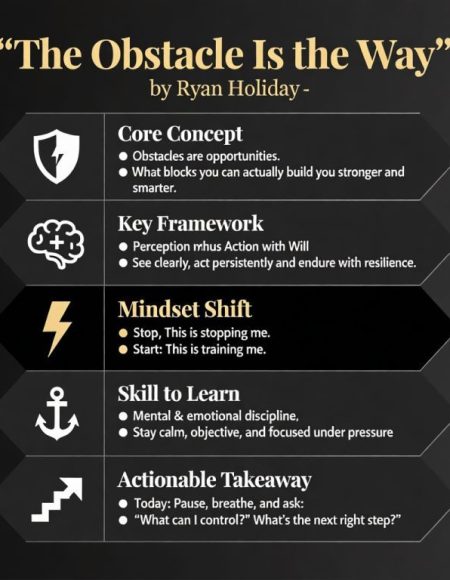
The Obstacle Is the Way teaches that the challenges you want to avoid are often the very things that will make you stronger, wiser, and more capable, if you learn how to face them correctly.

Who should read The Obstacle is the Way and why?

This book is best for people who keep running into resistance, setbacks, or pressure and want a calm, practical way to deal with it, not hype, not shortcuts, not empty motivation.

Below are the types of readers who will benefit most, and exactly what they’ll gain.

1. People Going Through a Difficult Season

(Career problems, financial stress, personal setbacks, uncertainty)

Why this book helps:

  • It teaches how to stay calm instead of panicking
  • It shows how to move forward even when things feel blocked
  • It replaces why me? thinking with what now? thinking

What they’ll learn:

  • How to stop making problems worse emotionally
  • How to find a path forward when options seem limited
  • How to endure without losing self-respect or hope

2. Entrepreneur, Founders & Side-Hustlers

Why this book helps:

  • Business is full of rejection, delays, and failure
  • The book teaches resilience, persistence, and problem-solving
  • It helps founders stop quitting too early

What they’ll learn:

  • How to turn setbacks into strategy
  • How to act with limited resources
  • How to keep going when results are slow

3. Professionals & Career Builders

(Employees, managers, leaders, freelancers)

Why this book helps:

  • Workplaces are full of pressure, politics, and unfair situations
  • The book teaches emotional discipline and professionalism

What they’ll learn:

  • How to respond calmly to criticism
  • How to grow under difficult bosses or environments
  • How to build a strong reputation through consistency

4. Leaders, Managers & Decision-Makers

Why this book helps:

  • Leadership means making hard decisions under pressure
  • This book trains mental toughness and clarity

What they’ll learn:

  • How to stay steady in chaos
  • How to make decisions without emotional bias

Athletes, Creatives & High-Performers

Why this book helps:

  • Performance always comes with failure, setbacks, and self-doubt
  • The book teaches discipline and long-term thinking

What they’ll learn:

  • How to use failure as training
  • How to persist through boredom and repetition
  • How to separate effort from outcome

5.  People Interested in Philosophy

Why this book helps:

  • It introduces Stoicism without complex language
  • It shows philosophy as a tool for living, not theory

What they’ll learn:

  • How ancient ideas apply to modern problems
  • How to build emotional control and mental strength
  • How to live intentionally instead of reactively

Who This Book May NOT Be For

This book might not be ideal if someone:

  • Wants quick hacks or overnight success
  • Expects life to be fair all the time
  • Avoids responsibility for their actions
  • Wants motivation without discipline
  • This book is about inner work, not external shortcuts.

 Why This Book Matters

The Obstacle Is the Way matters because it teaches a timeless truth:

  • Life doesn’t get easier  you get stronger, smarter, and more capable.

For anyone who wants to stop being overwhelmed by difficulty and start using it as fuel, this book is a powerful guide.
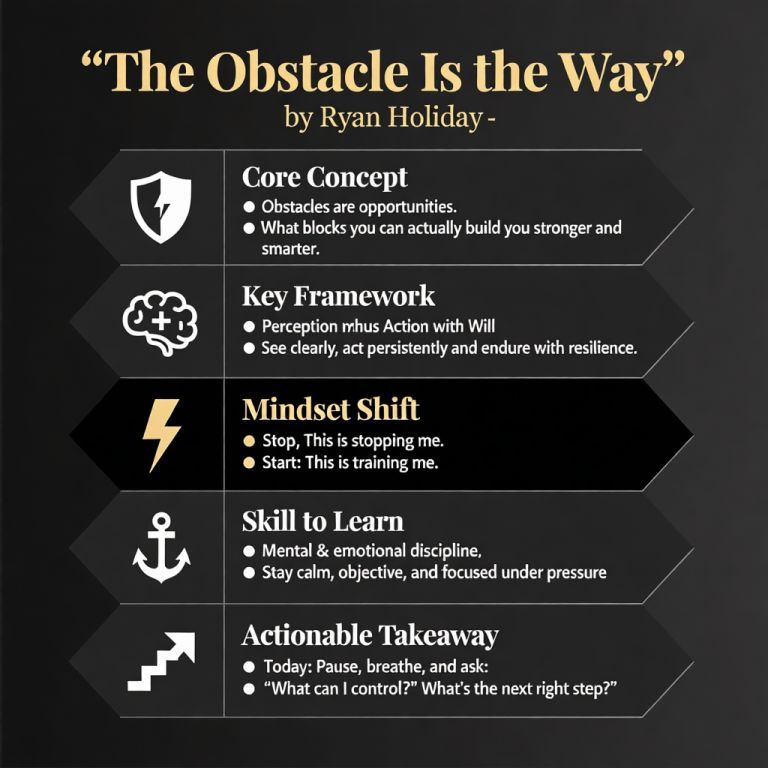
 

The obstacle is the way summary 111

Part I: Perception from The Obstacle Is the Way

Core idea of Part I: How you see a problem changes everything.

 Chapter 1: The Discipline of Perception

 Chapter 1 is basically Ryan Holiday saying, before you do anything about a problem, you need to learn how to see it properly.

He calls this the discipline of perception, and honestly, it’s one of the most practical skills in life, even though most people don’t realize it.

What the chapter is trying to teach

Holiday is saying that your eyes may look at an obstacle, but your mind decides what it truly is.

Two people can face the same problem, one panics, the other stays calm and finds a solution. The difference isn’t luck. It’s perception.

And perception isn’t something that happens automatically.
It’s something you practice, like learning to drive or knead dough.

What is Perception?

 Perception  is how you choose to interpret what’s happening. Not what is happening, but how you see it.

Holiday says good perception has these qualities:

  • You see things calmly, without drama
  • You remove your emotions from the first reaction
  • You look at a situation objectively, not emotionally
  • You see the bad, but don’t exaggerate it
  • You see the good, even if it’s tiny
  • You look at the whole picture, not just the scary parts

It’s like cleaning your glasses before you decide where to walk.

 
Here is why this matters


Most people don’t fail because the obstacle was too big.
They fail because:

  • they got scared,
  • they made it bigger in their mind,
  • they reacted emotionally,
  • or they didn’t pause long enough to see it clearly.

Holiday says If you don’t control your perception, the obstacle will control you.

Example: The Roman Emperors and Stoics

Holiday starts by mentioning Marcus Aurelius and other Stoics.

These people lived in dangerous times, war, betrayal, disease, slavery, politics, far worse than what most of us face. Yet they trained themselves to see problems calmly.

Marcus Aurelius used to write notes to himself like:

  • Is this actually bad, or am I just reacting?
  • Can I see this clearly?
  • What part of this is within my control?

Those questions helped him stay level-headed even when the world around him was shaking.


Hereis a  simple real-life analogy

Imagine you’re cooking  rice. You taste it and it’s too salty. One person might:

Throw the whole pot away

Complain

Panic

Get angry

Another person might:

Pause

Taste again

Add potatoes or water

Balance the flavor

Same problem.
Different perception.

The person who stays calm solves it.

🧪 Oily Hands Example (my friend explanation)

Holiday is basically saying:
When you touch a problem with “clean hands” (calm, clear thinking), you can handle it.

But when you touch it with “oily hands” (fear, anger, frustration), you’ll slip.

So first: wipe your hands — fix your perception.

💼 Real-world scenario: Business Crisis

Let’s say you launch a new product and nobody buys it.

Someone without disciplined perception might say:

“I’m a failure!”

“This idea was dumb.”

“Everything’s ruined.”

That emotional lens makes the situation look worse than it actually is.

But someone with trained perception would say:

“Okay, what happened?”

“Did people see the offer?”

“Is it the pricing?”

“Do people understand the value?”

“What small thing can I test next?”

Same situation.
But the second person is calm and clear — which means they still have power.

🪞 Holiday’s Point

Events don’t hurt us as much as the stories we tell ourselves about them.

Your reaction can turn a small obstacle into a mountain.

Or it can keep it small.

This chapter is Holiday showing us that perception is the foundation for everything else in the book.

🧠 Another Book Example: The Great Leaders

Holiday mentions how great leaders (military commanders, CEOs, inventors) mastered this discipline.

They stayed calm in situations that would have broken ordinary people.

Not because the problems were smaller.
But because their perception was stronger.

They saw things:

Without panic

Without exaggerating

Without assuming doom

With a sober, realistic mindset

This allowed them to make the right move.

💡 Why Holiday Calls It a “Discipline”

He uses the word “discipline” because:

it’s something you practice

it takes effort

it’s not automatic

it improves with repetition

you can get better at it the same way you get better at fitness, cooking, or public speaking

You train yourself to look at a problem and say:

“Let me see this clearly.”

That one sentence alone can save relationships, businesses, projects, and opportunities.

✔️ Practical Lessons from Chapter 1

Here’s how Holiday wants you to actually use this lesson:

1. Pause before reacting

Don’t rush into emotions or actions.

2. Ask: What exactly happened?

Stick to facts, not assumptions.

3. Ask: Am I seeing this bigger or scarier than it really is?

4. Ask: What’s in my control here? What isn’t?

Only focus on the controllable.

5. Look at the situation from a neutral angle

Pretend you are advising a friend — what would you say?

🌟 Final Reflection (1–2 sentences)

Chapter 1 teaches that how you see a problem determines how you handle it.
Clear eyes create better decisions — and better decisions turn obstacles into opportunities.

Absolutely — let’s dive into Chapter 2 of The Obstacle Is the Way, explained in a wrm, simple, “talking-to-a-friend” style, with examples, clarity, and real-life scenarios.

This chapter is called:

⭐ Chapter 2: Recognize Your Power

(Explained like you’re chatting with a friend who just wants to understand life better)

🌱 What the chapter is really about

Chapter 2 is Holiday telling you:

“You have far more control in difficult situations than you think — but not in the way most people assume.”

You don’t control:

what happens around you

other people

circumstances

surprises

external events

But you always control:

how you see the situation

how you respond

what meaning you give it

what action you take next

Holiday calls this your power.
And Chapter 2 is really about recognizing that power so you don’t feel helpless when life throws you into a corner.

🧠 The Big Message in One Line

Even when life takes away options, it never takes away your most important option: your response.

🔍 Breaking Down the Concept (Simple Terms)

⭐ 1. You can’t control what happens to you…

Storms come.
Plans fail.
People disappoint you.
Business deals fall apart.
Things you expect don’t go the way you imagined.

Holiday is not pretending bad things aren’t bad.

He’s saying:

Stop wasting energy on what you cannot influence.

⭐ 2. But you can always control your judgment about what happens.

This is the secret most people miss.

You can decide:

“This is the end”
OR

“This is the beginning of something new.”

You can decide:

“I’m a failure”
OR

“I’m learning something important.”

You can decide:

“This is blocking me”
OR

“This is redirecting me.”

This doesn’t magically fix the problem — but it gives you back your mental strength.

And when your mind is strong, you can figure out the next step.

📖 Examples from the Book

Holiday brings up the ancient Stoics again — especially Epictetus.

⭐ Example: Epictetus

Epictetus was born into slavery.
His master abused him so badly that his leg got permanently damaged.
He had every reason to give up, become bitter, or feel powerless.

But Epictetus said something incredible:

“I may be physically enslaved, but my mind is mine. My thoughts are mine.
Nothing can touch my ability to choose my attitude.”

He didn’t control:

where he lived

his freedom

his body

his daily routine

But he controlled how he interpreted everything happening around him.

And that mindset is what later made him one of the greatest Stoic teachers in history.

Holiday uses him to show us:

“If someone in chains can maintain their inner power, then you—who are free—have even more power than you realize.”

🧑‍🍳 Real-Life Analogy: Restaurant Fire

Imagine you run a restaurant and one night, a fire breaks out in the kitchen.

You don’t control the fire.
You don’t control the damage.
You don’t control the stress.

But you do control:

how you think about it

whether you panic or stay calm

whether you blame everyone or focus on what matters

whether you see it as the end or as a chance to rebuild better

Maybe the insurance payout allows you to remodel.
Maybe you finally fix things you’ve been ignoring.
Maybe a temporary closure gives you time to rethink your brand.

Same event.
Different mindset.
Totally different outcome.

📍 Holiday’s Key Point

Your judgment is the first line of power.

The world can shake everything else, but it cannot force your mind to think a certain way.

Your inner power is always available.

😮 A Modern Example (super relatable)

🎧 Let’s say you create content online.

You post a video.
You put all your heart into it.

It gets only 87 views.

Someone without inner power says:

“This is humiliating.”

“Nobody cares about me.”

“I’m not good at this.”

“I’m quitting.”

But someone who recognizes their power says:

“Okay, low views — why?”

“Did I post at a bad time?”

“Is the title not clear?”

“How can I improve this?”

“This is information — not a verdict on my value.”

The difference isn’t the number of views.
It’s the story the person tells themselves.

That’s perception.
That’s power.

🧰 Practical Lessons and Takeaways

Holiday wants you to leave this chapter with 4 clear understandings:

⭐ 1. You always have a choice in how you see a situation.

Even in tight, painful, frustrating moments.

⭐ 2. Your judgment can either weaken you or empower you.

Thoughts like “I can’t survive this” drain you.
Thoughts like “This is hard, but I can figure it out” strengthen you.

⭐ 3. You have more control than you think.

Not over life —
but over your interpretation of life.

⭐ 4. When you stay calm and rational, you make better decisions.

Good perception leads to good action.

🧩 How Chapter 2 Fits the Bigger Picture of the Book

Part 1 is about perception.

Chapter 1 said: See clearly.
Chapter 2 now says: From that clarity, recognize your inner strength.

Later, Chapters 3–10 build on this to teach you:

how to manage fear

how to calm your mind

how to make good decisions

how to turn problems into opportunities

So Chapter 2 is the foundation of emotional strength.

It prepares you to face obstacles without feeling like a victim.

🌟 Final Reflection (1–2 sentences)

Chapter 2 reminds you that even when life strips away options, your response remains yours — untouched, undamaged, and powerful.
Recognizing that power is the first step to turning challenges into victories.

Perfect — let’s move on to Chapter 3 of The Obstacle Is the Way. I’ll keep the friendly, “chat over coffee” vibe, with plenty of examples and real-life scenarios.

This chapter is called:

⭐ Chapter 3: Steady Your Nerves

🌱 Main Idea of the Chapter

Holiday is saying:

“When obstacles appear, most people panic. But if you can stay calm under pressure, you gain clarity and power to act.”

This chapter is all about emotional control in the face of crisis. The better you handle fear, stress, and surprise, the more effective your actions will be.

Think of it as keeping your hands steady when the world shakes — that’s the first step to doing anything meaningful.

🔍 Breaking Down the Concept

1. Nerves aren’t weakness — panic is.

Everyone feels fear, anxiety, or stress when something goes wrong. That’s normal. The problem is letting those emotions run your decisions.

Holiday emphasizes that leaders, entrepreneurs, and historical figures all faced terrifying situations. The difference wasn’t luck — it was their ability to steady their nerves.

2. Calmness = clarity

When your mind is calm, you can:

see facts clearly

separate what’s controllable from what’s not

identify small, practical actions

think creatively under pressure

Panicked people miss opportunities because their vision narrows and emotions take over.

📖 Book Examples

⭐ Ulysses S. Grant — The Calm Commander

Grant faced dangerous battles with Confederate armies.

His troops were often exhausted and under fire.

Other generals panicked or froze.

Grant stayed calm, assessed the situation, and acted decisively.
Lesson: Calmness under pressure allows you to see solutions others miss.

⭐ James Stockdale — POW Survival

Stockdale was a prisoner of war in Vietnam for years.

Torture, isolation, and hopelessness were daily realities.

He survived not by controlling the prison or captors, but by controlling his mind: routines, small goals, and mental discipline kept him sane.
Lesson: Nerves can’t eliminate obstacles — but controlling them preserves your ability to act.

🧑‍🍳 Everyday Analogy

Imagine you’re on a roller coaster you didn’t want to ride:

Panic: You scream, grab the bars, tense every muscle. You can barely think.

Calm: You take a deep breath, notice the path, hold the bars lightly, and enjoy the ride or focus on safely completing it.

Both people are on the same roller coaster — different internal states completely change the experience and how they handle it.

💼 Modern Real-World Scenario

🎧 Startup Crisis Example

Imagine your startup website goes down during a big product launch:

Panic reaction: Send frantic messages, post confusing updates, blame your team.

Steady nerves reaction: Take a deep breath, assess the exact issue, prioritize fixes, and communicate calmly with customers.

Who will likely recover faster and preserve credibility? The calm person.

Holiday emphasizes that nerves can be trained, just like muscles.

🧠 Practical Steps to Steady Your Nerves

Pause before reacting
Even a few seconds can prevent emotional overreaction.

Breathe and ground yourself

Simple 4-4-4 technique: inhale 4 sec, hold 4 sec, exhale 4 sec.

Slows heart rate, reduces stress.

Focus on the facts

What happened?

What is real?

Ignore exaggerations your mind might invent.

Break it into manageable parts

One small step at a time prevents overwhelm.

Prepare mentally for surprises

Anticipate worst-case scenarios, not to fear, but to be ready.

📍 Key Takeaways from Chapter 3

Fear is natural, panic is optional.

Calmness under pressure allows clarity and better decision-making.

Your ability to steady your nerves is a trainable skill.

Training your mind in daily small stresses prepares you for the big ones.

🌟 Why This Chapter Matters

Chapter 3 builds on the first two chapters:

Chapter 1: See clearly (Perception).

Chapter 2: Recognize your inner power.

Chapter 3: Stay steady so that power can actually work.

Think of it like this:

Seeing clearly is like having a map.

Knowing your power is like having fuel.

Steady nerves are like having control of the steering wheel.

Without steadiness, the map and fuel won’t get you anywhere.

🌈 Final Friend-Style Reflection

Obstacles don’t just challenge your plans — they test your mind.
If you can stay calm when everything feels chaotic, you gain the advantage, because most people panic and miss what’s right in front of them.

If you want, I can continue with Chapter 4 next, which is about Controlling Your Emotions, and it naturally builds on this chapter.

Perfect — let’s move on to Chapter 4 of The Obstacle Is the Way, keeping the same friendly, detailed style with examples and practical insights.

This chapter is called:

⭐ Chapter 4: Control Your Emotions

🌱 Main Idea of the Chapter

Holiday’s point is:

“You can’t stop emotions from appearing — fear, anger, frustration — but you can control how they influence your actions.”

Where most people fail with obstacles isn’t because the obstacle is too big, but because their emotions hijack their judgment.

This chapter teaches how to manage emotions so they serve you instead of sabotage you.

🔍 Breaking Down the Concept

1. Emotions aren’t bad; unchecked emotions are.

Emotions are information, like a warning light in a car.

Fear tells you: “Pay attention, something might go wrong.”

Anger tells you: “Something feels unfair; energy is here to act.”

The trick is not suppressing them, but using them wisely.

2. Why control matters

Uncontrolled emotions narrow your thinking, cloud judgment, and push you toward impulsive choices.

Holiday points out:

People who let anger rule make decisions they regret.

People who let fear rule freeze and do nothing.

People who let frustration rule blame others instead of solving the problem.

Controlled emotion = energy + clarity.
You feel the emotion, then channel it into smart action.

📖 Book Examples

⭐ Bill Belichick — NFL Coach

Belichick is famous for his calm demeanor during high-pressure games.

Even in the final minutes of the Super Bowl, he doesn’t panic.

Players can react effectively because their leader’s emotions don’t infect the team.

Lesson: Emotional control is contagious — your composure influences everyone around you.

⭐ Thomas Edison — The Lightbulb Experiment

Edison failed thousands of times before creating the lightbulb.

He didn’t let frustration or despair take over.

He treated each failure as data, not as a personal defeat.

Lesson: Channel emotion into curiosity and persistence rather than self-doubt.

⭐ Stockdale — Prisoner of War Again

Stockdale also relied on controlling emotions to survive long-term captivity.

He felt despair, anger, and fear, but he didn’t act impulsively on them.

He created routines, mental exercises, and small goals to maintain control.

Lesson: Emotional discipline sustains you when circumstances are harsh.

🧑‍🍳 Everyday Analogy

Imagine someone cuts you off in traffic:

Emotional reaction: Honk, yell, rage, and stew about it the rest of the day.

Controlled emotion: Notice the frustration, breathe, let it go, focus on safely reaching your destination.

Same trigger, different outcome. The second option keeps your energy for what really matters.

💼 Modern Real-World Scenario

🎧 Workplace Conflict Example

You get a harsh email from your boss or client:

Emotional reaction: Fire back in anger, escalate, or make a poor decision.

Controlled emotion: Pause, identify the feeling, respond calmly with facts and options.

The second approach protects relationships, reputation, and opportunities.

🧠 Practical Steps to Control Emotions

Label the emotion

Step back and name it: “I feel angry,” “I feel anxious,” “I feel frustrated.”

Just naming it reduces intensity.

Pause before acting

Even 30 seconds can prevent emotional overreaction.

Ask: What is useful here?

“What part of this feeling can guide me to take action?”

Example: Anger → energy to solve the problem; Fear → attention to risk.

Separate facts from feelings

Write the facts first, then the emotional interpretation.

Act from the facts, not the stories your mind tells.

Use a ritual to calm yourself

Breathing, journaling, meditation, or even a short walk.

📍 Key Takeaways from Chapter 4

Emotions are signals, not dictators.

Unchecked emotions lead to bad decisions; controlled emotions lead to better action.

The skill is trainable: the more you practice pausing, labeling, and channeling, the stronger your control becomes.

Control doesn’t mean suppress; it means direct and use your energy wisely.

🧩 How Chapter 4 Fits Into the Big Picture

Chapter 1: See clearly (perception).

Chapter 2: Recognize your power (response is yours).

Chapter 3: Steady your nerves (calm under pressure).

Chapter 4: Control your emotions (use emotional energy effectively).

Think of it like this:

Perception = map

Power = fuel

Steady nerves = steering wheel

Emotional control = brakes and accelerator

Without controlling your emotions, even the clearest perception and calmest mind can make impulsive mistakes.

🌈 Practical Friend-Style Exercise

Daily check-in: Each morning, ask: “What might trigger strong emotions today?”

Emotional pause: When you feel a surge, stop, label it, and breathe.

Channel it: Ask: “How can this emotion help me move forward?”

Reflect: End the day by noting how controlling emotions helped you handle challenges better.

🌟 Final Reflection (1–2 sentences)

Controlling your emotions is like turning potential chaos into fuel for smart action.
Master this, and you’ll find obstacles feel less like roadblocks and more like challenges you can actually handle.

If you want, I can continue with Chapter 5: Practice Objectivity next, in the same detailed, friendly, and example-rich style.

Do you want me to go ahead with Chapter 5?

Great! Let’s dive into Chapter 5 of The Obstacle Is the Way, keeping the same friendly, detailed style with real-life examples and practical takeaways.

This chapter is called:

⭐ Chapter 5: Practice Objectivity

🌱 Main Idea of the Chapter

Holiday’s key message:

“When obstacles appear, your first reaction is often distorted by emotion, bias, or ego. To overcome them, you must see things as they really are — objectively.”

Objectivity is about looking at situations without exaggeration, fear, or wishful thinking. It’s like wiping fog off a window: suddenly you see clearly what’s really happening and what’s possible.

🔍 Breaking Down the Concept

1. What is Objectivity?

In simple terms:

Objectivity = seeing the world as it is, not as your emotions or opinions tell you it is.

It’s different from indifference. You care, but you don’t let feelings distort reality.

Without objectivity:

Problems feel bigger than they are

People’s actions feel more hostile than they are

Mistakes feel catastrophic

With objectivity:

Problems are assessable

Others’ actions are understood rationally

Mistakes become learning opportunities

2. Why Objectivity Matters

Holiday explains that every obstacle has two parts:

The external fact — what actually happened.

Your mind’s interpretation — how you feel about it, which can exaggerate, distort, or mislead.

Most people react to interpretation, not fact, and that’s why obstacles feel overwhelming.

Objectivity gives you clarity, which is the first step to effective action.

📖 Book Examples

⭐ John D. Rockefeller — The Business Giant

Rockefeller faced tough competition, unpredictable markets, and public criticism.

He didn’t react to gossip or emotion; he assessed facts rationally.

When competitors panicked, he saw opportunity.
Lesson: Objectivity allows you to act while others are frozen by fear.

⭐ Ulysses S. Grant — Again

Grant faced battlefields filled with chaos, fear, and confusion.

He assessed troop strength, enemy movements, and terrain without letting panic cloud judgment.

Objectivity allowed him to make strategic moves that others would miss.

⭐ Everyday Analogy: Driving in Traffic

Imagine traffic suddenly backs up:

Emotional reaction: “This is terrible, I’ll be late, everything’s ruined!”

Objective reaction: “Traffic is delayed by 15 minutes. Alternate route exists. I’ll adjust my plan.”

The event is the same, but objectivity prevents unnecessary stress and wasted energy.

🧠 Practical Steps to Practice Objectivity

Separate facts from interpretation

Fact: “The client canceled the meeting.”

Interpretation: “They think I’m incompetent.”

Focus on the fact; don’t let assumptions control your emotions.

Step outside yourself

Pretend you are an advisor to a friend. What advice would you give if you weren’t personally involved?

This reduces ego-driven bias.

Ignore unnecessary drama

Your mind loves stories, often negative.

Filter for what’s relevant to solving the problem.

Ask: What is actually under my control?

You can’t control other people, but you can control your response and decisions.

Look for opportunities hidden in problems

When you see clearly, obstacles often reveal ways to improve, pivot, or innovate.

💼 Modern Real-World Scenario

🎧 Startup Product Failure Example

Your product launch flops. Initial emotions:

“This is a disaster!”

“No one likes me!”

“I wasted months!”

Objective approach:

Look at data: How many people visited? Which features worked? Which didn’t?

Separate emotions: You feel disappointment — that’s normal.

Decide next steps: Fix bugs, pivot features, or try a new marketing strategy.

Clear, unemotional assessment turns a failure into actionable insight.

📍 Key Takeaways from Chapter 5

Objectivity = seeing things as they really are, not as your emotions tell you.

It’s the foundation for good decision-making.

Ego, assumptions, and panic distort perception; practice stepping back.

Every problem contains data — if you remove emotional noise, you can see it clearly.

Objectivity allows you to find opportunity inside the obstacle itself.

🧩 How Chapter 5 Fits Into the Big Picture

Chapter 1: See clearly (Perception)

Chapter 2: Recognize your power

Chapter 3: Steady your nerves

Chapter 4: Control your emotions

Chapter 5: Objectivity = the lens you use to interpret events accurately

Think of it as:

Perception = map

Power = fuel

Calm nerves = steering

Emotional control = brakes/accelerator

Objectivity = the windshield

Without it, everything is blurry, and even the calmest driver might crash.

🌟 Practical Friend-Style Reflection

Objectivity turns chaos into clarity.
When you see obstacles clearly, you stop being a victim of circumstance and start being a problem-solver — and that’s when opportunities appear.

If you want, I can continue with Chapter 6: Alter Your Perspective, in the same detailed, example-rich style.

Do you want me to go ahead with Chapter 6?

Perfect! Let’s dive into Chapter 6 of The Obstacle Is the Way in our friendly, detailed style.

This chapter is called:

⭐ Chapter 6: Alter Your Perspective

🌱 Main Idea of the Chapter

Holiday’s key message:

“When faced with obstacles, the way you frame or interpret the situation determines your outcome. By changing your perspective, you can turn even the worst setbacks into advantages.”

In simple terms, it’s like saying:

Problem = brick wall

Perspective = ladder or window you can use to get over it

Your obstacle doesn’t change. But how you see it can change everything.

🔍 Breaking Down the Concept

1. Perspective shapes your reality

Two people can face the same event:

Person A: Sees a failure → panic, shame, despair

Person B: Sees a failure → learning opportunity, stepping stone

Holiday emphasizes that you can train yourself to see like Person B. That’s what Stoics called “framing”.

Framing = how you mentally interpret what’s happening.

2. Why perspective matters

Obstacles are neutral; your mind gives them meaning.

Are they punishment?

Are they unfair?

Are they temporary?

Are they lessons in disguise?

Changing your lens lets you:

Stay calm under pressure

Discover solutions you couldn’t see before

Learn from mistakes instead of being crushed by them

📖 Book Examples

⭐ Abraham Lincoln — Early Failures

Lincoln lost elections, faced business failure, and endured personal tragedy.

Instead of quitting, he reframed failures as preparation for leadership.

That perspective ultimately helped him lead the U.S. through its darkest time.

Lesson: What looks like a career-ending setback can become a foundation for future success.

⭐ Amelia Earhart — Aviation Challenges

Faced skepticism, gender bias, and mechanical setbacks.

She reframed obstacles as challenges to overcome rather than insurmountable blocks.

That mindset allowed her to achieve historic flights.

Lesson: Perspective converts external barriers into internal motivation.

⭐ Everyday Analogy: Traffic Jam

Lens 1: “This is ruining my day!” → stress, tension, frustration

Lens 2: “Extra time to listen to a podcast or think” → calm, opportunity

Same situation. Different experience. Same principle applies to bigger challenges in business, school, or relationships.

💼 Modern Real-World Scenario

🎧 Startup Pivot Example

Your app launch fails, users complain, investors hesitate.

Fixed mindset: “We’re doomed, we wasted time and money”

Growth mindset & perspective shift: “Feedback tells us exactly what to fix; pivoting will make the app stronger”

Perspective turns obstacle → insight → opportunity.

🧠 Practical Steps to Alter Perspective

Ask: “How would an outsider see this?”

Pretend you’re a consultant giving advice to a friend.

Look for the silver lining

Even small insights can be leveraged.

Ask: “How can I turn this into advantage?”

Framing as a challenge to solve energizes action.

Take time to reflect

Journal, meditate, or discuss with a mentor.

Practice gratitude in adversity

Seeing what’s still working gives clarity and motivation.

📍 Key Takeaways from Chapter 6

Perspective determines power: your mind gives obstacles meaning.

Reframing challenges allows you to act instead of panic.

Small perspective shifts create big changes in decisions and outcomes.

Stoics mastered this: they didn’t just endure adversity — they used it as a tool.

🧩 How Chapter 6 Fits Into the Big Picture

Chapter 1: See clearly

Chapter 2: Recognize your power

Chapter 3: Steady your nerves

Chapter 4: Control emotions

Chapter 5: Objectivity

Chapter 6 adds the superpower of flexibility:

Even after seeing clearly, being calm, and controlling emotions, your mindset determines whether you collapse under a problem or turn it into an opportunity.

🌈 Practical Friend-Style Exercise

Pick one small problem today.

Write down your first reaction.

Reframe it: “What can I learn?” or “How could this help me?”

Notice how the new perspective changes your energy and options.

🌟 Final Reflection (1–2 sentences)

The obstacle itself doesn’t define you — your perspective does.
Shift your lens, and the same challenge that once blocked you can become your stepping stone.

If you want, I can continue with Chapter 7: Is It Up to You?, the next chapter in Part 1, and keep building this step-by-step, detailed, friend-friendly summary.

Do you want me to continue with Chapter 7?

Great! Let’s dive into Chapter 7 of The Obstacle Is the Way in our detailed, friendly style.

This chapter is called:

⭐ Chapter 7: Is It Up to You?

🌱 Main Idea of the Chapter

Holiday’s central message:

“Focus on what you can control and let go of what you cannot. Your energy should go where it matters most — on actions that are up to you.”

This chapter is all about accepting reality and taking ownership of your part, instead of wasting time, energy, and emotion on things outside your control.

🔍 Breaking Down the Concept

1. Control what’s yours — ignore the rest

Life will throw challenges, criticism, or chaos your way.

You cannot control: the market, the weather, other people, accidents, random events.

You can control: your actions, effort, response, attitude, preparation.

Holiday emphasizes that the freedom to act comes from focusing only on what is yours to influence.

2. Why this matters

Most people get stuck because they:

Blame others for their problems

Waste energy complaining about circumstances

Feel helpless when things don’t go their way

Instead of wasting energy, Holiday says:

“Ask yourself: Which part of this is truly under my control?”
“Direct your energy there, and let go of the rest.”

This mindset turns frustration into focus.

📖 Book Examples

⭐ Marcus Aurelius — The Stoic Emperor

Marcus faced political chaos, plague, and betrayal.

He could not control the empire or other people’s actions.

He could control his attitude, decisions, and moral character.

By focusing on what he could control, he remained effective and resilient.

⭐ The Wright Brothers — Inventing the Airplane

Thousands of people thought flight was impossible.

External criticism and technical failure were beyond their control.

They focused on testing, learning, and iterating — the part that was up to them.

That focus eventually led to success.

⭐ Everyday Analogy: Group Project

Imagine a team project at school:

You can’t control: your teammates’ effort, the teacher’s mood, or unexpected tech issues.

You can control: your research, your contribution, your attitude.

Focusing on what you can’t control = stress, arguments, wasted energy.
Focusing on what you can control = better results, less frustration.

💼 Modern Real-World Scenario

🎧 Startup Launch Example

Your app crashes due to a server issue during a big launch:

Not up to you: the server failure (outside provider), competitors’ reactions, public criticism.

Up to you: communicating clearly with users, fixing the bug, preventing future issues.

Holiday emphasizes: focus on your “circle of control” and stop obsessing over what you can’t change.

🧠 Practical Steps to Apply This Chapter

List everything bothering you

Identify which parts are in your control and which aren’t.

Focus your effort

Work on controllable tasks only.

Release the rest

Mentally or physically let go of what you can’t change.

Check yourself daily

Ask: “Am I spending energy on what’s mine to fix, or on whining about the uncontrollable?”

📍 Key Takeaways from Chapter 7

Life will always throw things you can’t control. That’s normal.

Freedom and progress come from focusing only on what is up to you.

Energy spent on uncontrollable events = wasted potential.

Mastery of this principle keeps you calm, effective, and resilient in adversity.

🧩 How Chapter 7 Fits Into the Big Picture

Chapters 1–6 set the foundation: perception, power, nerves, emotions, objectivity, and perspective.

Chapter 7 now channels all of that toward action where it counts.

Think of it as:

Map → fuel → steering → brakes → clear windshield → flexible lens → focus on your lane.

Without focusing on what’s up to you, all previous skills can get wasted on stress and frustration.

🌈 Practical Friend-Style Exercise

Take a current problem in life or work.

Write down everything about it that’s bothering you.

Circle what’s truly under your control.

Make a small, actionable step for each controllable item.

Let the rest go — seriously, mentally release it.

🌟 Final Reflection (1–2 sentences)

Obstacles become manageable the moment you stop fighting what you cannot change and start acting on what you can.
Master this, and life’s chaos becomes a map for meaningful action instead of a source of despair.

If you want, I can continue with Chapter 8: Live in the Present Moment, keeping the same detailed, friendly, example-rich approach.

Do you want me to go ahead with Chapter 8?

Perfect! Let’s dive into Chapter 8 of The Obstacle Is the Way, continuing our detailed, friend-friendly style with examples and practical takeaways.

This chapter is called:

⭐ Chapter 8: Live in the Present Moment

🌱 Main Idea of the Chapter

Holiday’s main message is:

“The obstacle is never overcome in the past or future — it’s overcome right now, in the present moment. Focus on what you can do today, not what has already gone wrong or what might happen tomorrow.”

In simple terms: worrying about yesterday or tomorrow drains your energy. The only time you can act effectively is this moment.

🔍 Breaking Down the Concept

1. The danger of dwelling on the past

Many people get stuck ruminating on mistakes or past failures.

Holiday points out: you cannot change the past, so obsessing over it only wastes energy and clouds judgment.

The trick: learn the lesson, then turn your attention fully to what you can do now.

2. The danger of obsessing about the future

Worrying about what might happen — failure, rejection, loss — creates fear and inaction.

Holiday stresses: uncertainty is inevitable. Planning is good, but overthinking the future paralyzes you.

3. Power of the present moment

The present is where action lives.

Even the smallest step taken now can start a chain reaction that overcomes the obstacle.

The Stoics believed: life is short, the present is all you have, so act fully in it.

📖 Book Examples

⭐ Ulysses S. Grant — Battle Focus

Grant faced battlefields with chaos all around.

Instead of worrying about past mistakes or potential outcomes, he focused on the immediate decisions: troop placement, timing, and strategy.

That focus allowed him to win battles that others would have lost due to overthinking.

⭐ The Roman Emperor Marcus Aurelius

He reminded himself daily: “Focus on what is before you. Don’t get lost in what has passed or what may come.”

This mindset helped him rule an empire full of crises without being paralyzed by fear or regret.

⭐ Everyday Analogy: Homework Panic

Imagine a huge assignment is due tomorrow. You panic about how you fell behind, or what grade you might get.

Objectively, only what you do right now matters.

Break it into the next actionable step — research one section, write one paragraph. That’s the present moment in action.

💼 Modern Real-World Scenario

🎧 Startup Launch Example

Your app faces a sudden bug during launch:

Panicking about all the possible ways it could fail tomorrow or last week’s mistakes = wasted energy

Focus on what can be fixed right now: isolate the bug, alert your team, communicate with users

Each present-moment action moves you closer to resolving the obstacle

🧠 Practical Steps to Live in the Present Moment

Focus on the next actionable step

Don’t think about the whole mountain; take the next step you can do today.

Ignore past regrets and future “what-ifs”

Acknowledge them quickly, then redirect attention to the present.

Mindful awareness

Pay attention to what’s happening around you and in you right now.

Meditation, journaling, or simply deep breathing helps.

Prioritize action over worry

Energy spent on fear or regret doesn’t solve problems; action does.

Celebrate small wins now

Completing one small task today builds momentum and reduces overwhelm.

📍 Key Takeaways from Chapter 8

The past is gone; the future is uncertain; the present is all you have to act.

Living in the present moment keeps you calm, focused, and effective.

Small, deliberate steps today are more powerful than endless worry.

Obstacles shrink when you direct all energy into the current moment.

🧩 How Chapter 8 Fits Into the Big Picture

Previous chapters taught perception, power, emotional control, objectivity, perspective, and focus on what’s up to you.

Chapter 8 ties it all together: all those skills are useless unless applied in the present moment.

Think of it as:

Map → fuel → steering → brakes → windshield → lens → focus → foot on the accelerator now

No action in the present = no progress.

🌈 Practical Friend-Style Exercise

Pick one challenge you’re facing today.

Ask: “What’s the very next action I can take right now?”

Focus only on that step.

Repeat with the next step.

Notice how small present actions build forward momentum.

🌟 Final Reflection (1–2 sentences)

Obstacles are conquered one present moment at a time.
Stop worrying about the past or future — your power lies in what you do right now.

If you want, I can continue with Chapter 9: Think Differently, keeping the same thorough, friendly, and example-rich approach.

Do you want me to continue with Chapter 9?

Awesome! Let’s move on to Chapter 9 of The Obstacle Is the Way, keeping it detailed, example-rich, and easy to understand.

This chapter is called:

⭐ Chapter 9: Think Differently

🌱 Main Idea of the Chapter

Holiday’s central message:

“Obstacles aren’t just roadblocks — they’re invitations to think differently, to be creative, and to innovate.”

In simple terms: when life throws a wall in your path, the key isn’t to bash your head against it but to find another angle, a new approach, or an unexpected opportunity.

It’s about turning limitations into fuel for inventive problem-solving.

🔍 Breaking Down the Concept

1. Obstacles are reframing opportunities

Most people see obstacles as:

Problems

Punishments

Setbacks

Holiday argues: if you shift your mindset, obstacles become:

Challenges to solve

Lessons to learn

Catalysts for growth

This is the essence of creative thinking under pressure.

2. Why thinking differently matters

When standard solutions fail, success depends on flexibility and creativity.

Historical leaders and innovators didn’t just endure adversity — they used it as a tool.

Obstacles force you to innovate, because the usual methods no longer work.

📖 Book Examples

⭐ John D. Rockefeller — Innovative Business Strategy

Rockefeller faced unpredictable markets and competitors trying to undercut him.

Instead of reacting conventionally, he restructured his business, diversified, and negotiated cleverly.

Competitors who panicked went bankrupt; Rockefeller saw opportunity where others saw doom.

Lesson: Thinking differently turns market chaos into strategic advantage.

⭐ Amelia Earhart — Aviation Obstacles

Faced technical challenges and societal barriers.

Instead of giving up, she engineered new flight routes, training methods, and techniques.

Obstacles became her innovation platform.

⭐ Everyday Analogy: Stuck in a Crowded Line

Traditional thinking: “I have to wait 30 minutes, there’s nothing I can do.”

Creative thinking: “I can check if another line is shorter, order online, or multitask while waiting.”

Same obstacle, different mindset, different outcome.

💼 Modern Real-World Scenario

🎧 Startup Pivot Example

Your product feature fails during beta testing:

Conventional reaction: Panic, delay, blame the team

Thinking differently: Analyze feedback → pivot the feature → test a new solution → delight users

Creative reframing transforms a failed feature into a unique selling point.

🧠 Practical Steps to Think Differently

Ask “What if?”

Challenge assumptions: “What if the usual way won’t work?”

Flip the problem

Instead of asking, “How do I fix this?” ask, “How can this obstacle help me?”

Seek alternative perspectives

Ask friends, mentors, or even outsiders for their take.

Break it down

Large obstacles often hide smaller, solvable pieces. Solve them one by one.

Experiment

Small trials and iterations often lead to creative solutions without huge risk.

📍 Key Takeaways from Chapter 9

Obstacles aren’t just roadblocks — they’re opportunities to innovate.

Standard approaches may fail; creativity is the key to progress.

Reframing challenges shifts your mind from victim to problem-solver.

Even small mindset shifts open up new solutions and possibilities.

🧩 How Chapter 9 Fits Into the Big Picture

Previous chapters gave you perception, power, calmness, emotional control, objectivity, perspective, focus on what’s yours, and present-moment action.

Chapter 9 adds the lens of innovation: now that you’re seeing clearly and acting wisely, obstacles can spark creativity rather than stop you.

Think of it as:

Map → fuel → steering → brakes → windshield → lens → focus → foot on accelerator → creative navigation

Without thinking differently, you might still act, but in predictable ways that don’t exploit opportunities.

🌈 Practical Friend-Style Exercise

Identify a current obstacle in life or work.

Write down the usual way you think about it.

Ask: “How else could this situation work to my advantage?”

Brainstorm at least three alternative approaches, no matter how unusual.

Pick one small action to try today.

🌟 Final Reflection (1–2 sentences)

Obstacles are gifts in disguise — they force you to stretch your thinking and innovate.
The bigger the problem, the bigger the opportunity to solve it in a way no one else imagined.

If you want, I can continue with Chapter 10: Finding the Opportunity, the next chapter in Part 1, in the same thorough, practical, friendly style.

Do you want me to continue with Chapter 10?

Perfect! Let’s dive into Chapter 10 of The Obstacle Is the Way, keeping our detailed, practical, and friendly style.

This chapter is called:

⭐ Chapter 10: Finding the Opportunity

🌱 Main Idea of the Chapter

Holiday’s core message:

“Every obstacle contains a hidden opportunity — if you’re willing to look for it and act.”

In simple terms: obstacles aren’t just problems; they’re masks for chance and growth. The key is to shift your mindset from frustration to curiosity and ask, “How can this challenge help me?”

🔍 Breaking Down the Concept

1. Obstacles as gateways

Obstacles are often frustrating, unfair, or inconvenient.

But Holiday argues: obstacles can push you to learn, grow, innovate, and become stronger.

The moment you stop seeing obstacles as enemies and start seeing them as opportunities, everything changes.

2. Why most people miss the opportunity

Fear of failure or pain makes people avoid challenges.

People focus on what went wrong instead of what they can gain.

Holiday stresses: opportunity is always present, even if hidden beneath difficulty.

📖 Book Examples

⭐ Ulysses S. Grant — Using Obstacles in War

Grant faced heavily fortified Confederate positions during the Civil War.

Instead of attacking blindly, he looked for weak points and ways to turn enemy strength into his advantage.

By seeing opportunity in difficulty, he achieved decisive victories.

⭐ Thomas Edison — The Lightbulb

Edison’s thousands of failed experiments could have been discouraging.

He reframed each failure as a step closer to success, a lesson in what doesn’t work.

“I have not failed,” he said, “I’ve just found 10,000 ways that won’t work.”

Lesson: Opportunity is hidden in persistence, not just luck.

⭐ Everyday Analogy: Job Loss

Traditional view: “I’m unemployed. Everything is ruined.”

Opportunity view: “I now have a chance to start that side hustle, upgrade skills, or change careers.”

The same obstacle can either trap you or launch you — perspective makes the difference.

💼 Modern Real-World Scenario

🎧 Startup Example: Failed Product Launch

Product flops → most founders panic or blame market conditions.

Innovative founder asks:

“What feedback can we extract?”

“Which features are actually valuable?”

“Can we pivot this idea to a more profitable solution?”

Holiday emphasizes: opportunities often lie hidden in mistakes, feedback, and constraints.

🧠 Practical Steps to Find the Opportunity

Step back and ask: “What is this obstacle teaching me?”

List all potential benefits — even small lessons count.

Shift perspective: Instead of “Why me?” ask, “How can I leverage this?”

Experiment: Try small, calculated actions to explore the hidden possibilities.

Be persistent: Opportunity often requires digging through difficulty.

📍 Key Takeaways from Chapter 10

Every obstacle has an opportunity — sometimes hidden, sometimes disguised as failure.

Opportunity is found by curiosity, persistence, and a mindset shift.

The bigger the obstacle, the bigger the potential growth or advantage.

Focusing on opportunity turns frustration into action and action into progress.

🧩 How Chapter 10 Fits Into the Big Picture

Previous chapters taught you: perception, power, calmness, emotional control, objectivity, perspective, focus, present-moment action, and creative thinking.

Chapter 10 shows why all of that matters: once you’re equipped with clarity, emotional control, and flexible thinking, you can uncover the opportunities hidden in obstacles.

Think of it as:

Map → fuel → steering → brakes → windshield → lens → focus → foot on accelerator → creative navigation → treasure spotting

🌈 Practical Friend-Style Exercise

Pick a current problem in life, work, or school.

Ask: “What lessons, openings, or advantages exist here?”

Write down at least three possibilities, no matter how small.

Take one small step today to explore one of these opportunities.

🌟 Final Reflection (1–2 sentences)

Obstacles aren’t just hurdles — they’re secret doorways to growth and advantage.
Learn to find the opportunity in every challenge, and you’ll turn setbacks into stepping stones.

If you want, I can continue with Chapter 11: Prepare to Act, the final chapter of Part 1, keeping the same detailed, friendly, and practical style.

Do you want me to continue with Chapter 11?

Perfect! Let’s wrap up Part 1 of The Obstacle Is the Way with Chapter 11: Prepare to Act, keeping the same friendly, detailed, and example-rich style.

⭐ Chapter 11: Prepare to Act

🌱 Main Idea of the Chapter

Holiday’s central message:

“Once you’ve seen clearly, controlled your emotions, gained perspective, and spotted the opportunity, the next step is to prepare yourself to take effective action. Success depends on readiness, not just intention.”

In simple terms: knowing what to do is useless if you aren’t ready to act decisively and efficiently. Preparation bridges the gap between insight and results.

🔍 Breaking Down the Concept

1. Why preparation matters

Obstacles often appear unexpectedly.

If you wait until the moment of crisis to figure out what to do, panic and indecision can take over.

Preparation ensures you can respond immediately, confidently, and wisely.

Think of it like: a firefighter who trains daily can respond effectively in a fire, but someone untrained will freeze even if they know the fire is dangerous.

2. Preparation is more than planning

Holiday emphasizes that preparation isn’t just writing plans on paper. It’s also about:

Mental readiness: knowing how you’ll stay calm and focused under pressure

Skill readiness: practicing the abilities you’ll need

Emotional readiness: being able to respond without panic or ego

Preparation = practice + mindset + skills.

📖 Book Examples

⭐ George Washington — Revolutionary Readiness

Washington’s army faced challenges like low supplies, harsh winters, and overwhelming enemy forces.

He trained, drilled, and mentally prepared his troops for crises.

When tough moments came, his preparation allowed him to lead effectively despite chaos.

⭐ Marcus Aurelius — Daily Mental Preparation

The Stoic emperor mentally rehearsed potential problems each day.

He asked himself: “What challenges might arise, and how will I face them virtuously?”

By the time crises hit, he wasn’t panicked — he was ready to act with clarity and calm.

⭐ Everyday Analogy: Job Interview

Preparation = knowing the company, rehearsing answers, and practicing calm confidence.

Without it, nerves and uncertainty sabotage performance.

With it, you move from anxiety to action and increase your chance of success.

💼 Modern Real-World Scenario

🎧 Startup Launch Example

Your app is about to go live. Preparation looks like:

Testing all systems to prevent crashes

Preparing a customer support plan in case of issues

Practicing messaging for bad press or unexpected bugs

Mentally rehearsing how the team will respond

Prepared teams act swiftly and effectively; unprepared teams flounder.

🧠 Practical Steps to Prepare to Act

Mentally rehearse challenges

Imagine obstacles, then visualize your calm, effective response.

Build skills in advance

Study, practice, and strengthen abilities you’ll need.

Plan for contingencies

Have alternative actions ready in case Plan A fails.

Train emotional resilience

Practice staying calm under stress; meditation, journaling, or controlled exposure to stressors can help.

Take small steps daily

Preparation isn’t one moment — it’s a series of consistent, intentional actions.

📍 Key Takeaways from Chapter 11

Obstacles are overcome not just by ideas, but by readiness to act effectively.

Mental, emotional, and skill preparation ensures you can respond decisively under pressure.

Preparation converts insight into results; it bridges thinking and doing.

Small daily steps accumulate into major readiness for life’s unpredictable challenges.

🧩 How Chapter 11 Fits Into the Big Picture

Chapters 1–10 gave you tools: perception, power, calmness, objectivity, perspective, focus, present-moment action, creative thinking, and opportunity recognition.

Chapter 11 connects all of these to action: knowledge and insight are useless without readiness to execute.

Think of it as:

Map → fuel → steering → brakes → windshield → lens → focus → foot on accelerator → creative navigation → treasure spotting → gear up and go

🌈 Practical Friend-Style Exercise

Take a current challenge or goal.

List all skills, tools, and knowledge you’ll need to overcome it.

Identify gaps and create small daily steps to fill them.

Mentally rehearse potential obstacles and your response.

Begin today — even small preparation compounds over time.

🌟 Final Reflection (1–2 sentences)

Obstacles may be inevitable, but prepared action makes you unstoppable.
When you combine clarity, calm, perspective, creativity, and readiness, challenges become stepping stones instead of roadblocks.

If you want, I can now provide a full, integrated summary of all of Part 1, tying all 11 chapters together into one cohesive, practical guide with examples and actionable takeaways.

Do you want me to do that?

Part 2: Action

🌱 Core Idea of Part 2

While Part 1 focused on how to see and think about obstacles (perception, mindset, perspective, emotional control), Part 2 is all about what to do about them.

Perfect! Let’s jump into Chapter 12 of The Obstacle Is the Way, which is the first chapter of Part 2: Action. We’ll keep it detailed, practical, and easy to follow.

This chapter is called:

⭐ Chapter 12: Get Moving

🌱 Main Idea of the Chapter

Holiday’s core message:

“The best way to overcome obstacles is to take action immediately, even if the first step is small. Waiting, overthinking, or hoping for perfect conditions only strengthens the obstacle.”

In simple terms: knowing what to do isn’t enough. You have to start doing, even if it feels scary or imperfect. Motion creates momentum — and momentum turns obstacles into opportunities.

🔍 Breaking Down the Concept

1. Action breaks the cycle of fear and indecision

People often freeze when obstacles appear.

Holiday emphasizes: fear disappears when you start moving.

Taking even tiny steps builds confidence and uncovers new possibilities.

Think of it like: standing at the edge of a pool. The water looks cold and scary. The moment you jump in, it’s not as bad as you imagined, and now you can swim.

2. Action beats waiting for the “perfect moment”

Waiting for perfect timing or perfect conditions = inaction disguised as prudence.

Obstacles are rarely convenient — you’ll never feel 100% ready.

Momentum is more valuable than perfect planning.

📖 Book Examples

⭐ Amelia Earhart — Taking Flight Despite Risk

Every flight had risk: mechanical failures, weather, societal pressure.

She didn’t wait for “perfect” conditions; she prepared as best she could and acted.

That willingness to move despite fear led her to historic achievements.

⭐ Ulysses S. Grant — Early Battles

Grant faced opponents who were stronger or better positioned.

Instead of hesitating or overanalyzing, he acted decisively with the resources he had, gaining small victories that built toward ultimate success.

⭐ Everyday Analogy: Exercise

Thinking about starting a workout can feel overwhelming.

You don’t need to run a marathon today — just step outside and walk 5 minutes.

Action builds energy, habit, and confidence — momentum follows naturally.

💼 Modern Real-World Scenario

🎧 Startup Example: Launching a Minimum Viable Product (MVP)

Entrepreneurs often wait to launch a perfect product, losing months or years.

Holiday’s lesson: launch a basic version, gather feedback, iterate.

Action uncovers problems, teaches lessons, and creates opportunities faster than endless planning.

🧠 Practical Steps to “Get Moving”

Identify the smallest first step

Ask: “What can I do right now that moves me forward?”

Act immediately

Don’t overthink. Start.

Use momentum

One small action often leads to the next naturally.

Accept imperfection

Action is more valuable than flawless planning.

Break obstacles into steps

Large challenges can be overwhelming; divide them into actionable pieces.

📍 Key Takeaways from Chapter 12

Action defeats fear and indecision.

Waiting for perfect conditions = stagnation.

Momentum compounds small steps into real progress.

Obstacles shrink when you start moving instead of hesitating.

🧩 How Chapter 12 Fits Into the Big Picture

Part 1 prepared your mindset: perception, control, perspective, and opportunity recognition.

Chapter 12 turns that mental readiness into physical action.

It’s the bridge between thinking and doing — without action, insight alone doesn’t solve problems.

Think of it like:

Map → fuel → steering → windshield → lens → focus → insight → foot on the accelerator

🌈 Practical Friend-Style Exercise

Identify one obstacle or task you’ve been putting off.

Break it into one tiny action you can do today.

Commit to doing it — don’t wait, just start.

Notice how completing one step naturally leads to the next.

🌟 Final Reflection (1–2 sentences)

Momentum is magic — the moment you act, obstacles start shrinking.
Waiting won’t help; the first step, however small, is always the most powerful.

If you want, I can continue with Chapter 13: Practice Persistence, the next chapter in Part 2, keeping the same thorough, example-rich approach.

Do you want me to continue with Chapter 13?

Great! Let’s dive into Chapter 13 of The Obstacle Is the Way, keeping the same detailed, practical, and friendly style.

This chapter is called:

⭐ Chapter 13: Practice Persistence

🌱 Main Idea of the Chapter

Holiday’s core message:

“Obstacles are rarely overcome with a single action. True success comes from steadfast, repeated effort, even when progress seems slow or results are not immediate.”

In simple terms: persistence is the secret weapon against difficulties. The bigger and tougher the obstacle, the more persistent you need to be.

🔍 Breaking Down the Concept

1. Why persistence matters

Obstacles are often frustrating because solutions take time.

Most people give up when they don’t see immediate results.

Holiday emphasizes: consistent, small actions over time compound into real achievement.

Think of it like: dripping water eventually hollows out stone. A tiny effort repeated consistently can conquer enormous challenges.

2. Persistence is more than stubbornness

It’s not just “never quit no matter what.”

Holiday explains it’s smart, disciplined persistence:

Learning from failures

Adjusting strategy

Continuing despite setbacks

Persistence + Adaptation = Progress

📖 Book Examples

⭐ Abraham Lincoln — Political Persistence

Lincoln lost multiple elections before becoming president.

Each defeat taught him lessons; he adjusted, refined his approach, and kept moving forward.

His persistence transformed setbacks into stepping stones for ultimate success.

⭐ Thomas Edison — The Lightbulb Again

Edison’s persistence is legendary: thousands of failed experiments.

Each failure was feedback, not a reason to quit.

His repeated efforts eventually created a practical, functioning lightbulb.

⭐ Everyday Analogy: Learning a New Skill

Learning guitar or coding seems impossible at first.

Early mistakes and slow progress are normal.

Daily practice — even 15–30 minutes — compounds over months into real skill and confidence.

💼 Modern Real-World Scenario

🎧 Startup Example: Product Iteration

A startup launches a product that isn’t perfect.

Feedback shows flaws, competitors are ahead.

Instead of giving up, the team iterates, improves, and relaunches repeatedly.

Persistence turns an initial failure into a market-winning product.

🧠 Practical Steps to Practice Persistence

Break big obstacles into daily tasks

Focus on what you can do consistently every day.

Track progress

Seeing incremental improvements motivates continued effort.

Learn and adapt

Each attempt should teach you something; refine your approach.

Ignore external noise

Criticism, doubt, and setbacks are part of the journey. Keep moving.

Commit to long-term effort

Understand that meaningful progress rarely happens overnight.

📍 Key Takeaways from Chapter 13

Persistence is the bridge between action and success.

Obstacles are overcome gradually through repeated, disciplined effort.

Immediate results aren’t necessary — consistent effort compounds into achievement.

Persistence is more than stubbornness; it’s adapted, intelligent action over time.

🧩 How Chapter 13 Fits Into the Big Picture

Chapter 12 taught us to get moving.

Chapter 13 emphasizes don’t stop — momentum must be sustained.

Action without persistence = wasted effort.

Persistence transforms small, imperfect actions into real results.

Think of it as:

Foot on the accelerator → keep driving steadily, even over bumps and rough roads

🌈 Practical Friend-Style Exercise

Pick a current challenge that feels difficult.

Decide on one small action you can repeat daily.

Track your effort for a week — no matter how small the progress.

Reflect: small repeated steps eventually lead to big breakthroughs.

🌟 Final Reflection (1–2 sentences)

Obstacles may slow you down, but they can’t stop consistent, persistent effort.
When you combine movement with persistence, even the biggest barriers eventually crumble.

If you like, I can continue with Chapter 14: Iterate, the next chapter in Part 2, using the same detailed, practical, example-filled approach.

Do you want me to continue with Chapter 14?

Perfect! Let’s continue with Chapter 14 of The Obstacle Is the Way, keeping it detailed, practical, and full of examples.

This chapter is called:

⭐ Chapter 14: Iterate

🌱 Main Idea of the Chapter

Holiday’s core message:

“Rarely does the first attempt succeed. Overcoming obstacles requires repeated trials, learning from mistakes, and adjusting your approach.”

In simple terms: the first solution rarely works perfectly. Success comes from testing, learning, and improving repeatedly — this is what “iteration” means.

🔍 Breaking Down the Concept

1. What iteration really is

Iteration is not random trial-and-error.

It’s a structured cycle:

Take action

Observe the result

Learn from what happened

Adjust your next action

Think of it like baking a new recipe: your first batch may be too salty, the second too dry, the third perfect. Each attempt teaches you something.

2. Why iteration beats perfection

Waiting for the perfect plan = wasted time.

Obstacles rarely allow perfect conditions.

Repeated, informed action moves you forward faster than waiting or overplanning.

📖 Book Examples

⭐ Thomas Edison — Lightbulb Again

Edison’s experiments were the ultimate example of iteration:

Each “failure” revealed something new about materials, design, or technique.

By systematically testing, learning, and adjusting, he eventually created a practical lightbulb.

⭐ Abraham Lincoln — Legal and Political Career

Lincoln faced multiple failures: failed businesses, lost elections.

Each setback taught him lessons he applied to his next case or campaign.

Iteration — learning from repeated attempts — helped him eventually lead the country successfully.

⭐ Everyday Analogy: Writing an Essay

First draft = rough ideas

Feedback = shows gaps or confusion

Revision = you improve clarity and structure

Final essay = product of repeated iteration, not instant perfection

💼 Modern Real-World Scenario

🎧 Tech Startup Example: App Development

First version of an app may crash or have poor user experience.

Team collects feedback → updates features → tests again → repeats.

Iteration ensures steady improvement, eventually leading to a product users love.

🧠 Practical Steps to Iterate

Take imperfect action

Don’t wait for perfect plans — start with what you have.

Observe results closely

What worked? What failed? Why?

Adjust your approach

Use insights to improve the next attempt.

Repeat the cycle

Consistency and learning compound over time.

Focus on learning, not ego

Failures are feedback; don’t take them personally.

📍 Key Takeaways from Chapter 14

First attempts rarely succeed; iteration is essential.

Each attempt is a chance to learn and improve.

Iteration beats perfection and accelerates progress.

Obstacles are best overcome through repeated, informed action.

🧩 How Chapter 14 Fits Into the Big Picture

Chapter 12 = get moving

Chapter 13 = practice persistence

Chapter 14 = refine your actions

Iteration connects action and learning: obstacles teach you how to adjust your approach until you succeed.

Think of it like:

Foot on the accelerator → steady driving → adjust steering with each curve until you reach your destination safely

🌈 Practical Friend-Style Exercise

Pick a current problem or project.

Take a first step today — don’t aim for perfection.

Track the results carefully.

Make one adjustment and try again tomorrow.

Repeat — small improvements compound into big results.

🌟 Final Reflection (1–2 sentences)

Success isn’t usually a lightning strike — it’s a process of learning, adjusting, and improving.
The obstacle becomes your teacher, and every repeated attempt brings you closer to victory.

If you want, I can continue with Chapter 15: Follow the Process, the next chapter in Part 2, with the same thorough, practical style.

Do you want me to continue with Chapter 15?

Absolutely! Let’s dive into Chapter 15 of The Obstacle Is the Way, keeping it detailed, practical, and full of examples.

This chapter is called:

⭐ Chapter 15: Follow the Process

🌱 Main Idea of the Chapter

Holiday’s core message:

“Overcoming obstacles isn’t about luck, sudden inspiration, or dramatic gestures — it’s about relying on a disciplined process, step by step, day after day.”

In simple terms: obstacles feel overwhelming because we see them as huge, unsolvable problems. Breaking them into a process makes them manageable and actionable.

🔍 Breaking Down the Concept

1. What “the process” means

The process is a repeatable system you follow to deal with challenges.

It’s about taking consistent, deliberate steps, rather than relying on guesswork or emotion.

Think of it like assembling furniture with instructions: instead of staring at the pile of parts and panicking, you follow step 1, step 2… eventually, it works.

2. Why following a process is powerful

Reduces anxiety: you know what comes next, even in uncertainty.

Prevents ego-driven mistakes: you focus on the system, not your pride or fear.

Compounds effort: repeated, consistent steps build momentum toward success.

📖 Book Examples

⭐ John D. Rockefeller — Systematic Business Practices

Rockefeller didn’t just work hard; he built clear, repeatable processes for efficiency, management, and negotiations.

By following these processes, he consistently outperformed competitors, turning obstacles into predictable outcomes.

⭐ World War II — Military Planning

Successful generals relied on careful, repeatable processes: reconnaissance → strategy → resource allocation → execution.

Soldiers who followed processes effectively handled chaos, while those who relied on improvisation often failed.

⭐ Everyday Analogy: Cooking a Complex Meal

Recipe = process

Step 1: Prep ingredients

Step 2: Cook each part at the right time

Step 3: Combine everything correctly

Chaos without a process = burnt or ruined meal; following the process = success

💼 Modern Real-World Scenario

🎧 Startup Scaling Example

Launching a product is one thing, scaling it is another.

Teams that follow a clear process for testing, customer feedback, iterations, marketing, and scaling outperform teams that act randomly.

Process provides predictability and control in the face of obstacles.

🧠 Practical Steps to Follow the Process

Break your goal into repeatable steps

Focus on actionable tasks, not overwhelming outcomes.

Document the steps

A checklist or routine ensures nothing is forgotten.

Stick to the system daily

Progress compounds when actions are consistent.

Adjust when necessary

The process can evolve, but always maintain structure.

Focus on execution, not emotion

Don’t let fear, frustration, or ego dictate your next move — trust the process.

📍 Key Takeaways from Chapter 15

Discipline and structure are powerful weapons against obstacles.

Following a process reduces overwhelm and increases consistency.

A process turns chaos into manageable, actionable steps.

Success is rarely dramatic; it’s built on repetition, discipline, and reliable systems.

🧩 How Chapter 15 Fits Into the Big Picture

Chapters 12–14 taught movement, persistence, and iteration.

Chapter 15 emphasizes structure and systematization.

Action alone isn’t enough — disciplined execution through a process transforms repeated efforts into real results.

Think of it like:

Foot on the accelerator → steady driving → iterative adjustments → following the GPS to reach your destination safely and efficiently

🌈 Practical Friend-Style Exercise

Pick a current challenge or goal.

Break it into small, repeatable steps.

Create a checklist or simple process for daily or weekly action.

Follow it consistently, adjusting as needed.

Notice how structure transforms overwhelm into progress.

🌟 Final Reflection (1–2 sentences)

Action without structure is scattered energy; a disciplined process channels your efforts into real progress.
Obstacles become manageable when you trust the system and commit to following it step by step.

If you want, I can continue with Chapter 16: Do Your Job, Do It Right, the next chapter in Part 2, keeping the same detailed, example-rich, practical approach.

Do you want me to continue with Chapter 16?

Absolutely! Let’s continue with Chapter 16 of The Obstacle Is the Way, keeping it detailed, practical, and example-rich.

This chapter is called:

⭐ Chapter 16: Do Your Job, Do It Right

🌱 Main Idea of the Chapter

Holiday’s central message:

“Obstacles are overcome not by shortcuts, luck, or clever tricks — they are overcome by focusing on doing your work properly, with excellence and attention to detail, no matter how small or mundane the task.”

In simple terms: when faced with a challenge, stop looking for gimmicks or heroic solutions. Focus on what you can control, and do it well. Excellence is a form of resistance against obstacles.

🔍 Breaking Down the Concept

1. Focus on what you can control

You can’t always change the obstacle itself.

But you can control your actions, attitude, and effort.

Holiday emphasizes: success comes from mastering your own responsibilities rather than blaming the situation.

Think of it like: if a storm floods the streets, you can’t stop the rain, but you can secure your home, help neighbors, and navigate safely.

2. Excellence is a weapon

Doing your job well, even when nobody notices, creates leverage for bigger opportunities.

Ordinary effort produces ordinary results; extraordinary execution creates momentum and reputation.

📖 Book Examples

⭐ George Washington — Leading the Continental Army

Washington faced an undertrained, undersupplied army.

He focused on drilling, training, and preparation instead of blaming circumstances.

By mastering what he could control — discipline, strategy, and morale — he turned a weak army into a winning force.

⭐ Steve Jobs — Attention to Detail

Jobs was obsessed with product quality and user experience.

Even small design elements mattered.

That dedication to doing the work right transformed Apple’s products and brand into icons of excellence.

⭐ Everyday Analogy: Cleaning Your Room

Obstacle = messy, chaotic room.

Instead of lamenting the mess, focus on the small task of putting things in order.

Gradually, the entire room is transformed — progress is built one careful, deliberate step at a time.

💼 Modern Real-World Scenario

🎧 Workplace Example: Customer Service

Company faces complaints and a challenging reputation.

Employees who handle each case thoroughly, politely, and efficiently turn frustrated customers into loyal ones.

Mastering your role produces results far beyond the individual task — reputation, trust, and opportunities grow.

🧠 Practical Steps to Do Your Job Right

Identify your responsibilities clearly

Focus on what is truly under your control.

Break tasks into manageable steps

Excellence comes from attention to detail in each step.

Avoid shortcuts

Shortcuts may save time but sacrifice quality and long-term results.

Commit fully to each task

Focus your energy and attention on completing it well.

Repeat consistently

Mastery comes from habitual excellence, not sporadic brilliance.

📍 Key Takeaways from Chapter 16

Focus on what you can control; don’t waste energy on things you can’t.

Mastery of small tasks leads to larger successes.

Excellence is a strategy to overcome obstacles — not just a personal habit.

Consistent, careful effort compounds over time into significant results.

🧩 How Chapter 16 Fits Into the Big Picture

Chapters 12–15 taught: movement, persistence, iteration, and process.

Chapter 16 emphasizes quality execution.

Action + persistence + iteration + process = results only when executed well.

Think of it like:

You’re driving steadily and adjusting with care → now make sure you navigate every turn correctly and don’t crash

🌈 Practical Friend-Style Exercise

Pick one current task, big or small.

Identify exactly what “doing it right” looks like.

Focus on completing it thoroughly today, without rushing or cutting corners.

Reflect on how attention to detail creates progress and builds confidence.

🌟 Final Reflection (1–2 sentences)

Obstacles are defeated not with clever hacks, but with careful, dedicated execution.
Doing your job well, consistently, is one of the most powerful ways to turn challenges into triumphs.

If you want, I can continue with Chapter 17: What’s Right is What Works, the next chapter in Part 2, keeping the same detailed, example-filled, practical approach.

Do you want me to continue with Chapter 17?

Absolutely! Let’s continue with Chapter 17 of The Obstacle Is the Way, keeping it detailed, practical, and full of examples.

This chapter is called:

⭐ Chapter 17: What’s Right Is What Works

🌱 Main Idea of the Chapter

Holiday’s central message:

“When facing obstacles, don’t get caught up in rules, opinions, or conventional ideas of ‘right.’ Focus on what actually works to overcome the problem in front of you.”

In simple terms: effectiveness beats ego, pride, or tradition. Your goal is to solve the obstacle, not to follow rigid rules or satisfy critics.

🔍 Breaking Down the Concept

1. Effectiveness over ideology

People often fail because they focus on how things “should” be done rather than what actually produces results.

Holiday emphasizes: results matter more than appearances, theories, or reputation.

Think of it like: in a fire, the “right” thing according to theory might be to stay put, but what works is to escape safely, even if it breaks rules.

2. Be flexible and pragmatic

Obstacles rarely conform to plans or expectations.

You need practical solutions, not idealized ones.

Rigidity = stalled progress; flexibility = opportunity.

📖 Book Examples

⭐ John D. Rockefeller — Business Flexibility

Rockefeller didn’t stick to rigid methods; he adjusted strategies based on circumstances.

When a competitor tried to undercut him, he changed tactics instead of following the “ideal” approach.

His pragmatism led to dominance in the oil industry.

⭐ Napoleon Bonaparte — Tactical Adaptation

Napoleon adapted to battlefield conditions rather than sticking to textbook strategies.

He focused on what produced results, not what “should” be done according to theory.

Flexibility in action allowed him to win battles others thought impossible.

⭐ Everyday Analogy: Fixing a Car

A mechanic has a textbook repair method, but your car may have a unique problem.

The “right” method isn’t following the book; it’s fixing the car effectively.

💼 Modern Real-World Scenario

🎧 Startup Pivot Example

A startup launches a product according to a conventional plan, but users don’t adopt it.

Rather than stubbornly sticking to the original idea, the team adapts to user behavior.

They pivot, improve features, or change the target audience.

What works = survival and growth; what “should” work = irrelevant.

🧠 Practical Steps to Apply “What Works”

Focus on results, not rules

Ask: “What actually moves me closer to overcoming this obstacle?”

Be willing to pivot

Adjust strategy when initial plans fail.

Experiment and test

Small trials reveal what truly works before full commitment.

Ignore unnecessary opinions

Don’t let critics or conventions dictate action if they don’t produce results.

Evaluate objectively

Assess solutions by their effectiveness, not their theoretical correctness.

📍 Key Takeaways from Chapter 17

Success is about what works, not what “should” work.”

Flexibility and pragmatism outperform rigid thinking.

Results, not pride or tradition, determine the right course of action.

Obstacles are best overcome by focusing on practical, effective solutions.

🧩 How Chapter 17 Fits Into the Big Picture

Chapters 12–16 taught movement, persistence, iteration, process, and doing your job right.

Chapter 17 emphasizes flexibility and practicality: even with effort and process, success requires choosing what works in the moment.

It connects mental clarity, action, and discipline with smart decision-making under real-world constraints.

Think of it like:

You’re driving, following the GPS, doing everything carefully → if a road is closed, the “right” move is to take a detour, not argue with the map

🌈 Practical Friend-Style Exercise

Pick a current problem or obstacle.

List your options for solving it.

Evaluate each option based on what actually works, not tradition, theory, or pride.

Choose the most effective approach and take action immediately.

🌟 Final Reflection (1–2 sentences)

Obstacles aren’t solved by rigid rules — they’re solved by pragmatic, effective action.
The path forward is always the one that works, not the one that looks “right” on paper.

If you want, I can continue with Chapter 18: In Praise of the Flank Attack, the next chapter in Part 2, keeping the same detailed, example-filled, practical approach.

Do you want me to continue with Chapter 18?

Absolutely! Let’s dive into Chapter 18 of The Obstacle Is the Way, keeping it detailed, practical, and example-rich.

This chapter is called:

⭐ Chapter 18: In Praise of the Flank Attack

🌱 Main Idea of the Chapter

Holiday’s central message:

“When facing obstacles, you don’t always have to confront them head-on. Sometimes the smartest approach is to attack indirectly, find alternative paths, and approach the challenge from unexpected angles.”

In simple terms: direct confrontation isn’t always the fastest or safest path. Being strategic, creative, and flexible often leads to better results.

🔍 Breaking Down the Concept

1. Why indirect approaches work

Directly attacking an obstacle can be risky, slow, or futile.

Holiday emphasizes: success often comes from outmaneuvering the problem, not overpowering it.

Think of it like: a locked door. You can bang on it, or you can look for a side window or hidden key — often the clever route wins.

2. The power of strategy over brute force

The obstacle may be bigger, stronger, or better defended than you.

By finding a flank attack, you use intelligence and creativity to achieve your goal.

Flexibility + insight = more effective outcomes than sheer strength or stubbornness.

📖 Book Examples

⭐ Hannibal — Flanking the Romans

During the Second Punic War, Hannibal didn’t always attack Roman armies head-on.

He used clever maneuvers, unexpected routes, and surprise attacks to outsmart stronger enemies.

Result: Hannibal achieved victories against numerically superior forces.

⭐ Abraham Lincoln — Political Maneuvers

Lincoln often used indirect tactics in politics: building alliances, negotiating behind the scenes, and timing public announcements strategically.

By avoiding direct confrontation when unnecessary, he achieved long-term goals effectively.

⭐ Everyday Analogy: Negotiating at Work

You want a raise, but direct confrontation may trigger resistance.

Indirect approach: improve visibility, document achievements, gain allies, then present a strong case.

Outcome: success through strategy, not conflict.

💼 Modern Real-World Scenario

🎧 Business Example: Startups Entering Competitive Markets

A new company can’t always beat a dominant player head-on.

Instead, it finds niche markets, unique value propositions, or underserved customers.

Example: Netflix didn’t try to compete with blockbuster stores initially; it used mail-order and later streaming — an indirect, strategic path to market dominance.

🧠 Practical Steps to Use the Flank Attack

Analyze the obstacle from multiple angles

What paths are obvious? Which are overlooked?

Identify strengths and weaknesses

Both yours and the obstacle’s.

Find indirect approaches

Small, creative steps may achieve the same goal with less resistance.

Act strategically, not recklessly

Timing and positioning matter more than raw force.

Be flexible

Adjust your approach as the situation evolves.

📍 Key Takeaways from Chapter 18

Obstacles don’t always require head-on confrontation.

Creativity, strategy, and indirect approaches often yield better results.

Flexibility + insight = effective problem-solving.

Success comes from outsmarting the obstacle, not just overpowering it.

🧩 How Chapter 18 Fits Into the Big Picture

Part 2 emphasizes action, persistence, and process.

Chapter 18 adds a layer of strategy: it’s not just about moving and persisting — how you move matters.

Combining movement, persistence, and clever strategy transforms challenges into opportunities.

Think of it like:

You’re running an obstacle course → instead of jumping head-first into a wall, you find the path around or over it, saving energy and achieving your goal faster.

🌈 Practical Friend-Style Exercise

Identify a current obstacle in your work or life.

List the direct ways to tackle it.

Brainstorm at least two indirect or creative approaches.

Test one alternative path and observe the outcome.

🌟 Final Reflection (1–2 sentences)

Sometimes the smartest path forward isn’t straight ahead — it’s around, over, or through a clever angle you hadn’t noticed.
Strategy and creativity can turn even the most imposing obstacle into an achievable opportunity.

If you want, I can continue with Chapter 19: Use Obstacles Against Them, the next chapter in Part 2, keeping the same detailed, example-rich, practical approach.

Do you want me to continue with Chapter 19?

Perfect! Let’s continue with Chapter 19 of The Obstacle Is the Way, keeping it detailed, practical, and full of examples.

This chapter is called:

⭐ Chapter 19: Use Obstacles Against Them

🌱 Main Idea of the Chapter

Holiday’s core message:

“Obstacles are not just challenges to overcome — they can be turned into advantages. What seems like a problem can be transformed into a tool that works in your favor.”

In simple terms: the very thing blocking you can become your secret weapon if you think strategically.

🔍 Breaking Down the Concept

1. Flip the obstacle

Every obstacle has energy, rules, or forces behind it.

Holiday suggests: don’t just fight it — use it.

Think of it like: wind pushing against a sailboat. You can resist it and struggle, or you can use it to propel yourself forward.

2. Turn limitations into strengths

Constraints can spark creativity and innovation.

Obstacles force you to adapt, experiment, and discover new solutions.

A limitation can focus your energy and attention, often producing better results than unlimited freedom.

📖 Book Examples

⭐ Marcus Aurelius — Stoic Philosophy

The Roman emperor faced countless crises: wars, plague, political treachery.

Instead of despairing, he used each challenge to practice virtue, patience, and discipline.

Outcome: he became stronger, wiser, and more effective as a leader.

⭐ Thomas Edison — Using Failure as Feedback

Every failed lightbulb experiment provided information about what didn’t work.

He turned setbacks into tools, refining materials and methods.

His failures weren’t roadblocks — they were ingredients for success.

⭐ Everyday Analogy: Traffic Jam

You’re stuck in traffic and frustrated.

Instead of wasting energy on anger, you listen to an audiobook, plan your day, or brainstorm ideas.

Obstacle = opportunity to do something useful you wouldn’t have done otherwise.

💼 Modern Real-World Scenario

🎧 Business Example: Netflix & Blockbuster

Blockbuster’s rigid model was a huge obstacle for Netflix.

Netflix used this constraint — customers’ desire for convenience — to design a mail-order and later streaming service.

What seemed like a competitive challenge became the very advantage that led to dominance.

🧠 Practical Steps to Use Obstacles Against Them

Identify the obstacle clearly

What is actually blocking you?

Analyze its properties

How can it be leveraged instead of resisted?

Flip the perspective

Ask: “How can this problem help me or give me an advantage?”

Take deliberate action

Use the obstacle strategically to advance your goal.

Embrace constraints

Limitations often focus effort, spark creativity, and uncover solutions you wouldn’t otherwise find.

📍 Key Takeaways from Chapter 19

Obstacles contain hidden opportunities if approached strategically.

Constraints and challenges can be leveraged as tools.

Effective problem-solving is about using the force of the obstacle, not just resisting it.

Adversity can strengthen, focus, and inspire innovation.

🧩 How Chapter 19 Fits Into the Big Picture

Part 2 emphasizes action, persistence, process, and strategy.

Chapter 19 teaches the next level: don’t just move, persist, or follow a process — harness the obstacle itself.

It connects mindset, action, and strategy by showing how challenges can be converted into advantages.

Think of it like:

You’re running through a storm → instead of resisting the wind and rain, use it to cool yourself, propel your movement, and sharpen focus

🌈 Practical Friend-Style Exercise

Pick a current obstacle or limitation.

Write down at least two ways this obstacle could actually help you.

Take one small action today that leverages this challenge.

Reflect on how the problem becomes a tool rather than a block.

🌟 Final Reflection (1–2 sentences)

Obstacles aren’t just barriers — they’re potential allies if approached with strategy and creativity.
The challenges in your path can become the very tools that propel you forward.

If you want, I can continue with Chapter 20: Channel Your Energy, the next chapter in Part 2, using the same thorough, example-rich, practical style.

Do you want me to continue with Chapter 20?

Perfect! Let’s dive into Chapter 20 of The Obstacle Is the Way, keeping it detailed, practical, and full of examples.

This chapter is called:

⭐ Chapter 20: Channel Your Energy

🌱 Main Idea of the Chapter

Holiday’s central message:

“Obstacles often stir up frustration, anger, or panic. The key is to redirect that energy toward constructive action instead of letting it consume you.”

In simple terms: emotions are powerful tools, but only if you channel them effectively. Instead of wasting energy on stress or resentment, use it to solve the problem in front of you.

🔍 Breaking Down the Concept

1. Energy is neutral — it’s how you use it that matters

Anger, frustration, and fear are natural responses to obstacles.

These emotions aren’t inherently bad; they become powerful forces when directed toward productive action.

Think of it like: a river can destroy a village if uncontrolled, but it can power mills or irrigate crops if guided.

2. Redirect negative emotions into productive force

Instead of complaining, resisting, or giving up, focus on what can be done right now.

Holiday emphasizes: the obstacle doesn’t have to drain you — it can fuel you.

📖 Book Examples

⭐ Amelia Earhart — Aviation Challenges

Earhart faced extreme weather, mechanical failures, and skepticism in aviation.

She could have been paralyzed by fear or frustration.

Instead, she channeled her energy into preparation, skill development, and bold action, breaking records and inspiring generations.

⭐ Theodore Roosevelt — The Rough Riders

Leading troops in battle is stressful and chaotic.

Roosevelt converted adrenaline and stress into leadership, courage, and tactical action.

He didn’t let fear or chaos stop him; he used it to motivate and focus his team.

⭐ Everyday Analogy: Gym Motivation

Frustrated after a long day? Use that frustration as fuel for a workout.

The same energy that could be wasted as stress is now building strength and health.

💼 Modern Real-World Scenario

🎧 Startup Example: Product Failure

A launch fails, customers complain, investors doubt, team morale drops.

Instead of panicking or blaming, the team channels the energy into problem-solving: analyzing data, iterating product, improving communication.

Result: a stronger product and a more resilient team.

🧠 Practical Steps to Channel Your Energy

Acknowledge your emotions

Don’t ignore frustration, anger, or fear. Recognize them.

Decide to redirect

Ask: “How can I use this energy to improve the situation?”

Focus on action

Channel energy into specific, constructive tasks.

Break problems into small steps

Large obstacles can overwhelm; directing energy toward manageable actions prevents burnout.

Reflect and adjust

After action, check if your energy was effectively used — refine next steps.

📍 Key Takeaways from Chapter 20

Obstacles stir emotions — don’t fight them, harness them.

Energy, when redirected, becomes a powerful tool for action.

Emotional intensity = fuel, not a liability.

Productive action requires focus, clarity, and discipline in channeling your energy.

🧩 How Chapter 20 Fits Into the Big Picture

Part 2 emphasizes action, persistence, process, and strategy.

Chapter 20 adds emotional mastery: obstacles are not just practical challenges, they trigger internal reactions.

Mastering your energy ensures emotions help rather than hinder your path.

Think of it like:

You’re running an obstacle course → your adrenaline spikes → instead of panicking, you use it to sprint, climb, and push through effectively

🌈 Practical Friend-Style Exercise

Identify a current obstacle that’s frustrating or stressful.

Notice the emotions it brings up.

List one or two constructive ways to use that energy.

Take action immediately — even a small step counts.

Reflect: frustration can be a tool, not a trap.

🌟 Final Reflection (1–2 sentences)

Obstacles trigger powerful emotions, but those feelings don’t have to control you.
When you channel them intentionally, frustration and fear become fuel that propels you forward rather than holding you back.

If you want, I can continue with Chapter 21: Seize the Offensive, the next chapter in Part 2, keeping the same detailed, example-rich, practical approach.

Do you want me to continue with Chapter 21?

Perfect! Let’s dive into Chapter 21 of The Obstacle Is the Way, keeping it detailed, practical, and example-rich.

This chapter is called:

⭐ Chapter 21: Seize the Offensive

🌱 Main Idea of the Chapter

Holiday’s central message:

“Don’t wait for obstacles to pass or hope problems will go away — take the initiative, attack challenges head-on, and control the situation whenever possible.”

In simple terms: proactivity beats passivity. Instead of reacting to problems, you can shape outcomes by moving decisively and confidently.

🔍 Breaking Down the Concept

1. Be proactive, not reactive

Obstacles often provoke fear or hesitation.

Holiday emphasizes: waiting or avoiding only gives the obstacle power over you.

Think of it like: in a storm, you can either drift and get swept away, or steer your boat actively toward safety.

2. Take the initiative

Offensive action doesn’t mean aggression — it means assertive problem-solving.

By acting first, you dictate terms, set momentum, and create options.

3. Control the situation whenever possible

Even small actions can give you leverage over seemingly overwhelming obstacles.

Seizing control reduces uncertainty, builds confidence, and increases effectiveness.

📖 Book Examples

⭐ Julius Caesar — Crossing the Rubicon

Caesar faced a political obstacle: Roman law forbade bringing armies into Rome.

Instead of waiting for others to act, he made the decisive move, crossing the Rubicon, taking initiative to shape his destiny.

Outcome: By seizing the offensive, he dictated the course of events rather than being dictated to.

⭐ Abraham Lincoln — Civil War Leadership

Lincoln didn’t wait for crises to dictate his actions.

He took decisive measures early, like issuing the Emancipation Proclamation and appointing strong generals, steering the Union through uncertainty.

⭐ Everyday Analogy: Workplace Problem

Project deadline is at risk. You could wait for instructions, panic, or blame others.

Instead, you organize your team, prioritize tasks, and communicate solutions proactively.

Result: the project is saved, and you’ve gained respect and control.

💼 Modern Real-World Scenario

🎧 Startup Example: Market Disruption

A competitor launches a similar product.

Instead of panicking, a proactive team:

Analyzes weaknesses in the competitor’s offering

Improves their own product

Launches marketing campaigns aggressively

By seizing the offensive, the company shapes the market rather than reacting to it.

🧠 Practical Steps to Seize the Offensive

Identify what’s within your control

Focus on actions you can take right now.

Act decisively

Avoid overthinking — momentum is often your ally.

Be bold, but strategic

Offensive action is about smart initiative, not reckless risk.

Create opportunities from challenges

Look for ways to turn the obstacle’s momentum into your advantage.

Maintain momentum

Once you take the first step, keep moving to capitalize on your initiative.

📍 Key Takeaways from Chapter 21

Waiting or reacting gives power to obstacles; proactive action shifts control to you.

Seizing the offensive builds confidence, momentum, and leverage.

Bold, strategic action turns obstacles into opportunities to lead and shape outcomes.

Even small steps taken decisively can transform overwhelming challenges.

🧩 How Chapter 21 Fits Into the Big Picture

Part 2 focuses on action, persistence, strategy, and energy management.

Chapter 21 emphasizes initiative: you’ve prepared, focused, and harnessed energy — now act before the obstacle dictates terms.

It connects mindset, strategy, and execution into decisive movement.

Think of it like:

You’re in a stormy obstacle course → don’t wait for the rain to stop, take control of your path and steer with purpose

🌈 Practical Friend-Style Exercise

Identify a current obstacle or challenge.

List three actions you can take immediately to influence the outcome.

Choose one bold, strategic step and act on it today.

Reflect on how taking the initiative shifts control and creates momentum.

🌟 Final Reflection (1–2 sentences)

Obstacles lose power when you act decisively.
Taking initiative, even in small ways, turns reactive fear into proactive control and opens doors that passivity never will.

I can continue with Chapter 22: Prepare for None of It to Work, the next chapter in Part 2, keeping the same detailed, practical, example-rich style.

Do you want me to continue with Chapter 22?

Perfect! Let’s continue with Chapter 22 of The Obstacle Is the Way, keeping it detailed, practical, and full of examples.

This chapter is called:

⭐ Chapter 22: Prepare for None of It to Work

🌱 Main Idea of the Chapter

Holiday’s core message:

“No matter how much you plan, prepare, and act, things might still fail. The key is to accept this possibility and remain resilient, adaptable, and ready to start again.”

In simple terms: expect setbacks and embrace them as part of the process. Obstacles don’t always disappear just because you try hard — your mindset matters as much as your effort.

🔍 Breaking Down the Concept

1. Failure is inevitable sometimes

Even the best strategies can fail due to circumstances beyond your control.

Holiday emphasizes: anticipating failure reduces panic and frustration.

Think of it like: bringing an umbrella to a storm doesn’t stop the rain — but it keeps you prepared and focused.

2. Focus on resilience, not guarantees

Success isn’t about avoiding failure; it’s about recovering, adapting, and continuing to act.

The strongest people are those who can fail gracefully and start over with determination.

3. Detach ego from outcome

Results may not reflect effort or talent.

Holiday encourages: measure success by your process, not by immediate results.

This mindset keeps you calm, focused, and persistent, even when the obstacle seems insurmountable.

📖 Book Examples

⭐ Thomas Edison — 1,000 Failed Lightbulbs

Edison’s experiments often “failed,” but he used each failure as information.

By preparing for the possibility that each attempt might not work, he remained focused and persistent.

Outcome: eventual invention of the lightbulb — success built on resilience.

⭐ Ulysses S. Grant — Battle Losses

Grant lost several battles during the Civil War, but he anticipated setbacks and kept adapting strategies.

His ability to remain steady, adjust plans, and continue advancing ultimately led to victory.

⭐ Everyday Analogy: Job Search

You apply to multiple jobs, but rejection happens.

Expect some applications not to work out.

Use the experience to refine your resume, interview skills, or approach — resilience is more valuable than avoiding rejection.

💼 Modern Real-World Scenario

🎧 Startup Example: Product Launches

A startup launches a new app. Downloads are lower than expected.

Instead of panicking, the team analyzes feedback, iterates, and tries again, anticipating that some attempts won’t succeed.

Preparing for “failure” allows the company to pivot quickly and improve outcomes without losing morale.

🧠 Practical Steps to Prepare for None of It to Work

Acknowledge the possibility of failure

Mentally accept that obstacles may not yield immediate results.

Plan for flexibility

Have alternative approaches or backup plans.

Focus on effort over outcome

Success comes from what you do, not just what happens.

Learn from every attempt

Each failure provides insight, even if the results aren’t immediate.

Build emotional resilience

Detach ego from outcome to maintain clarity, patience, and persistence.

📍 Key Takeaways from Chapter 22

Not everything will go as planned — anticipate setbacks.

Resilience, adaptability, and patience are as important as action.

Focus on process, effort, and learning, not just results.

Obstacles don’t stop the persistent; they test and strengthen those who continue.

🧩 How Chapter 22 Fits Into the Big Picture

Part 2 is about action, persistence, strategy, and energy management.

Chapter 22 reminds us that even the best strategies can fail, so mental toughness is crucial.

It connects all prior action-oriented chapters with Stoic resilience, preparing you to face setbacks without despair.

Think of it like:

You’re climbing a mountain → sometimes you slip, weather changes, paths close → accept it, adjust, and keep moving forward

🌈 Practical Friend-Style Exercise

Think of a current challenge or project.

Ask: “What could go wrong?” and list possible failures.

Plan one or two ways to adapt or respond if those failures happen.

Take action knowing setbacks won’t stop your progress.

🌟 Final Reflection (1–2 sentences)

Obstacles often defy your plans, but resilience and preparation allow you to keep moving forward.
Expect setbacks, learn from them, and use them to grow stronger — persistence, not perfection, wins the day.

If you want, I can continue with Part III: The Discipline of the Will, starting with Chapter 23: Build Your Inner Citadel, keeping the same detailed, example-rich, practical approach.

Do you want me to continue with Part III?

Part 3: The Will — Discipline of the Will

Core Idea:
Part III focuses on the inner, mental, and emotional strength needed to endure challenges that you cannot control.

Perfect! Let’s dive into Chapter 23 of The Obstacle Is the Way, keeping it detailed, practical, and full of examples.

This chapter is called:

⭐ Chapter 23: Build Your Inner Citadel

🌱 Main Idea of the Chapter

Holiday’s central message:

“No matter what obstacles you face, your internal strength is the one thing no one can take from you. Building a mental and emotional fortress — an ‘inner citadel’ — allows you to remain calm, focused, and resilient no matter what life throws at you.”

In simple terms: your mind is your safe haven. If you cultivate self-discipline, perspective, and emotional control, external circumstances can’t shake you.

🔍 Breaking Down the Concept

1. What is the Inner Citadel?

Imagine a fortress inside you, impervious to outside chaos, criticism, or misfortune.

It’s a place of calm, clarity, and control you can retreat to anytime.

Holiday emphasizes: obstacles will come, but your inner citadel gives you power over your reaction.

2. Why It Matters

External events are unpredictable — people fail, opportunities vanish, markets crash.

If you rely on external stability for confidence, you’ll be constantly at the mercy of chance.

Building an inner citadel ensures your resilience doesn’t depend on luck, circumstances, or other people.

3. Key Components of the Inner Citadel

Mental Clarity – Seeing the situation as it is, without distortion from fear, ego, or bias.

Emotional Control – Managing anger, frustration, or despair, and redirecting energy toward solutions.

Focus and Discipline – Staying committed to principles and action even when things are chaotic.

Perspective – Understanding what truly matters versus what is trivial or temporary.

📖 Book Examples

⭐ Marcus Aurelius — The Stoic Emperor

Even as Rome faced wars, plagues, and political betrayal, Marcus Aurelius retreated into his inner citadel through Stoic practice.

By meditating, reflecting, and controlling his mind, he remained calm and effective.

Outcome: He ruled wisely and acted decisively despite extreme external pressures.

⭐ Thomas Edison — Mental Fortitude

Edison faced countless failed experiments in inventing the lightbulb.

He cultivated a mindset that didn’t collapse under repeated failure, focusing on learning and persistence.

His inner citadel allowed him to keep trying while others would have quit.

⭐ Everyday Analogy: Emotional Armor

Imagine a co-worker criticizes you unfairly.

Your inner citadel is the mental space where you don’t overreact, stay composed, and respond effectively rather than reacting impulsively.

💼 Modern Real-World Scenario

🎧 Startup Founder Example

A founder faces a failed launch, investor doubts, and public criticism.

Instead of panicking, they rely on their inner citadel:

They stay calm and focused

Analyze the failure objectively

Plan next steps

Outcome: setbacks become manageable because the founder controls their reaction, not the situation.

🧠 Practical Steps to Build Your Inner Citadel

Daily reflection and meditation

Spend time reviewing your mind and emotions; build calmness and clarity.

Focus on what you can control

Release energy wasted on external events beyond your influence.

Train emotional resilience

Practice responding to frustration, criticism, or setbacks with composure.

Develop perspective

Ask: “Will this matter in a week, a month, a year?”

Avoid overreacting to trivial obstacles.

Internalize your principles

Let your values guide actions, not fear or circumstance.

📍 Key Takeaways from Chapter 23

External obstacles can’t destroy your inner strength — only you can weaken it.

Building an inner citadel gives you calm, clarity, and resilience, regardless of external chaos.

Mental and emotional fortitude is as important as skill, strategy, and action.

🧩 How Chapter 23 Fits Into the Big Picture

Part III emphasizes mental and emotional mastery.

Chapter 23 lays the foundation: before anticipating setbacks, loving your fate, or persevering through adversity, you must first secure your inner stronghold.

It connects Stoic philosophy with practical resilience, showing that true power begins inside you.

Think of it like:

Life is a battlefield → you can’t control the enemy or the weather, but you can control your fortress, your calm, and your response

🌈 Practical Friend-Style Exercise

Identify one situation that stresses or frustrates you regularly.

Mentally “step back” and observe your emotions without acting.

Ask: “Which parts can I control, and which are outside my power?”

Practice responding from calmness, not impulse.

Repeat daily to strengthen your inner citadel.

🌟 Final Reflection (1–2 sentences)

Your mind is your ultimate fortress — obstacles can challenge your body, plans, or circumstances, but they cannot penetrate the inner citadel you build through clarity, discipline, and resilience.
Strength within is the foundation for turning any obstacle into an opportunity.

If you want, I can continue with Chapter 24: Anticipation (Thinking Negatively), the next chapter in Part III, keeping the same thorough, example-rich, practical style.

Do you want me to continue with Chapter 24?

Absolutely — let’s dive into Chapter 24, keeping it friendly, detailed, and packed with examples and real-life applications.

⭐ Chapter 24: Anticipation (Thinking Negatively)

(Part III — The Discipline of the Will)

🌟 Main Idea of the Chapter

This chapter explains a surprising but powerful Stoic practice:

To prepare for the worst — not to be negative, but to never be shocked or unprepared.

Ryan Holiday shows that anticipating difficulties makes you stronger, calmer, and more capable when challenges actually show up.

This isn’t about being pessimistic.
It’s about being mentally ready.

Think of it like carrying an umbrella because you saw the clouds gathering.
Not because you want rain — but because you don’t want to get drenched if it happens.

🔍 Breaking Down the Concept in Simple Terms

1. What Does “Thinking Negatively” Mean?

It’s not complaining, whining, or expecting doom.

It means:

imagining possible obstacles

preparing mentally for tough situations

thinking ahead so you’re not shocked

rehearsing challenges before they come

Holiday calls this a form of “premeditation of evils” (a Stoic phrase) — which simply means:

“Let me think about what could go wrong so I’m not blindsided.”

Examples:

“If this deal falls through, what will I do?”

“If my project faces delays, how will I respond?”

“If someone betrays my trust, what’s my plan?”

This doesn’t make you anxious.
It actually reduces anxiety because you feel prepared.

2. Why Stoics Loved This Technique

Because life is unpredictable.

If you expect everything to be smooth, you’ll suffer more.
But if you expect challenges, then when they happen, you respond like:

“Oh, I knew this could happen. No problem. Let’s adjust.”

It gives you emotional shock absorbers.

3. The Key Stoic Message Here

Holiday emphasizes:

“The only thing that truly hurts us is surprise.”

Not the obstacle itself, but the shock of it.

Preparation removes the shock.

📖 Book Examples

⭐ Ulysses S. Grant — Calm in Chaos

Holiday describes a moment during the Civil War:

Grant approached a camp expecting it empty. Suddenly, Confederate soldiers ambushed them.
Most generals would panic.

Grant didn’t.

Why?

Because he had trained himself to expect setbacks.
His mindset: “Of course something went wrong — now what’s the best move?”

This calm response helped him win battles others would have lost.

⭐ Seneca — Rehearsing Misfortune

Seneca, a famous Stoic, practiced “negative visualization.”

He imagined:

losing his wealth

falling ill

facing betrayal

being exiled

Not to torture himself, but to stay ready emotionally.

The result?

When he did get exiled… he remained calm.
He had mentally experienced it already.

⭐ A Modern Everyday Example

Imagine you’re preparing for a job interview.

Most people only imagine everything going perfectly.

A Stoic would also think:

“What if they ask a question I don’t know?”

“What if I’m late because of traffic?”

“What if they seem unimpressed?”

And then prepare solutions:

practice tricky questions

leave home early

plan how to redirect the conversation

This reduces fear and boosts confidence.

💼 Modern Real-World Applications

✔️ In Business

Entrepreneurs use this principle all the time.

“What if sales drop?” → build savings

“What if competition increases?” → innovate early

“What if customers complain?” → create support systems

This kind of thinking is the reason strong companies survive economic downturns.

✔️ In Tech & AI

Tech teams use something called stress testing and failure simulations.

They ask:

“What if the system crashes?”

“What if hackers attack?”

“What if the servers overload?”

By imagining failures ahead of time, they prevent disasters.

This is Stoicism in modern form.

✔️ In Personal Life

Think about relationships.

If you assume everything will be perfect, minor problems feel huge.

But if you anticipate:

misunderstandings

delays

bad days

emotional ups and downs

…you respond with patience and understanding rather than anger and surprise.

🧠 A Few Key Jargon Terms—Decoded Simply

Premeditatio Malorum

Latin for “thinking about potential problems before they happen.”

This is just a fancy way of saying:
“Prepare for what could go wrong.”

Anticipation

Not worry.
Not pessimism.
Just getting mentally ready.

Like checking your fuel gauge before a long trip.

🧩 How Chapter 24 Fits the Big Picture

This chapter deepens the shift from external to internal strength.

Part I taught you how to see obstacles clearly.

Part II taught you how to act in spite of them.

Part III (this chapter begins it) teaches you how to mentally and emotionally withstand obstacles you can’t control.

Chapter 23 gave you the “inner fortress.”
Chapter 24 teaches you to prepare for the storms that will hit that fortress.

It’s like building a house (inner citadel) and then checking the roof, windows, and walls for future storms (anticipation).

Both are necessary.

🚀 Practical Exercises You Can Do Today

Morning Scan
Ask yourself:

“What might challenge me today?”

“How can I prepare emotionally?”

Weekly Obstacle Review
List three things that could go wrong this week.
Note how you’ll respond if they do.

Emotional Rehearsal
Mentally rehearse responding calmly to:

criticism

delays

disappointments

mistakes

Plan B Habit
For every major decision, always ask:
“What’s my Plan B?”

This sparks resilience automatically.

🌈 One- or Two-Sentence Final Reflection

Preparing for difficulties doesn’t make you fearful — it makes you fearless.
When you expect life to test you, obstacles stop feeling like disasters and start feeling like challenges you already trained for.

Ready for Chapter 25: The Art of Acquiescence?

Absolutely — let’s dive into Chapter 25 with the same warm, detailed, example-rich style. This chapter is simple but deeply powerful.

⭐ Chapter 25: The Art of Acquiescence

(Part III — The Discipline of the Will)

🌟 Main Idea of the Chapter

This chapter teaches a counterintuitive but life-changing Stoic lesson:

Sometimes the smartest, strongest thing you can do is to accept what you cannot change — fully, calmly, even gracefully.

Not surrender.
Not giving up.
Not being passive.

But accepting reality so you can stop wasting energy fighting battles that cannot be won.

Holiday calls this acquiescence — which simply means making peace with what is, especially when resistance changes nothing.

🧠 Why This Chapter Matters

A lot of suffering in life comes from arguing with reality:

“This shouldn’t have happened.”

“Why me?”

“Life is unfair.”

“I refuse to accept this.”

Holiday is saying:
When something is truly outside your control, fighting it only makes you miserable and weaker.

Acceptance doesn’t mean you approve of what happened.
It means you’re ready to move forward without emotional drag.

🔍 Breaking Down the Concept: “The Art of Acquiescence” in Simple Terms

✔️ What Acquiescence IS

Letting go of resistance to the unchangeable

Saving your energy for what you can affect

Staying calm in the face of harsh realities

Moving forward from acceptance instead of denial

❌ What Acquiescence Is NOT

Being passive

Being lazy

Letting people walk over you

Giving up in defeat

Think of it like swimming:
If a strong current is pushing you, fighting it head-on will drown you.
But if you adjust, float, or let it carry you sideways, you survive and eventually take back control.

That’s the art.

📖 Examples & Stories from the Book

⭐ Amelia Earhart — Flexibility vs Rigidity

Holiday shares how Earhart, the aviation pioneer, understood the power of accepting constraints.

When she wanted to fly around the world, she faced:

lack of funding

skeptical sponsors

limited options

Instead of resisting the conditions (“Why can’t I get better sponsors?”), she accepted them and worked with what she had.

Outcome:

She got the deal done

She made history

She moved forward instead of getting stuck

Her attitude was basically:
“Okay, these are the terms. Let’s move.”

Acceptance → movement → achievement.

⭐ Demosthenes — Turning Limitations Into Strength

The great Greek orator had:

a weak voice

a speech impediment

no political family

no natural advantages

Instead of ranting about unfairness, he accepted his reality completely.

Then he asked:
“What can I do with the voice I have? The body I have? The life I have?”

He practiced speaking with pebbles in his mouth.
He strengthened his voice by shouting into the ocean wind.
He trained harder than gifted speakers.

His acceptance became his superpower.

🌍 Modern Real-Life Scenarios

✔️ 1. A Business Owner Facing Market Shift

A founder realizes:

customers want something different

the old product isn’t selling

trends have changed

The ineffective reaction:
“This is unfair! Why is the market doing this to me?”

The Stoic reaction:
“This is reality. Let me adjust.”

Acceptance → pivot → survival.

✔️ 2. A Parent Realizing a Child Has a Different Personality

Maybe a parent expects a child to be bold and outgoing, but the child is quiet and reflective.

Resisting reality causes frustration.
Acceptance allows space for:

understanding

patience

better parenting strategies

✔️ 3. Losing a Job Unexpectedly

Most people resist:

“They shouldn’t have done this.”

“It’s not fair.”

But once acceptance kicks in:

new opportunities open up

creative ideas emerge

emotional energy returns

🧩 Why Acceptance Is a Superpower

Holiday explains something profound:

When you stop wasting energy fighting what you cannot change, you free up massive amounts of internal strength.

Resistance drains you.
Acceptance liberates you.

You don’t have to like the situation.
You just have to stop pretending it shouldn’t be happening.

📘 How This Chapter Connects to the Whole Book

Part I taught you to see obstacles for what they are.

Part II taught you to act wisely and persistently.

Part III teaches the internal muscle of willpower.

And Chapter 25 fits perfectly:

It teaches that the will isn’t just about pushing harder — sometimes it’s about softening, adapting, yielding in order to preserve strength.

Just like a tree:

rigid trees snap in storms

flexible ones bend and survive

Acquiescence is strategic flexibility — a hallmark of true resilience.

💬 Jargon Explained Simply

Acquiescence

A fancy word for
“making peace with what you can’t change.”

Not weakness — wisdom.

Non-resistance

Choosing not to fight battles that are already lost, or unwinnable.

Like trying to stop the tide with your hands — pointless.

🧠 Practical Action Steps (Friendly Version)

Here’s how to practice the art of acquiescence in your life:

1. Ask the Stoic Question:

“Can I change this?”
If no, accept it fully.

2. Stop the Emotional Spiral

Don’t add extra pain:

complaining

comparing

wishing things were different

Just drop it.

3. Reframe the Situation

“This is the reality. What’s the best move from here?”

4. Release the Ego

Many times we resist because our pride is hurt.
Letting go frees you.

5. Focus on the Next Step

Accept → adapt → act.

🌈 Final Reflection (1–2 Sentences)

Acceptance doesn’t make you weaker — it makes you unstoppable, because nothing wastes your energy or blindsides you anymore.
When you embrace reality instead of resisting it, you gain the clarity and power to move forward with strength.

Ready for Chapter 26: Love Everything That Happens — Amor Fati? This is one of the most beautiful ideas in the entire book.

Absolutely — Chapter 26 is one of the most beautiful, transformative, and deeply Stoic ideas in the whole book. Let’s break it down gently, clearly, and thoroughly — like we’re talking over a warm cup of tea.

⭐ Chapter 26: Love Everything That Happens — Amor Fati

(Part III — The Discipline of the Will)

🌟 Main Idea of the Chapter

This chapter introduces a powerful Stoic mindset:

Don’t just accept what happens.
Don’t just endure it.
Love it — because it becomes fuel, wisdom, strength, and direction.

The Stoics called this Amor Fati, Latin for “love of fate.”

It’s not about liking pain or wishing for hardships.
It means:
“Since this thing has already happened, I choose to treat it as something that works for me, not against me.”

It’s a radical kind of resilience.

❤️ What “Amor Fati” Really Means (In Simple Terms)

Let’s break it down like talking to a friend.

✔️ Not: “I enjoy suffering.”

No. Stoics weren’t crazy.

✔️ Not: “Bad things are good.”

Also no.

✔️ Instead: “Whatever happens, I will turn it into fuel.”

It means:

Using everything — even the painful parts — as raw material for growth.

Seeing every event as part of your path, not a detour.

Refusing to feel cursed or unlucky.

Saying:
“This happened. I can grow from it. I can use it.”

Even when it hurts.

🔍 Why This Mindset Is So Powerful

Most people spend mental energy on:

blaming

complaining

asking “Why me?”

wishing things were different

Amor Fati cuts through all that.

It turns every situation into a win, because even hardship becomes:

a lesson

a new direction

a sharpening of character

a strengthening of will

an opportunity

It’s the mindset of people who can’t be defeated.

📖 Examples & Stories from the Book

⭐ Thomas Edison — Turning Disaster Into Triumph

Holiday shares one of the most stunning examples in the entire book.

In 1914, Thomas Edison’s factory caught fire.
It was full of chemicals, old film, and highly flammable material.

The flames were so huge that firefighters couldn’t even get close.

What did Edison do?

He didn’t fall to the floor crying.
He didn’t say “My life is over.”
He didn’t scream “This shouldn’t be happening!”

No.

He called his son and said:

“Go get your mother and all her friends.
They’ll never see a fire like this again.”

Imagine that.

A lifetime of work burning down, and Edison treated it like a spectacle.

Later he said:

“I am 67 now, but I’m not too old to make a fresh start.”

And he did.
Insurance covered little.
He rebuilt.
The disaster pushed him to new innovations.

That is Amor Fati.

⭐ Marcus Aurelius — Turning Hardship Into Philosophy

Ryan Holiday points out that Marcus Aurelius, emperor of Rome, experienced:

plagues

betrayals

war

death of his children

political pressure

constant threats

And yet, we don’t have records of him complaining.

In his journal (Meditations), he repeatedly reminds himself:

“Accept everything that happens as if you wanted it.”

Not because he enjoyed suffering…

But because he knew the only way to avoid misery was to align himself with reality, not fight it.

He turned pain into philosophy — and became one of history’s most loved leaders because of it.

🌍 Modern Real-Life Scenarios

✔️ 1. Losing Your Job — Fuel for Reinvention

People who practice Amor Fati don’t say:

“This is the worst thing ever.”

They say:

“This is painful… but maybe it’s pushing me toward something new.”

Many successful entrepreneurs started after losing jobs.
That setback became their launchpad.

✔️ 2. Breakups — A Rewrite of Your Life Path

Instead of:

“My life is ruined,”
Amor Fati encourages:

“This hurts, but maybe this clears the path for a better story.”

Many people look back and realize breakups saved them from the wrong trajectory.

✔️ 3. Failures in Business — Redirection to Better Ideas

Maybe the product didn’t sell.
Maybe the partnership failed.
Maybe customers rejected your idea.

Amor Fati says:

“This is information.”

“This is guiding me toward something better.”

Most great companies only succeeded after multiple failures.

🔧 How Amor Fati Connects to the Whole Book

This chapter is the emotional climax of the Stoic philosophy Ryan Holiday builds.

Here’s how:

✔️ Part I: Perception

You learn to see obstacles differently.

✔️ Part II: Action

You learn to act intelligently despite difficulties.

✔️ Part III: Will

You learn to endure, persist, and transform obstacles internally.

Chapter 26 is where the will reaches its highest form.

Not just:

Seeing obstacles clearly

Acting through them

…but loving the journey, including the hard parts.

It completes the Stoic triad:

clarity

action

acceptance

Amor Fati is the attitude that makes a person unstoppable because they’re not resisting life — they’re riding with it.

📘 Jargon Explained Simply

Amor Fati

Latin for “love of fate.”
It means turning everything — good or bad — into part of your path forward.

Non-resistance on steroids

You’re not just accepting fate.
You’re embracing it.

🧠 Practical Ways to Practice Amor Fati Today

**1. When something annoying happens, say:

“This is fuel.”**

Late to work? Use the delay to practice patience.
Lost a client? Use it to refine your offer.

2. Reframe your struggles

Instead of:
“This shouldn’t be happening,”
Try:
“This is happening for me.”

3. Practice mini-Amor-Fati moments

Stuck in traffic? Practice calm.

Someone insults you? Practice emotional detachment.

You fail at something? Treat it like feedback.

Small practice builds big resilience.

4. Remember Edison’s Response

If a man can lose a factory and smile, maybe the things stressing us aren’t as catastrophic as we think.

🌈 Final Reflection (1–2 Sentences)

Loving your fate turns every setback into strength and every challenge into purpose.
When nothing that happens can break you — because you turn it all into fuel — you finally become truly free.

Ready for Chapter 27: Perseverance? It’s the chapter that ties together grit, endurance, and unbreakable will.

Here’s Chapter 27 of The Obstacle Is the Way explained like you’re chatting with a curious friend over a relaxed afternoon conversation—clear, friendly, and super digestible:

Chapter 27 — Something Bigger Than Yourself

This chapter is like Ryan Holiday gently tapping your shoulder and saying:
“Hey… maybe the reason your challenges feel heavy is because you’re only carrying them for you. What if you were carrying them for something larger?”

Let’s unpack it.

💡 Core Idea of the Chapter

When your mission is tied to something bigger than your personal comfort, ego, or success, you become more resilient, more courageous, and far more unstoppable.

Stoics believed that when you act for a greater purpose—service, duty, mission, community—obstacles shrink. They stop feeling like personal attacks and start looking like tasks.

🧠 Main Message (Broken Down Simply)

**1. The ego makes obstacles heavier.

But purpose makes obstacles lighter.**

If your only motivation is “me, myself, and my goals,” challenges feel painful because they threaten your identity.
But when you’re doing something you feel called to do, you stop taking setbacks personally.

It’s like the difference between:

“Why is this happening to me?”
vs
“This is part of the mission. Let’s go.”

Same problem. Completely different energy.

2. You tap into courage you didn’t know you had.

Think about parents:
If danger came toward their child, they’d run through fire—even if they’re normally scared of a candle flame.

Purpose pulls bravery out of you.

Ryan Holiday is saying:
Find something worth that level of commitment.
Because when you do, obstacles no longer intimidate you the same way.

**3. Great leaders and change-makers weren’t driven by vanity.

They served something bigger.**

He mentions examples like:

Florence Nightingale, who revolutionized modern nursing—not because it was easy, but because she believed it would save lives and uplift society.

George Washington, who often didn’t want power, but accepted responsibility because he felt duty-bound.

Marcus Aurelius, who saw his role as emperor as a service, not a privilege.

These people weren’t powered by ego.
They were powered by responsibility.
And that made them tougher than the average person.

📚 Examples & Stories (Explained Simply)

Example: John D. Rockefeller

Ryan explains Rockefeller didn’t see business crises as personal tragedies.
He saw them as opportunities to:

stabilize the market,

protect his employees,

and build a long-term legacy.

He was serving a vision of industrial stability, not his ego.
That gave him clarity and calm.

Example: The American Civil Rights Movement

Think of people like:

Martin Luther King Jr.

Rosa Parks

John Lewis

These people weren’t thinking, “This protest might ruin my reputation.”

They were thinking, “This might change a whole generation.”

Their mission was bigger than their fear.

🧩 What This Means for You (Real-life scenarios)

Scenario 1: Running a business

If your mission is “I want to make money,” you’ll quit quickly.
But if your mission is:

“I want to help small business owners succeed”
or
“I want to create opportunities for young people…”

Then:

setbacks become lessons,

slow months become puzzles,

competition becomes motivation.

Purpose turns pressure into fuel.

Scenario 2: Losing weight or trying to be healthier

If the reason is only “I want to look good,” temptation beats you easily.
But if your purpose is:

“I want to live long for my children…”
“I want to break generational health patterns…”

Your discipline becomes sturdier.

Scenario 3: Studying or building your career

The motivation “I don’t want to fail” is weak.
But “I want to be someone my community can rely on” is powerful.

Purpose sharpens focus.

🔧 Practical, Actionable Lessons

Identify a mission bigger than personal gain.
Ask: Who or what am I doing this for?

Shift your language.
From: “I have to do this.”
To: “I’m serving something important.”

Let purpose override fear.
When obstacles show up, remind yourself:
“This mission matters more than my discomfort.”

Stop making everything about you.
Challenges feel less dramatic when you stop seeing yourself as the center of the universe.

Serve others.
Service gives you emotional armor.

🔗 How Chapter 27 Connects to the Whole Book

The book teaches that obstacles become pathways.
In Part 3: Will, Ryan Holiday focuses on mental endurance, patience, inner strength, and resilience.

Chapter 27 contributes by saying:

“One of the strongest sources of Willpower is committing to something larger than your ego.”

Purpose fortifies your mind.
It gives you the power to withstand obstacles without breaking.

📘 Simple Explanation of Any Terms

Ego → your sense of self-importance
Purpose → a mission or meaning beyond yourself
Service → doing something to help others
Stoicism → a philosophy focused on calm, logic, discipline, and inner strength

🎯 In One Beautiful, Memorable Reflection

When you live for something bigger than yourself, obstacles stop feeling like threats—
they become stepping stones toward a mission that truly matters.

And missions powered by purpose don’t break you… they build you.

If you’re ready, I can continue with Chapter 28.

Here’s Chapter 28 of The Obstacle Is the Way explained like you’re chatting with a curious, intelligent friend who just wants everything broken down simply, clearly, and in full detail — with examples, stories, real-life applications, and a warm friendly tone.

Chapter 28 — Meditate on Your Mortality

This chapter is one of the most powerful in the entire book — even though the idea it introduces can feel uncomfortable at first.
But Ryan Holiday presents it in a way that’s not scary, not dark, and not depressing.
Instead, it’s empowering.

Let’s break it down slowly and simply.

💡 Core Idea of Chapter 28

Remembering that you won’t live forever makes you braver, calmer, and more focused.

It makes you stop wasting time on nonsense.
It helps you appreciate life more deeply.
It helps you act with urgency and clarity.

The Stoics had a phrase for this:

“Memento Mori” — Remember that you will die.”

Not to scare you.
But to wake you up.

🧠 The Big Lesson (Explained Simply)

1. Mortality gives life meaning.

If life went on forever, nothing would matter.
Deadlines matter.
Time limits matter.
Knowing that life has an end makes you appreciate the middle.

2. When you remember your life is finite, you become focused.

All the petty worries —
the gossip, the jealousy, the fear of being embarrassed —
suddenly lose their power.

You realize:

“Hmm… maybe this thing I’m stressing about is actually small.”

“Maybe this fight isn’t worth it.”

“Maybe I shouldn’t delay my dreams again.”

3. Mortality removes fear

People fear failure because they think it will ruin them forever.
But when you remember that you’ll die someday anyway, failure doesn’t seem that devastating.

It becomes:

a lesson,

a phase,

a story,

a stepping stone.

📚 Examples & Stories from Ryan Holiday

1. Steve Jobs’ famous Stanford speech

Ryan highlights how Steve Jobs said that remembering his mortality was the most important tool he had for making big decisions.

Jobs said:
“Almost everything — all external expectations, all pride, all fear of embarrassment or failure — fall away in the face of death.”

This helped him:

start new projects boldly,

push boundaries,

leave toxic situations quickly,

focus on what mattered.

When he remembered life was short, he lived more intensely and purposefully.

2. Ancient Roman generals

When a Roman general returned from a victorious battle, the tradition was strange but powerful:

As the general paraded through the city celebrating, a servant stood behind him whispering:

“Remember you are mortal.”

Why?

So he wouldn’t let victory inflate his ego.
So he would stay grounded, humble, and focused.

It kept him balanced.

3. Marcus Aurelius, the Stoic emperor

Marcus constantly wrote reminders to himself like:

“You could leave life right now.”

“Don’t waste time.”

“Let this determine what you do and what you say.”

This wasn’t sad to him.
It was energizing.
It reminded him to live wisely now, not someday.

🧩 Real-Life Scenarios (For a Layman)

Let’s imagine everyday situations.

Scenario 1: You want to start a business but you’re scared.

Memento Mori tells you:

“You won’t be here forever.”

“Do you really want to reach 70 and regret never trying?”

“What’s the real risk compared to wasting your one life?”

This mindset often pushes people from fear → action.

Scenario 2: You’re wasting too much time on social media.

When you remember you only have one life, and your time is limited, your brain naturally shifts:

You start spending time on what matters.

You become more intentional.

You develop a sense of urgency.

Suddenly scrolling for 3 hours no longer feels harmless.

Scenario 3: You’re angry at someone.

When you remember mortality:

You forgive more easily.

You stop holding grudges.

You choose peace over ego.

Why? Because time is precious.

Scenario 4: You’re procrastinating your dreams.

Mortality forces you to ask:

“If not now, when?”

“What am I waiting for?”

“Why am I acting like I have endless years?”

This pushes you to take small steps immediately.

🔧 Practical, Actionable Advice from This Chapter

Here’s how Ryan suggests you turn this idea into actual power:

✔️ 1. Think about death—not in a scary way—but as a reminder of life.

You don’t need to obsess.
Just occasionally remind yourself:

“I don’t have forever.”

“Let me use today well.”

It makes you intentional.

✔️ 2. Don’t delay important things.

Call the person you need to call.
Start the project.
Try the idea.
Say the truth.
Fix the relationship.
Take the opportunity.

Life is fragile.

✔️ 3. Let go of fear.

When you remember your mortality:

embarrassment becomes small,

failure becomes normal,

risk becomes acceptable,

trying becomes brave.

✔️ 4. Stop wasting time on things that don’t matter.

Ask yourself:

“When I’m 80, will this matter?”

“If this was my last month alive, would this be important?”

It instantly clarifies priorities.

🔗 How Chapter 28 Fits Into the Whole Book

By this point in Part III: Will, Ryan is teaching how to become mentally unbreakable.

This chapter gives you the strongest mental tool of all:

A clear awareness that life is short — which makes you powerful, focused, and fearless.

Obstacles fade when you remember:

you won’t live forever,

you can’t waste time,

you are meant to act now.

📘 Simple Explanation of Any Terms

Mortality → the fact that we all die one day
Memento Mori → a Stoic reminder: “Remember, you will die.”
Urgency → acting like time matters
Clarity → seeing what truly matters

✨ Memorable One-Sentence Reflection

When you remember your time is limited, you stop living small — you start living intentionally.

If you’re ready, I can continue with Chapter 29.

Absolutely — here is Chapter 29 of The Obstacle Is the Way, explained like a warm, detailed conversation with a friend who wants every idea broken down simply, fully, and vividly.

Chapter 29 — Prepare to Start Again

This chapter is short but deeply important because it teaches something most people don’t expect:

👉 Even after you’ve applied the right perception…
Even after you’ve taken bold action…
Even after you’ve developed strong will…
Things may still fall apart.

And when they do, you must be ready to begin again.

Not bitter.
Not broken.
Not defeated.
Just… willing to restart.

This is the “final muscle” of resilience.

Let’s unpack it.

💡 Core Idea of Chapter 29

You must always be ready to pick yourself up and start over — with humility, patience, and courage.

Life doesn’t reward one-time effort.
Life rewards those who keep returning after setbacks.

Ryan Holiday is telling you:
The obstacle is not conquered once.
It is conquered over and over again.

🧠 What This Chapter Really Means (Explained Simply)

✔️ 1. There’s no “permanent victory” in life.

Success is not a straight line upward.
It’s more like waves hitting the shore:

Sometimes you’re high.

Sometimes you’re pulled back.

Sometimes you get wiped out completely.

The Stoics say:
“You can’t control the waves.
You can only control how you stand.”

So when life drags you backward, you don’t complain — you reset.

✔️ 2. Failure is not final — unless you refuse to start again.

Most people fail once and never return.
The truly strong fail a hundred times but always come back.

That ability to return is what makes them unstoppable.

Ryan calls this:

👉 The power of renewal.
The emotional ability to “wipe the slate clean” and begin fresh.

✔️ 3. You must be humble enough to restart from scratch.

Pride is what keeps most people stuck.
They think:

“I’ve come too far to start again.”

“I shouldn’t be back here.”

“Why should I begin from zero?”

But the Stoics teach:

Starting again is not shameful. It’s honorable.

It shows strength, not weakness.

📚 Examples & Stories from the Book

Ryan Holiday gives some great historical and real-life examples of people who had to restart.

1. Ulysses S. Grant — The Comeback President

Before he became a hero of the Civil War and a U.S. President, Grant had:

failed in business,

quit the military once,

struggled financially,

worked in his father’s store,

been underestimated completely.

He was in his late 30s — practically “finished” according to society.

But then the Civil War broke out.
Grant restarted.
He rebuilt himself from the ground up.

And he became one of America’s greatest generals.

What’s the lesson?
Even when life wipes your slate clean, you can write a brilliant new chapter.

2. Thomas Edison — Starting Again After the Fire

One night in 1914, Edison’s entire factory burned to the ground.

Almost everything he had built over decades — gone.

Most people would have collapsed emotionally.

But Edison (67 years old!) said to his son:

“Go get your mother and all her friends.
They will never see a fire like this again.”

Then he calmly decided to rebuild.

Within three weeks, he was producing again.

Why?
Because he had already trained himself to start over without resentment or fear.

3. The Stoics themselves

Marcus Aurelius wrote repeatedly:

“Be prepared to face it all again tomorrow.”

“Every day is a new beginning.”

He was emperor of Rome — yet he still reminded himself humility is essential.

🧩 Real-Life Scenarios (Explained Simply)

Let’s bring the idea home.

Scenario 1: You lose your job.

Many people sit in bitterness for months.

But the Stoic response is:

feel the disappointment

accept it

get back up

apply again

adjust

rebuild

Restart.

Scenario 2: Your business collapses.

A lot of entrepreneurs hide in shame.

But Ryan says:

“Collapse is not the end. It is the start of a new version.”

Start again, smarter.

Scenario 3: You fail an exam.

Instead of:

“I’m terrible.”

“My life is over.”

“I can’t do this.”

You say:

“Okay. Back to square one. Fresh plan. Fresh mind.”

And you return.

Scenario 4: A relationship ends.

You don’t say:

“I’ll never find love again.”

You say:

“I’ll start anew.
I’ll rebuild myself.
I’ll be better next time.”

🔧 Actionable Lessons from This Chapter

Ryan gives us simple but powerful tools:

✔️ 1. Expect setbacks as part of the process.

Not as a failure of the process.

✔️ 2. Train your mind to see restarting as strength.

Only rigid things break.
Flexible things survive storms.

✔️ 3. Don’t carry emotional baggage when you restart.

Start with:

a clean mind

a steady heart

zero ego

zero bitterness

✔️ 4. Every restart is an opportunity to improve.

You’re not starting from scratch.
You’re starting from experience.

🔗 How Chapter 29 Fits the Overall Book

Part III is about The Will — the inner strength to endure whatever life brings.

This chapter completes the final skill:

👉 Endurance + renewal.

The ability not just to survive difficulty, but to come back stronger, again and again.

This completes the Stoic formula:

Perception: See clearly

Action: Move effectively

Will: Endure and restart

This is how obstacles turn into the way forward.

✨ One-Sentence Reflection

Strength is not in never falling — it’s in rising cleanly every time the world knocks you down.

Absolutely — let’s go into Final Thoughts: The Obstacle Becomes the Way, explained in a warm, friendly, deeply detailed way, just like we’ve done with the chapters.

This section is short in the book, but it wraps together everything Ryan Holiday has been building toward.

FINAL THOUGHTS — THE OBSTACLE BECOMES THE WAY

(Explained Like a Conversation With a Curious Friend)

Think of this final section as Ryan Holiday stepping back, putting the book aside, looking you directly in the eye, and saying:

“Everything in this book leads to one truth:
The thing you think is stopping you… is actually your path forward.”

That’s the essence of the final thoughts.

Let’s break it down simply, clearly, and deeply.

🌟 1. The Core Message (Simple and Clear)

Life is full of obstacles.
You can’t avoid them.
But you can choose how you approach them.

And if you choose the Stoic way —
using right perception, right action, and right will —
those obstacles don’t ruin your life.

They shape your life.

They make you:

clearer

stronger

wiser

more resilient

more successful

Ryan is saying:

👉 The obstacle isn’t blocking the path.
It is the path.

This is the final reminder.

🌱 2. Why He Ends on This Message

Throughout the book, you’ve seen:

Generals

Presidents

Inventors

Athletes

Activists

Everyday people

…who turned disasters into triumphs.

By the end, Ryan wants you to internalize a permanent mindset:

“Difficulties are not punishments — they are opportunities.”

Once this becomes instinct, you stop:

panicking,

complaining,

freezing,

overthinking,

feeling helpless.

Instead, you start:

adapting,

acting,

learning,

enduring,

growing.

This shift is the true goal of the book.

🔍 3. The Final Philosophy in Plain Terms

Ryan wraps everything around three Stoic steps:

STEP 1: Change how you SEE things (Perception).

Most obstacles look scary because of how you interpret them.

When your perception is calm and objective,
the obstacle shrinks.

STEP 2: Change how you RESPOND (Action).

Do what you can.
With courage.
With creativity.
With persistence.

Action turns problems into progress.

STEP 3: Change what you EXPECT (Will).

Life will hit you hard.
But you choose whether you get back up.
You choose whether you turn the pain into strength.

This is the formula.

This is the “Way.”

📚 4. Examples Ryan Wants You to Remember

He doesn’t repeat all the stories in Final Thoughts,
but he reminds you that the pattern is universal:

Thomas Edison losing everything in a fire — and starting the next morning.

Ulysses S. Grant, a failed businessman — becoming one of America’s greatest generals.

Amelia Earhart, Theodore Roosevelt, Abraham Lincoln, and others turning crisis into power.

Entire groups of people turning oppression into movements.

The final message:
If they could do it, so can you.

🧩 5. How This Section Fits the Whole Book

Think of the book as a journey:

Part I teaches you to see differently.

Part II teaches you to act differently.

Part III teaches you to endure differently.

This final section shows how all three parts integrate into one powerful mindset:

👉 Obstacles are not dead ends — they’re the raw material of greatness.

Just like heat makes steel,
pressure makes diamonds,
obstacles make leaders.

🛠 6. The Practical Takeaway Ryan Leaves You With

He wants you to walk away with this daily habit:

**When something hard happens, pause and ask:

“What does this make possible?”**

Instead of:

“Why is this happening to me?”

“This is unfair.”

“I’m finished.”

“Everything is ruined.”

You ask:

“What is this teaching me?”

“What advantage does this give?”

“How can I use this?”

“What part of me can grow through this?”

This question is the doorway to the Stoic mindset.

This question is the bridge from suffering to strength.

🔥 7. The Ultimate Point

Ryan closes the book by reminding you:

You don’t control events.
You control your response.

And that response determines whether:

an obstacle becomes grief
or

an obstacle becomes power.

That’s the Stoic secret.

That’s the Way.

✨ Final One–Sentence Reflection

When you accept that every obstacle contains the seed of your next breakthrough, life stops threatening you — and starts training you.

If you want, I can now:
👉 summarise the Postscript (“You’re Now a Philosopher. Congratulations.”)
or
👉 give you a full book-wide summary written like a friendly, powerful conversation
or
👉 create actionable worksheets for perception, action, and will.

Just tell me what you want next.

The Obstacle is the way infographic

Here is how to implement the principles in The Obstacle is the Way 

Implementation Guide for The Obstacle Is the Way (Practical, Layman-Friendly, Actionable)

**1. PRACTICAL TAKEAWAY #1 (Easiest):

👉 Train Yourself to Pause Before Reacting (Control Your Perception)**

What this means:

You learn to stop reacting emotionally to obstacles and instead look at them calmly and objectively.

How to Implement (Step-by-Step)

Step 1 — Notice when something annoys you.

Someone cuts you off in traffic

A customer complains

A plan fails
Just catch yourself before reacting.

Step 2 — Pause for 2–5 seconds.

Literally inhale and exhale once.

This interrupts emotional reaction.

Step 3 — Ask the 3 objectivity questions:

Is this thing actually as bad as my mind is making it?

What part of this situation is in my control?

Will this matter a week or a month from now?

Step 4 — Reframe it:
→ Instead of “Why is this happening to me?”
Say, “Okay. What can I do with this?”

Timeframe:

Day 1: Start the pause practice.

1 week: You’ll catch yourself in at least 3–5 emotionally intense moments.

1 month: It becomes automatic.

Challenges Readers May Face:

Forgetting to pause

Feeling overwhelmed by emotions

Overthinking the situation

How to Overcome:

Set a reminder on your phone: “Pause. Don’t react.”

Put a sticky note on your desk: “Objective, not emotional.”

Measurable Metrics:

Count how many times per week you catch yourself pausing instead of reacting.

Track reduction in emotional outbursts (journal it).

**2. PRACTICAL TAKEAWAY #2:

👉 Practice Seeing the Good Hidden in Every Problem (Reframing)**

What this means:

You train your mind to find the advantage inside every disadvantage.

How to Implement (Step-by-Step)

Step 1 — Take any problem you’re facing today.
Examples:

You lost a client

Someone betrayed your trust

Your launch failed

You weren’t accepted for a grant

Step 2 — Ask the “hidden opportunity” questions:

What is this teaching me?

What can I build or improve because of this?

What new options opened up?

What strength can I develop from this?

Step 3 — Write down at least 1 possible benefit.
Examples:

Losing the client forces you to upgrade your skills.

Rejection makes you refine your pitch.

A delay gives you time to re-strategize.

Step 4 — Speak it out:
“This problem is giving me __________.”

Timeframe:

Day 1: Identify 1 reframe.

Week 1: Reframe 3–5 obstacles.

Month 1: You reframe problems instantly.

Challenges Readers May Face:

Feeling discouraged

Still seeing problems as threats

Struggling to find benefits

How to Overcome:

Ask:
“If someone else experienced this, how would THEY turn it into something good?”

This removes emotional bias.

Measurable Metrics:

Number of problems reframed per week

Reduction in stress when problems appear

Journal entries showing positive reinterpretation

**3. PRACTICAL TAKEAWAY #3:

👉 Take Bold, Focused Action (Do What You Can With What You Have)**

What this means:

You stop waiting for perfect conditions and start doing what is possible today.

How to Implement (Step-by-Step)

Step 1 — Identify your current obstacle.
Example:

No money to scale

Not enough customers

Feeling stuck in your job

Fear of failure

Step 2 — Break it down into the smallest action you CAN take today.
Examples:

Can’t launch full business → create a simple MVP

Can’t find customers → talk to 3 people

Can’t afford ads → use organic marketing

Scared to start → do one tiny step

Step 3 — Focus only on the next step.
Don’t worry about the whole mountain.

Step 4 — Do it immediately (within 24 hours).

Timeframe:

Day 1: Identify 1 big obstacle + 1 tiny step

Day 2–7: Act daily

1 month: You build momentum

Challenges Readers May Face:

Procrastination

Fear of failure

Overthinking

Wanting perfect conditions

How to Overcome:

Use the rule:
“Never skip two days.”

Even if you miss one day, do the next.

Measurable Metrics:

Daily tiny actions completed

Number of “wins” accumulated weekly

Reduced procrastination patterns

**4. PRACTICAL TAKEAWAY #4:

👉 Practice Persistence (Build an Unstoppable Work Ethic)**

What this means:

You keep going—calmly and steadily—even when things are slow, boring, or hard.

How to Implement (Step-by-Step)

Step 1 — Choose one long-term project you want to work on.
Examples:

Growing your business

Improving your writing

Building a skill

Selling out a product

Step 2 — Create a 30-day consistency plan.

Choose ONE daily habit

Make it small and doable
Examples:

Write for 10 minutes

Engage on LinkedIn for 15 minutes

Pitch 1 person per day

Practice for 20 minutes

Step 3 — Track it daily.
Don’t break the chain.

Step 4 — When obstacles appear, adapt, don’t quit.

Timeframe:

Day 1: Choose habit

Week 1: Build rhythm

Week 2: Face resistance

30 days: Habit becomes natural

Challenges Readers May Face:

Boredom

Slow progress

Self-doubt

Fatigue

How to Overcome:

Remember: process > results

Reward yourself weekly

Use accountability partners

Measurable Metrics:

Number of consecutive days completed

Amount of work produced

Clear before/after progress

**5. PRACTICAL TAKEAWAY #5:

👉 Focus on the Bigger Picture (Build Inner Calm + Purpose)**

What this means:

You learn to make decisions based on long-term purpose—not emotions, ego, or fear.

How to Implement (Step-by-Step)

Step 1 — Define your long-term core aim.
Examples:

“I want financial independence.”

“I want to help people.”

“I want a stable career.”

“I want to be the best in my field.”

Step 2 — Identify the top 3 obstacles blocking you.

Step 3 — For each obstacle, write the ‘Stoic response’:

What is the right perception?

What is the right action?

What attitude must I maintain?

Step 4 — Review this weekly.

Timeframe:

Week 1: Define your purpose

Week 2: Connect obstacles to purpose

Ongoing: Maintain attitude daily

Challenges Readers May Face:

Confusion about life goals

Feeling discouraged

Getting distracted by emotions

How to Overcome:

Create a “Stoic Morning Ritual”:

2 minutes of deep breathing

2 minutes reviewing purpose

2 minutes writing what you can control today

Measurable Metrics:

Weekly clarity (journal it)

Number of emotional decisions reduced

Number of disciplined decisions increased

**6. PRACTICAL TAKEAWAY #6 (Most Challenging):

👉 Learn to Accept, Endure, and Transform Hardship**

What this means:

You stop wishing life were easier and instead use hardships as training.

How to Implement (Step-by-Step)

Step 1 — Identify your biggest current hardship.
Examples:

Financial stress

Career setbacks

Relationship strain

Lack of support

Failures or mistakes

Step 2 — Accept reality fully.
Say:
“This is the situation. I will face it.”

Step 3 — Choose how you will endure:

Build patience

Build emotional strength

Stay disciplined

Keep showing up

Step 4 — Transform it:
Ask:
“How can this hardship make me stronger, smarter, or more capable?”

Step 5 — Act consistently for 30–90 days.

Timeframe:

Days 1–7: Accept the situation

Weeks 2–6: Endure and master emotional responses

Months 2–3: Transform hardship into strength

Challenges Readers May Face:

Wanting quick solutions

Feeling overwhelmed

Fear

Self-doubt

Fatigue

How to Overcome:

Break everything into micro-steps

Seek support from mentors or peers

Celebrate small wins

Practice gratitude daily

Measurable Metrics:

Ability to stay calm under pressure

Problems you solved without giving up

Strength you gained (skills, resilience, discipline)

❤️ Final Word

If you follow this implementation plan, you won’t just “understand the book”—
you will LIVE it.

Your mindset will change.
Your reactions will change.
Your productivity will change.
Your confidence will change.

And over time, you’ll naturally start turning every obstacle into fuel for your growth.

If you want, I can also create:
✅ A 30-day “Obstacle Is the Way” personal transformation challenge
or
✅ A printable worksheet/workbook

Just tell me!


The obstacle is the way quotes 1
The obstacle is the way quotes 11

Your Next Read

Create an Account

Lost your password?