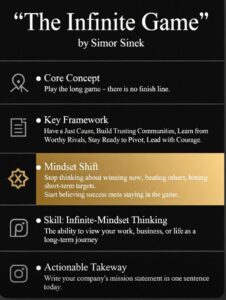
Chapter 1: Finite and Infinite Games
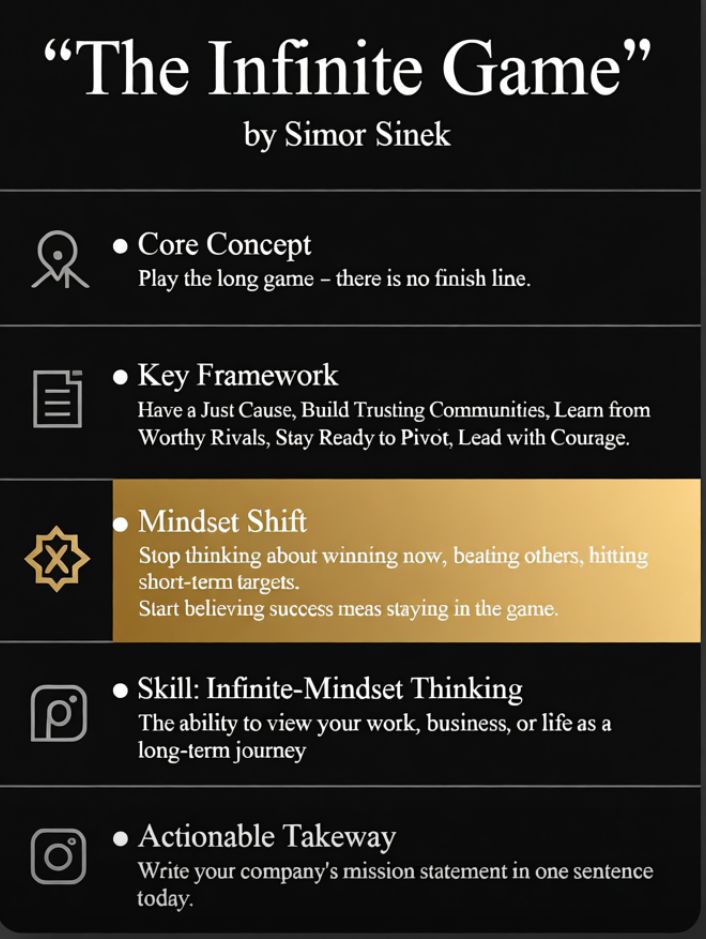
You know how we’re taught from a young age that life is about winning? Whether it’s getting the highest grade, landing the best job, or beating a competitor, we are conditioned to think there is a finish line. But in Chapter 1, Simon Sinek points out a massive flaw in that logic. He argues that most of the things we care about, such as our careers, our businesses, and even our relationships, don’t actually have an end date.
He calls this the difference between finite and infinite games. Understanding this is like putting on a new pair of glasses; suddenly, you realize you’ve been trying to win at things that don’t even have a scoreboard.
The Two Types of Games
First, let’s look at finite games. These are easy to spot. Think of a soccer match or a game of chess. The players are known. The rules are fixed. There is a clear beginning and a definitive end. Everyone agrees on what it takes to win. Because there is a clock, you can make short-term sacrifices to get that victory.
You might play through an injury or use a risky strategy because, once the whistle blows, the game is over.
Then there are infinite games. These are different. The players come and go. The rules are changeable. There is no finish line. In an infinite game, the goal isn’t to win; it’s to keep playing. You can’t win at marriage. You can’t win at being a parent. You certainly can’t win at business. You can only stay ahead for a while, or you can drop out when you run out of the will or the resources to keep going.
The Common Mistake: Mixing Them Up
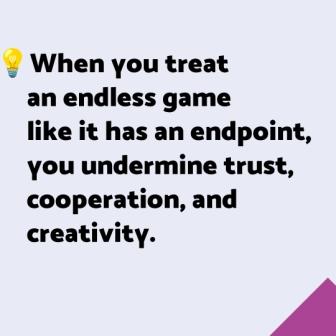
Here is where things get messy. Sinek explains that problems arise when you try to play an infinite game with a finite mindset. Imagine showing up to a professional football game and trying to build a relationship with the opposing team instead of scoring points. You’d lose. Now imagine the opposite: showing up to your marriage and trying to win every argument so you can be the champion. You might win the argument, but you’ll probably end up divorced.
In business, this happens constantly. Leaders obsess over quarterly earnings or beating a rival. They treat the business like it’s a game with a final buzzer. But business doesn’t end. If you focus only on the short-term win, you start making decisions that hurt the long-term health of the organization, like cutting corners on quality or burning out your best people just to hit a number.
A Tale of Two Tech Giants
Sinek shares a great story about Microsoft and Apple that really hammers this home. Years ago, he spoke at an education summit for Microsoft and then at one for Apple.
At the Microsoft event, most of the executives spent their stage time talking about how they were going to beat Apple. They were focused on the competition. At the Apple event, the executives spent their time talking about how they wanted to help teachers teach and help students learn. One was playing to beat a rival; the other was playing to advance a purpose.
Later, Sinek was in a taxi with a high-ranking Microsoft executive and mentioned that Apple’s new iPod was much better than Microsoft’s Zune. The executive looked at him and said, I know.
That’s the difference. Microsoft was obsessed with the product and the win. Apple was obsessed with why they were doing it in the first place. When you have an infinite mindset, you realize that your competition isn’t someone to be destroyed. They are someone to help you improve. If they have a better product, it’s not a defeat; it’s a prompt for you to get better so you can stay in the game longer.
Wait, Let’s Pause for a Reality Check
I want to challenge a common assumption here. You might be thinking, That sounds nice, but I have bills to pay. If I don’t win this contract, I’m in trouble.
This is where people get stuck. They think being infinite means you don’t care about the numbers. That’s a mistake. You still need to hit your targets and make a profit. Profit is like fuel for a car. In a finite mindset, the goal of the trip is to get more fuel. In an infinite mindset, the goal is to go somewhere, and you need fuel to get there. Don’t confuse the fuel with the destination. If you only focus on the fuel, you’ll eventually realize you’re just sitting in a gas station going nowhere.
How to Actually Use This
So, how do you apply this to your life today? It starts with changing your vocabulary and your focus.
- Stop trying to be the best. In an infinite game, the best is a temporary status based on arbitrary metrics. Instead, strive to be better than you were yesterday. This shifts the focus from external competition to internal growth.
- Check your metrics. Are you measuring things that only matter for the next thirty days? Or are you looking at things like trust, morale, and innovation? Those are the things that keep you in the game for the long haul.
- Look at your rivals differently. Stop hating your competitors. If someone in your field is doing something great, study them. Use their success as a mirror to find your own weaknesses. Their existence forces you to be better.
My Take on the Practicality
I’ll be honest with you: this is hard to do. We live in a world designed for finite games. Wall Street wants quarterly results. Social media wants instant likes. Your boss might want a win this week.
The hardest part of Chapter 1 to apply is the courage to be patient. It takes a lot of guts to pass up a short-term gain because it doesn’t align with your long-term values. But the benefit is huge. People who play the infinite game build more trust, more loyalty, and more innovation.
They don’t just survive; they thrive because they aren’t panicked by every little setback. They know the game is long, and they are playing for the right reasons.
Chapter 2: Just Cause
Chapter 1 is about recognizing the game you are in, Chapter 2 is about finding your reason for playing. Sinek introduces the concept of a Just Cause. This isn’t just a goal or a mission statement; it is a specific vision of a future state that does not yet exist. It is a cause so compelling that people are willing to make sacrifices to help advance it.
Most of us confuse a Just Cause with a “Why,” but Sinek makes a distinction. Your Why comes from the past, it is who you are and where you come from. A Just Cause is about the future, it is where you are going. It gives your life and your work a sense of direction that persists even when the world changes around you.
The Five Standards of a Just Cause
Sinek is very opinionated about what counts as a Just Cause. He argues that for a vision to be truly infinite, it must meet five specific criteria. If it’s missing one, it’s likely just a finite goal in disguise.
- For Something: It must be affirmative and optimistic. It shouldn’t be about being “anti-poverty” or “against” a competitor. It should be for a world where everyone has the tools to thrive.
- Inclusive: It must be an open invitation to others to join you. It’s not just about you or your company; it’s about inviting anyone who believes what you believe to contribute.
- Service-Oriented: The primary benefit of the cause must go to people other than the contributors. If the main goal is to make the founders rich, it’s not a Just Cause; it’s a business plan.
- Resilient: It must be able to withstand political, technological, and cultural shifts. A Just Cause is bigger than the product you sell.
- Idealistic: It must be big, bold, and ultimately unachievable. You don’t “finish” a Just Cause. You spend your life advancing toward it.
The Case of the Declaration of Independence
Sinek uses the American Declaration of Independence as a classic example of a Just Cause. The founders wrote that all men are created equal and endowed with certain unalienable rights. When they wrote those words, they weren’t true in practice, slavery existed, and women couldn’t vote.
But the statement provided a North Star. It gave the nation a direction. Over centuries, the U.S. has moved closer to that ideal through the abolition of slavery, the civil rights movement, and women’s suffrage. The cause is never “won,” but the progress toward it is what gives the country its resilience and meaning. In your own life, you need a version of this, a statement that remains true and worth fighting for even when you hit a wall.
Let’s Pause for a Reality Check
I see people make a huge mistake here: they think their Just Cause is to be the best or to be the biggest. I have to tell you, being number one is not a Just Cause. That is a finite goal. If your goal is to be the biggest coffee shop in the city, what happens once you achieve it? You lose your direction. You start playing defense to protect your status instead of playing offense to change the world. A real Just Cause ensures that even if you are the biggest, you still feel like you have work to do.
Service is the Secret Sauce
The part of this chapter that most people struggle with is the service-oriented requirement. In a world that tells you to get yours, Sinek argues that the most successful infinite players are those who put others first.
Think about a leader who says their goal is to maximize shareholder value. That’s not a Just Cause; it’s a calculation. It doesn’t inspire an employee to give their best at 4:00 PM on a Friday.
But if that same leader says their cause is to ensure every person has access to clean energy, that inspires sacrifice. People don’t give their blood, sweat, and tears for a stock price; they give it for a human being or a better future.
How to Actually Use This
Finding your Just Cause isn’t something you do in a ten-minute brainstorming session. It takes deep reflection.
- Look at your frustrations. Often, a Just Cause is born out of seeing something in the world that is unjust or broken and wanting to fix it.
- Write it down. Try to draft a single sentence that describes the world you want to live in. Make sure it’s optimistic. Instead of saying I want to stop bullying, say I want to build a world where every child feels safe and valued.
- Test your decisions against it. Next time you have a tough choice, ask: Which option advances my cause? If an opportunity makes you a lot of money but moves you away from your vision, an infinite mindset tells you to walk away.
My Take on the Practicality
This is the most high-level part of the book, and it can feel a bit airy-fairy if you aren’t careful. The hardest part to apply is staying idealistic when things are going wrong. It is very easy to abandon your Just Cause when you are losing money or your rival is winning.
However, this is actually the most practical tool in the book for preventing burnout. People don’t burn out because they work too hard; they burn out because they lose sight of why the work matters. Having a Just Cause gives you a “why” that is big enough to carry you through the how when things get ugly. It turns your job into a career and your career into a calling.
Chapter 3: Cause, No Cause
This chapter is a bit of a reality check. Sinek looks at what happens when a vision is weak, selfish, or missing entirely. He argues that most organizations today think they have a cause, but they actually just have a set of finite goals or a collection of platitudes that don’t drive real behaviour.
The core of this chapter is the distinction between having a true cause and simply having a purpose sounding mission statement.
Sinek is quite critical here, suggesting that if your cause is too vague or too self-serving, it won’t provide the resilience needed to survive the ups and downs of the infinite game.
The Trap of Corporate Speak
We have all seen those mission statements in office lobbies. They usually say something like, we aim to be the most respected provider of innovative solutions in our industry. Sinek hates these. Why? Because they are completely meaningless.
They fail the Just Cause test because they aren’t for something specific, and they aren’t service-oriented. Being the most respected is a finite goal, it’s about how others perceive you, not about a future vision you are trying to build. When a cause is that thin, people don’t feel inspired. They just show up for the paycheck, and as soon as a better offer comes along, they leave. A real cause should feel like an invitation to join a movement, not just a description of a business model.
The Moonshot vs. The Just Cause
Sinek makes an interesting distinction between a moonshot, a massive, one-time goal, and a Just Cause. President John F. Kennedy’s goal to put a man on the moon by the end of the 1960s was a moonshot. It was incredible, and it galvanized a nation.
But the problem with a moonshot is that it is finite. Once the man landed on the moon and came back safely, the game was over. NASA struggled for decades afterward to find its footing because it had reached the finish line. A Just Cause, by contrast, is like the quest for scientific discovery. It never ends. The moonshot is just a marker on the path. If you only have a moonshot, you risk a massive letdown once you achieve it.
Loot at this
I want to point out a mistake many people make when trying to find their cause. They think that because they are passionate about their work, they have a Just Cause. Passion is not a cause. Passion is the energy you bring to a cause. You can be passionate about making money, or passionate about being famous, but those are finite pursuits.
If your passion is only directed at your own success, you’ll find that it’s very hard to get others to help you when things get tough. A Just Cause is what directs your passion toward something bigger than yourself so that when your energy flags, the community you’ve built can carry you forward.
The “Cause” of Growth
Sinek takes a swing at one of the most common justifications in modern business: growth. Many leaders say their cause is to grow the company by 20 percent every year.
In the infinite mindset, growth is a variable, not a cause. It is a result of doing something well. When growth becomes the primary focus, the organization starts to prioritize the short term over the long term. They might fire people to hit a growth target or compromise on quality. Sinek’s point is that you don’t grow for the sake of growing; you grow so that you have more resources to advance your cause. If you lose the cause, the growth is eventually going to stall because you’ve stopped providing the value that made you grow in the first place.
How to Actually Use This
To apply Chapter 3, you need to be brutally honest about the words you use to describe your work or your life.
- Audit your mission. Look at your personal or professional mission statement. Does it sound like corporate jargon? If you replaced your name with a competitor’s name, would it still “work”? If so, it’s not specific enough.
- Look for the who. If your goals are all about I or my company, you are missing the service component. Rephrase your goals to focus on the people you serve and how their lives will be better because of your work.
- Distinguish goals from cause. List your big objectives for the year. Those are your moonshots. Now, ask yourself: What happens after I hit them? If the answer is “I don’t know,” you need to find a Just Cause that spans beyond those milestones.
My Take on the Practicality
This chapter is actually very grounding. It reminds you that meaning is a survival strategy. In the real world, we get distracted by shiny objects, a promotion, a big sale, a new car. These are fine, but they don’t sustain us.
The most practical part of this is the idea that a clear cause makes decision-making incredibly simple. When you know exactly what you are for, you don’t have to debate every little choice. You just ask, does this help us build the world we envisioned?
If the answer is no, you don’t do it. It saves a massive amount of time and mental energy that most people waste on trying to decide what winning looks like in the moment.
Chapter 4: Keeper of the Cause
In this chapter, Sinek moves from the what of a Just Cause to the who. He introduces a specific role he calls the Keeper of the Cause. In the business world, we usually call this person the CEO, but Sinek argues that the title Chief Executive Officer is actually a finite title. It suggests that the person’s main job is to execute plans and manage the machine.
In an infinite game, the top leader’s primary responsibility is not the results of the company; it is the protection and communication of the Just Cause. This chapter is about why every organization, and every team, needs a visionary at the top who is focused on the horizon, not just the ground right in front of them.
The CVO: Chief Visionary Officer
Sinek suggests a thought experiment: rename the CEO to the CVO (Chief Visionary Officer). When you change the name, the job description changes. A CEO is often buried in spreadsheets, quarterly projections, and operational efficiency. But a CVO has a different mandate. Their job is to look out into the future and ensure that every decision the company makes is moving them closer to their Just Cause.
They are the ones who remind the team why they are working so hard when the numbers are down. They are the ones who say no to a profitable deal because it would violate the organization’s soul. Without a dedicated Keeper of the Cause, the pressure of the finite game (the need for immediate profit) will almost always win out over the long-term vision.
The Partnership: Visionary and Operator
Here is a step-by-step breakdown of how this actually works in a healthy organization. Sinek points out that most great companies were started by a partnership of two people. One is the visionary (the Keeper of the Cause) and the other is the operator (the one who makes the vision a reality).
Think of Walt and Roy Disney. Walt was the dreamer who envisioned theme parks and animated features that would change the world. Roy was the brilliant businessman who figured out how to finance those dreams and build the company.
If you only have Walt, you have a dreamer with no business. If you only have Roy, you have a business with no soul. The Keeper of the Cause needs an operator to build the infrastructure for the vision, but the operator must always be in service to the cause.
Let’s pause a little
I want to highlight a mistake that happens when companies grow: they start promoting the best operators to the role of Keeper of the Cause. You see this all the time. A brilliant CFO or COO is promoted to CEO.
The problem is that the skills required to be a great operator (attention to detail, efficiency, cost-cutting) are often the opposite of the skills required to be a great visionary (imagination, empathy, long-term thinking). Just because someone is amazing at running the machine doesn’t mean they are the right person to decide where the machine should go. When you put a finite-minded operator in the CVO seat, the company usually loses its way and starts focusing entirely on the numbers.
The Responsibility of Communication
Sinek emphasizes that the Keeper of the Cause must be a Chief Storyteller. The Just Cause only exists in the imagination of the people. It isn’t a physical thing. Therefore, the leader must constantly talk about it.
If the leader stops talking about the cause, the vacuum is immediately filled by the only other thing people can see: the numbers. In the absence of a clear, communicated vision, employees will default to finite metrics like their bonus or their sales targets.
The Keeper of the Cause must keep the vision so present and so vivid that the team feels they are part of something much bigger than a daily grind.
How to Actually Use This
You don’t have to be a CEO to apply this. You can be the Keeper of the Cause for your family, your small team, or even just for your own life.
- Identify your partner. If you are a big-picture dreamer, find someone who is great at the details and share your vision with them. If you are a practical doer, find a visionary whose cause you believe in and help them build it.
- Check your calendar. If you claim to be the leader of a cause, how much of your time is spent on long-term thinking and people versus spreadsheets and emails? If you are 100 percent operational, the cause is at risk.
- Practice the narrative. Can you explain your Just Cause in a way that makes someone else want to join you? If not, keep refining the story. A cause that cannot be communicated is a cause that will die with you.
My Take on the Practicality
The idea of a Keeper of the Cause is vital because it addresses why so many successful companies eventually become boring or even unethical. They lose their “Walt” and become run by a “Roy” who only cares about the balance sheet.
The most practical takeaway here is the power of roles. You need to know which role you are playing. If you try to be both the visionary and the operator at the same time, you will likely burn out or make poor decisions. Embracing the idea that you need a partner, or at least a distinct time in your week dedicated to being the Keeper, is what allows you to maintain your momentum over years instead of just months.
Chapter 5: The Responsibility of Business
Here, Sinek takes on a controversial and widely accepted idea: that the primary purpose of a company is to make money for its shareholders. He traces this mindset back to the economist Milton Friedman, who in 1970 argued that the only social responsibility of business is to increase its profits. Sinek argues that this single idea has done more to damage our organizations, our economy, and our sense of trust than perhaps anything else in the last fifty years.
He advocates for a revised definition of the responsibility of business. In an infinite game, profit is not the purpose of the business; it is the byproduct of pursuing a Just Cause and taking care of the people who help you get there.
The Shift from Stakeholders to Shareholders
Sinek explains that for most of human history, businesses existed to serve a community, provide a product, and take care of employees. But after the 1970s, the focus shifted almost exclusively to shareholder primacy. This created a world where leaders feel pressured to prioritize short-term stock prices over the long-term health of the company.
When you prioritize shareholders above all else, you start treating employees like costs to be managed rather than human beings to be led. This leads to mass layoffs just to meet quarterly projections, even when the company is profitable. Sinek points out that this is a finite move. It might make the numbers look good for a month, but it destroys the trust and safety required for an organization to innovate and survive in the long run.
The Triple Bottom Line
So, what should the responsibility of business be? Sinek proposes that an infinite-minded leader must balance three things simultaneously. If you ignore any of these, the game eventually ends for you.
- Advance a Just Cause: The business must exist to serve a purpose that is bigger than itself.
- Protect People: This includes your employees, your customers, and the community you operate in. You must treat them as ends in themselves, not as means to an end.
- Generate Profit: You still need to make money. Profit is the fuel that allows you to keep advancing the cause and protecting the people.
Sinek argues that the order matters. If you put profit first, you will eventually sacrifice your people and your cause. But if you put your cause and your people first, profit usually follows because you’ve built a loyal workforce and a customer base that believes in what you do.
Wait, Let’s Pause for a Reality Check
Here is where many people get skeptical. You might think, This sounds like a charity, not a business. If I don’t put shareholders first, they’ll fire me and find someone who will.
This is a common mistake. Being infinite-minded doesn’t mean you ignore your shareholders; it means you recognize that shareholders are not the only stakeholders. It takes massive courage to tell an investor, I am making a decision that will lower our profits this quarter but will make us a much stronger company three years from now.
Most leaders take the easy way out because they are afraid. But the irony is that companies that focus on their people and their cause like Costco or Patagonia often end up giving their shareholders better returns over time than the ones chasing short-term gains.
The Example of CVS Health
Sinek uses the example of CVS Caremark (now CVS Health) to show this in action. In 2014, CVS decided to stop selling cigarettes. From a finite perspective, this was a terrible idea. It meant walking away from 2 billion dollars in annual revenue. Their stock price even took a hit initially.
However, CVS realized they couldn’t claim their Just Cause was helping people on their path to better health while simultaneously selling a product that causes cancer. They chose their integrity over their income. Because they had a Just Cause, they were able to weather the short-term loss. Eventually, they rebranded, attracted more health-conscious partners, and their business became more resilient than ever. They played the infinite game, while their rivals remained stuck in the finite game of selling whatever makes a buck today.
How to Use This
You can apply this principle regardless of your rank. It’s about how you value the people around you compared to the results they produce.
- Stop calling people your greatest asset. Assets are things you own and can sell off. People are human beings. Start treating them like partners in your cause.
- Look at your incentives. Do you reward people only for the “what” (the numbers) or also for the “how” (how they treated others and stayed true to the cause)? If you only reward the results, you are incentivizing finite behavior.
- Prioritize the long term in your pitches. When you are asking for investment or approval for a project, frame it in terms of long-term value. Explain how this move protects the organization’s health, even if it’s more expensive right now.
My Take on the Practicality
This is probably the hardest chapter to stomach if you work in a traditional corporate environment. The pressure to hit the number is intense. But the most practical insight here is that trust is a competitive advantage.
In a finite company where people fear they might be laid off to save a cent, they hide mistakes, they stop sharing ideas, and they look out for themselves. In an infinite company where they know the leader has their back, they take risks and collaborate. That culture of safety is what actually generates the profit in the long run. If you want to be a leader people want to work for, you have to be the one who stands up and says the responsibility of our team is more than just the output, it’s the people doing the work.
Chapter 6: Will and Resources
Sinek in this Chapter dives into the two essential currencies required to play any game: Will and Resources. If you want to stay in the infinite game, you have to understand where these come from and, more importantly, which one is more valuable when things get tough.
Most leaders treat these two things as if they are the same, but they couldn’t be more different. Resources are tangible; Will is intangible. In this chapter, Sinek argues that the greatest failure of modern leadership is the tendency to prioritize Resources over Will, a mistake that eventually leads to the collapse of even the wealthiest organizations.
The Two Currencies
Let’s break these down. Resources are the things you can count. This includes money, headcount, office space, and technology. Resources come from the outside, usually from investors or customers. Because they are finite, you can run out of them.
Will, on the other hand, is the desire to keep playing. It is the morale, the motivation, and the commitment of the people in the organization. Will comes from the inside. You cannot buy Will; you can only earn it by leading people toward a Just Cause and creating a culture of trust. While Resources are necessary to stay in the game, it is Will that determines how long you can last when the Resources disappear.
The Lesson of the Vietnam War
Sinek returns to the example of the Vietnam War to illustrate this point. The United States had almost infinite resources. They had more money, better technology, and a vastly superior military. By every finite metric, the U.S. was winning. They won nearly every major battle and killed many more of the enemy than they lost themselves.
But the North Vietnamese were playing an infinite game. Their goal wasn’t to “win” a set of battles; it was to stay in the fight until the U.S. lost the will to keep playing. Eventually, the U.S. ran out of Will. The American public stopped supporting the war, and the government could no longer justify the cost. The U.S. didn’t lose the war because they were beaten on the battlefield; they lost because they ran out of Will, while their opponent’s Will was inexhaustible.
Reality Check
I want to challenge how you think about your own “fuel.” You might think that if you just make enough money (Resources), your team will be happy and motivated (Will). This is a massive mistake.
Money can buy compliance, but it cannot buy will. You can pay someone to show up at 9:00 AM and do their job, but you cannot pay them to care, to innovate, or to give you their best ideas when no one is looking. If your team is only there for the paycheck, you don’t have Will; you have a transaction.
The moment a competitor offers them more Resources, they are gone. True Will is what keeps people working hard even when the company is struggling and there are no bonuses in sight.
The Imbalance in Modern Business
Sinek points out that we have thousands of ways to measure Resources. We have balance sheets, P&L statements, and EBITDA. But we have no standard way to measure Will. Because we can’t measure it easily, we tend to ignore it.
When a company hits a rough patch, the first thing they usually do is cut the things that build Will, like training, travel for team-building, or even the people themselves, to protect their Resources. This is a downward spiral. By sacrificing Will to save Resources, you are weakening the very thing you need to generate more Resources in the future. An infinite leader understands that when times are tough, you should lean on your people’s Will to help you find more Resources, not the other way around.
How to Use This
You can start balancing these two currencies by changing where you look for solutions to your problems.
- Don’t just throw money at problems. If a team is underperforming, your first instinct might be to offer a bonus or buy a new software. Instead, check the Will. Are they burnt out? Do they still believe in the cause? Address the spirit before you spend the cash.
- Invest in the intangible. Spend time building relationships and trust. These don’t show up on a spreadsheet, but they are the reserve tank of Will you’ll need when the market crashes or a project fails.
- Watch your language. When you talk to your team, do you only talk about targets and budgets (Resources)? Or do you talk about the impact of their work (Will)? The more you focus on the “why,” the more Will you build.
My Take on the Practicality
This is the chapter that separates the managers from the leaders. Managing Resources is relatively easy, it’s math. Building Will is incredibly difficult, it’s psychology and heart.
The most practical takeaway is that Will is the ultimate competitive advantage. A team with high Will and low Resources will eventually find a way to get what they need. They will be scrappy, they will innovate, and they will persevere. But a team with high Resources and low Will is just waiting to be disrupted by someone who cares more than they do. In your own life, don’t just focus on your bank account; focus on the fire in your belly and the trust of the people around you. That’s what keeps you in the game.
Chapter 7: Trusting Teams
In this Chapter , Sinek focuses on the foundation of any infinite organization: Trusting Teams. He argues that you cannot have an infinite mindset without a culture of trust. While most companies focus on individual performance, infinite-minded leaders focus on the relationships between the people.
Trust is not something you can demand or include in a job description. It is a biological human need. When we feel safe among our colleagues, we are more likely to admit mistakes, share information, and ask for help. When trust is missing, we spend our time and energy protecting ourselves from each other, which leaves the organization vulnerable to the outside world.
Performance vs. Trust
Sinek introduces a fascinating way to look at employees by comparing Performance and Trust. He learned this from the Navy SEALs, one of the most elite teams on the planet.
- Performance: This is about technical skill. How good are you at your job? How many sales did you make? How fast can you run the drill?
- Trust: This is about character. What kind of person are you? Do you have my back? How do you behave when no one is looking?
The Navy SEALs have a saying: I may trust you with my life, but do I trust you with my money or my wife? They found that a high-performer with low trust is actually a toxic leader and a toxic team member. In fact, they would rather have a medium-performer with high trust than a high-performer with low trust. Most businesses, however, have a thousand metrics to measure performance and zero metrics to measure trust. As a result, they accidentally promote the very people who destroy the culture.
The Circle of Safety
Sinek explains that when we work in a high-trust environment, we belong to what he calls a Circle of Safety. When the leaders make us feel safe, our natural response is to offer our best work and our loyalty.
In a toxic culture, the circle is broken. People feel they have to hide their weaknesses because admitting a mistake might get them fired or passed over for a promotion. This is incredibly dangerous. If an employee sees a problem but is too afraid to speak up, the problem grows until it becomes a catastrophe. In a Trusting Team, speaking up is seen as an act of service to the cause, not a risk to your career.
Let’s Pause for a Reality Check
Here is a mistake people often make: they think building trust is about being nice or avoiding conflict. Trust is not about being nice. It is about being honest.
In a high-trust team, you can have a heated, difficult argument about a project because you know that everyone involved cares about the Just Cause more than their own ego. You don’t have to worry about political blowback or hurt feelings. If you find yourself holding back your true thoughts because you’re afraid of how your team will react, you don’t have a trust problem; you have a safety problem. True trust allows for radical candor.
The Impact of the Toxic High-Performer
Sinek is very opinionated about the damage done by the high-performer with low trust. These are the people who hit their numbers every month but leave a trail of broken spirits behind them.
If you keep a toxic high-performer on your team just because they make you money, you are telling everyone else that the numbers matter more than the people. This instantly kills the Will of the rest of the team. They will stop collaborating and start competing with each other. Over time, the cost of the toxicity will far outweigh the profit that one person brings in. An infinite leader has the courage to remove the toxic high-performer to protect the health of the team.
How to Actually Use This
Building a Trusting Team starts with the leader going first. Trust is a risk, and someone has to take it first.
- Lead with vulnerability. If you are the boss, start by admitting a mistake or asking for help with something you don’t understand. This gives your team permission to do the same.
- Change your evaluation criteria. Stop only looking at the sales board. Ask around: Who is the person on the team that everyone goes to for help? Who is the person that makes others feel better? Those are your high-trust players. Reward them.
- Stop the blame game. When something goes wrong, don’t ask Who did this? Ask What happened and how can we fix it? Shifting the focus from blame to solution keeps the Circle of Safety intact.
My Take on the Practicality
This is arguably the most important chapter for day-to-day operations. You can have the best strategy in the world, but if your team doesn’t trust each other, they will fail under pressure.
The most practical takeaway is that trust is a result, not an action. You can’t just tell people to trust each other. You have to create the conditions where trust can grow. It takes a long time to build and a second to break. If you want to play the infinite game, you have to realize that taking care of your people isn’t a distraction from the work, it is the work. A team that trusts each other is the only thing that can truly navigate the uncertainties of an infinite future.
Chapter 8: Ethical Fading
This chapter introduces a concept that is as subtle as it is dangerous: Ethical Fading. This is what happens when the culture of an organization shifts so far toward finite goals that people lose the ability to see the ethical implications of their decisions.
It is not usually about one “bad apple” decideing to be a criminal. Instead, it is a slow, systemic erosion where good people start making unethical choices because they believe they are just doing their jobs or hitting their targets. In an infinite game, ethical fading is a silent killer because it destroys the very trust we talked about in the last chapter.
The Slippery Slope of “Legal but Unethical”
Sinek explains that ethical fading often starts when we stop asking Is this right? and start asking Is this legal? or Is this within the rules?. When we rely solely on compliance departments and lawyers to tell us what we can do, we stop using our own moral compass.
In a finite-minded culture, the pressure to hit a quarterly number or a year-end bonus can become so intense that people begin to justify small shortcuts. They might massage the data, skip a safety check, or use high-pressure sales tactics that they know aren’t in the customer’s best interest. Because everyone else is doing it and the boss is rewarding it, the unethical becomes normal. People don’t feel like they are doing anything wrong; they feel like they are winning.
The Wells Fargo Scandal
Sinek uses the Wells Fargo cross-selling scandal as a textbook example of ethical fading. For years, Wells Fargo was the darling of the banking world. Their leaders set an incredibly aggressive goal: every customer should have eight different accounts with the bank. They called it “Gr-eight.”
The problem was that the goal was arbitrary and finite. To hit these impossible numbers, employees started opening millions of fake accounts without customers’ knowledge. When the scandal broke, the leadership blamed a few thousand “rogue” employees. But Sinek argues the employees weren’t the problem; the culture was the problem.
The pressure to hit the number was so high that the will to stay ethical faded away in favour of the resource of keeping their jobs.
Wait a second
I want to highlight a mistake many people make. They think that because they have a Code of Ethics or a set of Corporate Values on the wall, they are safe from ethical fading. Values are not what you write; they are what you reward.
If your company says they value honesty but you promote the person who used deceptive tactics to close a massive deal, you have just told everyone that honesty is optional. You cannot “policy” your way out of ethical fading.
You can only lead your way out of it by making sure that the Just Cause and the protection of people always come before the pursuit of the number.
The Role of Euphemisms
One of the most practical parts of this chapter is how Sinek points out the language we use to hide the truth. We use euphemisms to make unethical things sound professional.
- We don’t say we lied to a client; we say we managed expectations.
- We don’t say we fired people to make the stock price go up; we say we right-sized the organization.
- We don’t say we sold a product we knew was faulty; we say we met the shipping deadline.
This language is a tool for ethical fading. It allows us to distance ourselves from the human impact of our decisions. An infinite leader insists on plain language. They call things what they are so that the ethical weight of the decision remains visible to everyone.
How to Actually Use This
Preventing ethical fading requires constant vigilance. It is like weeding a garden; you are never done.
- Monitor the pressure. If you are a leader, look at the goals you set. Are they so aggressive that they force people to cheat to succeed? If the “cost of failure” is too high, people will choose unethical success every time.
- Listen for the euphemisms. Pay attention to how people describe “gray area” decisions. If the language sounds like it was written by a lawyer to avoid blame, stop the conversation and ask: Is this the right thing to do for our Just Cause?
- Celebrate the unprofitable right choice. When someone turns down a deal or misses a target because they refused to compromise their ethics, make them a hero. Showing that the cause matters more than the cash is the best way to reverse ethical fading.
My Take on the Practicality
This is a heavy chapter because it forces you to look at your own gray areas. We all like to think we are ethical, but we are all susceptible to groupthink and pressure.
The most practical takeaway is that ethics is a team sport. You need people around you who feel safe enough to pull your sleeve and say, Hey, I think we’re losing our way here.
If you have built a Trusting Team (from Chapter 7), they will save you from ethical fading.
If you haven’t, you are at the mercy of your own finite desires. In the infinite game, your reputation and your integrity are the only things that allow you to keep playing for the long term. Don’t trade them for a temporary “win.”
Chapter 9: Worthy Rival
In this chapter, Sinek flips the traditional concept of competition on its head. He introduces the idea of the Worthy Rival. In a finite mindset, we look at other players in our field as “competitors” to be beaten or “enemies” to be destroyed. But in the infinite game, other players are essential tools for our own growth.
A Worthy Rival is another player in the game worthy of comparison. Their existence reveals your weaknesses and pushes you to get better. This shift is vital because, in an infinite game, you don’t actually have to be the winner; you just have to be able to stay in the game. By reframing competitors as rivals, you stop obsessing over what they are doing and start focusing on how you can improve.
The Difference Between a Competitor and a Rival
Sinek explains that the word competitor implies a battle with a winner and a loser. If you view someone as a competitor, you are constantly reacting to their moves. If they launch a new feature, you launch a new feature. If they drop their price, you drop your price. You are trapped in a reactive loop.
A Worthy Rival is different. You don’t have to like them, and you don’t have to agree with them. But you must acknowledge that they are better than you at something.
Maybe they have a better product, a more loyal culture, or a clearer vision. Instead of being bitter or trying to undermine them, you use their success as a mirror. Their strength highlights your own area for improvement, which gives you a clear path for growth.
The Case of Sinek’s Own Rival
Sinek shares a personal story about a fellow author and speaker whom he used to despise. Every time this person had a bestseller or a big speaking gig, Sinek felt a surge of jealousy and insecurity. He viewed this man as a competitor who was taking his spot.
But when they were eventually asked to speak at the same event, Sinek had an epiphany. He realized the man was actually a Worthy Rival. The other author was much better at storytelling and technical structure than Sinek was. Once Sinek admitted this, the jealousy disappeared and was replaced by respect. He stopped trying to beat the other guy and started trying to learn from him. This is the power of the mindset shift: it turns toxic envy into productive motivation.
Let’s Pause
I want to highlight a mistake that can be quite painful. People often choose their rivals based on ego rather than growth. They pick someone they know they can beat just to feel good about themselves.
That is not a Worthy Rival. If you only look at people who are “below” you, you will become stagnant. To truly use this idea, you have to be humble enough to pick a rival who intimidates you. You need to find the person or company that makes you think, Wow, they are really good at that.
If it doesn’t sting a little bit to admit their strength, you haven’t picked a rival that will actually help you grow.
Cause Blindness
Sinek warns about a phenomenon he calls Cause Blindness. This happens when we become so obsessed with our own Just Cause, or so convinced of our own moral superiority, that we fail to see the strengths of our rivals.
This is especially common in politics and religion, but it happens in business too. We tell ourselves that our rivals are evil or cheating. When we do this, we stop learning.
We become arrogant and fragile. An infinite leader remains objective. They can disagree with a rival’s cause while still respecting their execution. By keeping your eyes open, you ensure that you don’t get blindsided by a rival who has found a better way to play the game.
How to Use This
You can start using the Worthy Rival concept to lower your stress and increase your focus immediately.
- Identify your rival. Who in your field makes you feel the most insecure? Don’t look away from that feeling. Lean into it. That person is your Worthy Rival.
- List their strengths. Write down exactly what they do better than you. Be specific. Do they have more discipline? Better design? More effective communication? Acknowledge it.
- Stop the comparison trap. Whenever you see them succeed, stop asking,
Why not me?
and start asking, What can I learn from this to advance my own cause?
This shifts your energy from the external battle to your internal progress.
My Take on the Practicality
This is one of the most liberating chapters in the book. It takes a massive weight off your shoulders. When you stop trying to “win” against everyone else, the world stops being a battlefield and starts being a classroom.
The most practical takeaway is that you are only ever truly in competition with yourself. Your rivals are just there to show you what is possible. In the real world, this prevents burnout because you aren’t constantly looking over your shoulder. You are looking at the horizon, and you are using everyone else in the field to help you get there faster and more effectively.
Chapter 10: Existential Flexibility
In Chapter 10, Sinek introduces the fourth practice of the infinite mindset: Existential Flexibility. This is the capacity for a leader to initiate an extreme, offensive disruption to their own business model or strategic course in order to more effectively advance their Just Cause.
While most companies try to protect what they have already built, an infinite-minded leader is willing to blow it all up if they find a better way to achieve their long-term vision.
Existential Flexibility is not a defensive reaction to a crisis; it is an offensive move made from a position of strength.
The Apple vs. Xerox Example
Sinek uses one of the most famous stories in tech history to illustrate this. In 1979, Steve Jobs and several Apple engineers visited Xerox PARC. Xerox had developed the first Graphical User Interface (GUI), the windows and mouse system we all use today. At the time, Apple was already a success with the Apple II, which relied on text commands.
When Jobs saw the GUI, he immediately realized it was the future. It aligned perfectly with Apple’s Just Cause of empowering individuals through technology. He decided to completely pivot the company’s strategy to build a computer centered around this new technology, even though it meant cannibalizing their current successful products. That flex eventually became the Macintosh, which changed the world.
Walt Disney’s Massive Gamble
Another powerful example is Walt Disney. By the early 1950s, Disney’s movie studio was incredibly successful. However, Walt realized that movies were a finite medium, once they were released, he couldn’t keep growing them. He envisioned a place where families could immerse themselves in his stories: Disneyland.
To fund this, he had to be existentially flexible. He liquidated his assets, borrowed against his life insurance, and even licensed his own name to start a new company called WED Enterprises. He was willing to risk his entire movie empire to pursue a better way to advance his Cause of bringing joy to people. This wasn’t a pivot to save a failing business; it was a leap to a bigger one.
The Danger of Finite Rigidity: Kodak
Sinek contrasts these successes with the story of Kodak. Ironically, a Kodak engineer actually invented the digital camera in 1975. However, Kodak’s leadership was so focused on the finite game of selling film, their primary source of profit, that they suppressed the technology.
They chose to protect their current resources rather than follow their will to innovate. Because they lacked Existential Flexibility, they stood still while the world moved toward digital. A company that once dominated the world of photography eventually filed for bankruptcy because they were too afraid to disrupt themselves.
Wait, Let’s Pause for a Reality Check
It is important to distinguish an Existential Flex from a desperate pivot. Many companies change their strategy because they are losing money or being forced by the market. That is not flexibility; that is survival.
An Existential Flex happens when you are already doing well, but you see a new path that is even more true to your Just Cause. It requires massive courage because you are often abandoning a sure thing for an unknown future. If you only change when you have to, you aren’t leading; you’re reacting.
How to Actually Use This
Existential Flexibility is about keeping your eyes on the horizon so you don’t get trapped by your own success.
- Stay tethered to the Why. If you define yourself by what you do (e.g., We sell film), you will fail when that what becomes obsolete. If you define yourself by your Just Cause, you can change your what as often as necessary.
- Listen to the dreamers. Every organization has people who see the next big thing. In a finite culture, they are ignored as distractions. In an infinite culture, they are the source of the next Flex.
- Be willing to cannibalize yourself. If you don’t disrupt your own successful business model, someone else will. An infinite leader would rather be the one to end their current success in order to start something better.
My Take on the Practicality
This is the most high-stakes chapter in the book. Most of us are taught to if it ain’t broke, don’t fix it. Sinek argues that if it’s not advancing the Cause as effectively as it could, it is broke.
The most practical takeaway is that longevity requires transformation. You cannot stay the same and survive forever in an ever-changing world. Whether you are a solo entrepreneur or leading a massive team, you must always be asking: “If we were starting today, with what we know now, would we build it this way?” If the answer is no, you might be due for an Existential Flex.
Chapyer 11: Courage to Lead
In Chapter 11, Sinek brings the entire framework together by discussing the Courage to Lead. This is not the kind of courage required for a one-time heroic act. It is the sustained, daily grit required to stay true to an infinite mindset in a world that is obsessed with finite rewards.
Sinek argues that changing your mindset is not an intellectual exercise; it is an emotional and behavioral struggle. Most leaders know that trust and purpose are important, but they lack the courage to prioritize them when their own bonuses, reputations, or jobs are on the line. This chapter is about why the courage to lead is the prerequisite for everything else in the book.
The Pressure of the System
Sinek points out that we are all operating in a “finite-friendly” world. Incentives are set up to reward short-term thinking. Wall Street, board members, and even the way we calculate success are designed to focus on the next ninety days.
To lead with an infinite mindset, you have to be willing to defy the gravity of these systems. It takes courage to spend money on training during a recession. It takes courage to admit your Worthy Rival is better than you. It takes courage to blow up a profitable product because it no longer serves your Just Cause. Without this courage, the pressure to conform to finite norms will eventually crush even the best intentions.
The Source of Courage
One of the most profound points Sinek makes is that courage is not an internal resource we find deep inside ourselves. Courage is external. It comes from the support of others.
He compares it to a trapeze artist. The artist has the courage to fly through the air not because they are fearless, but because they know there is a net below them. In an organization, the “net” is the Trusting Team. When you know that your colleagues and your leaders have your back, you find the strength to take risks and stand up for your values. This is why you cannot lead alone. An infinite leader builds a community that provides the courage necessary to stay the course.
Wait, Let’s Pause for a Reality Check
I want to challenge a common mistake: the idea that courage means you aren’t afraid. Courage is acting in spite of fear, not the absence of it.
If you feel nervous about pitching a long-term strategy to a boss who only cares about this month, that’s normal. If you feel sick to your stomach about firing a toxic high-performer, that’s normal. The mistake is waiting for the fear to go away before you act. An infinite leader accepts the fear and does the right thing anyway because they are accountable to a Just Cause that is more important than their own comfort.
The Long-Term Legacy
Sinek concludes the book by reminding us that we don’t get to choose whether a game is finite or infinite. We only get to choose how we play.
If you play the finite game, you might get the “victory,” but you will leave behind a wake of burnout and distrust. If you play the infinite game, you may not always be “number one” on a spreadsheet, but you will build something that outlasts you. You will leave a legacy of people who are inspired to keep the journey going. The courage to lead is ultimately the courage to be forgotten in the short term so that your cause can be remembered forever.
How to Actually Use This
Applying Chapter 11 is about making a series of difficult “micro-decisions” every day.
- Find your “net.” Identify one or two people who share your values and your mindset. Agree to hold each other accountable. When you feel the pressure to make a finite move, call them first.
- Speak the truth to power. Practice small acts of courage by questioning finite decisions in meetings. Ask:
How does this move help us in five years?
or Are we sacrificing trust for this result?
- Choose fulfillment over victory. At the end of the day, don’t just ask if you won. Ask if you advanced the cause and if you treated people with dignity. If you did, that was a day well-played.
My Take on the Practicality
This is the hardest part of the book to live out. It is easy to talk about Just Causes and Trusting Teams in a workshop; it is brutal to defend them when your company is losing money.
The most practical takeaway is that courage is a muscle. You don’t start by defying a CEO; you start by being honest with a teammate. You start by admitting you don’t have the answer. Every time you choose the infinite path over the finite one, you get stronger. Eventually, you realize that the “victory” promised by the finite game is hollow, but the fulfilment of the infinite game is what makes the work worth doing.