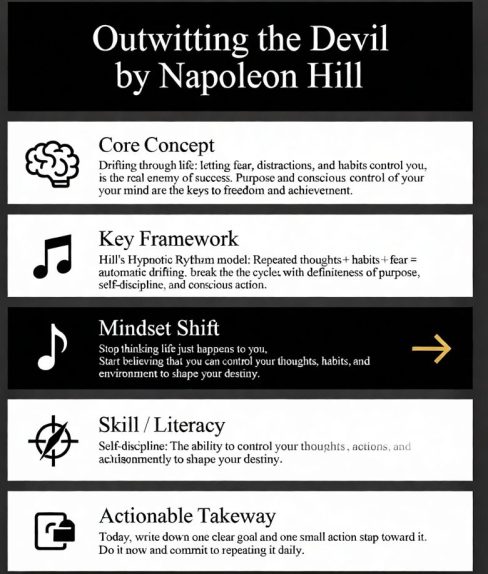

The book, Outwitting the Devil teaches that by taking control of your thoughts, defining a clear purpose, building self discipline, and learning from adversity, you can overcome fear, avoid drifting through life, and achieve lasting success.
Who should read Outwitting the Devil and why
1. Aspiring Entrepreneurs and Business Owners
Why:
The book teaches how to clarify purpose, overcome fear, and take decisive action, all critical for starting and growing a business. Lessons on self-discipline, habit formation, and using adversity as a stepping stone to help entrepreneurs avoid drifting and maintain momentum.
2. Students and Young Professionals
Why:
Many students and young professionals drift because they follow the crowd instead of defining their own goals. The book encourages definite purpose and conscious thought, helping them plan their careers and make smart decisions early.
3. People Struggling with Fear, Procrastination, or Lack of Focus
Why:
The book explains how fear, drifting, and negative habits give the Devil control. Readers learn practical ways to recognize fear, build discipline, and regain control over their lives.
4. Anyone Facing Challenges or Setbacks
Why:
Napoleon Hill in “Outwitting the Devil” emphasizes learning from adversity and turning failures into growth opportunities. Readers discover how obstacles can strengthen resilience, character, and skills instead of stopping progress.
5. Self-Improvement Enthusiasts
Why:
The book goes beyond conventional self-help advice; it dives deep into mindset, habits, environment, and strategic thinking. Ideal for readers who want to understand the root causes of drifting and personal limitations.
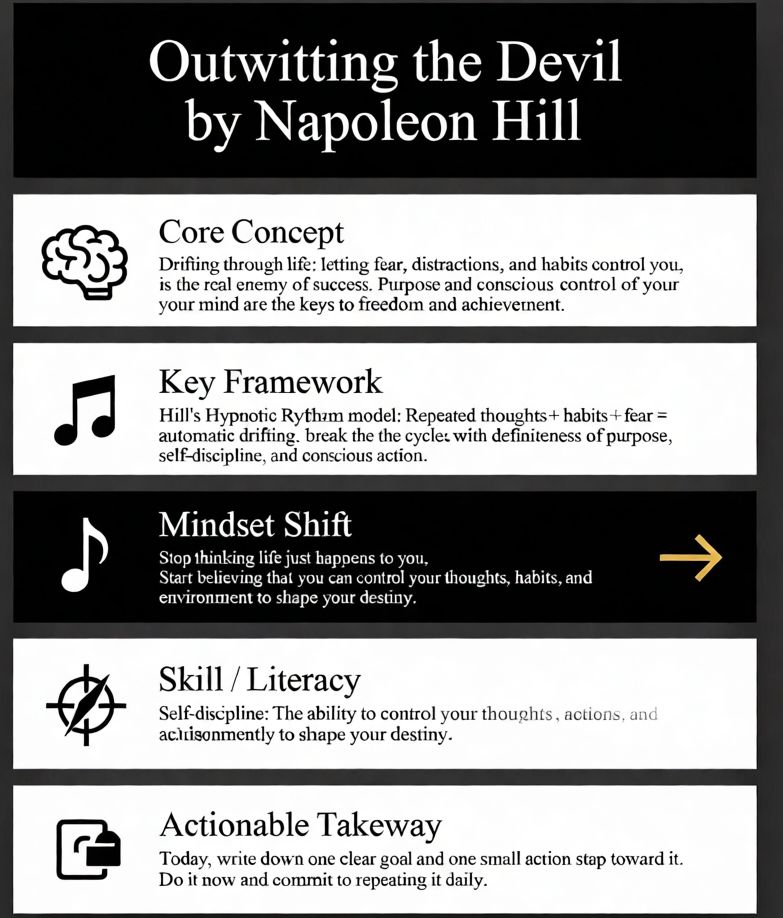
Chapter 1: My first Meeting with Andrew Carnegie: The 20-Year Dare
The story starts in 1908 when Hill, a young and ambitious journalist, met Andrew Carnegie, who was then the richest man in the world. Carnegie didn’t just give him a quote for a story. He gave him a mission that sounds absolutely insane by today’s standards: Carnegie challenged Hill to spend the next 20 years of his life interviewing the world’s most successful people to find a universal formula for success.
The catch was Carnegie wouldn’t pay him a single cent. He would only provide introductions to people like Thomas Edison and Henry Ford. Hill had to support himself while doing this research.
Why this matters for you: Most of us wait for a safe opportunity or a guaranteed paycheck before we commit to our big dreams. Carnegie was testing Hill’s courage and tenacity. In your own life, the Carnegie moments usually look like a choice between a comfortable, mediocre path and a difficult, uncertain path that actually leads to your potential.
The Discovery of the Other Self
Hill admits that while he accepted the challenge, he spent years struggling. He faced business failures, moved from job to job, and even fled for his life after a business associate was murdered. He was paralyzed by indecision and fear, the very things he was supposed to be teaching others to overcome.
In his lowest moment, hiding out and feeling like a fraud, he discovered what he calls the Other Self. This isn’t some mystical ghost. It’s a part of your mind that only wakes up when you are pushed to the absolute edge.
How it works in real life: Think of a time you were in a crisis and suddenly became incredibly calm and decisive. That’s your Other Self. Hill realized that most people never meet this version of themselves because they quit as soon as things get hard.
Wait, This Is Where Most People Get It Wrong
There is a common mistake people make here: they think meeting your Other Self means waiting for a sign or a feeling.
Hill’s experience shows the opposite. He didn’t find his Other Self while meditating in peace. He found it by walking around a school building hundreds of times, repeating to himself that there is a way out and he was going to find it, until his brain finally snapped into clarity. You don’t wait for inspiration; you force your mind to produce a solution through sheer persistence.
Practical Steps: How to Use Chapter 1 Today
Chapter 1 isn’t just a history lesson. It’s a blueprint for breaking out of a slump. If you’re feeling stuck, Hill’s experience suggests these moves:
- Stop the Indecision: Hill calls indecision the worst of all human ailments. If you have two choices, pick one. The wrong decision is almost always better than no decision, because action creates momentum.
- Look for the Seed: Hill insists that every failure contains the seed of an equivalent benefit. If you just lost a job or a relationship, don’t ask why this happened. Ask what is the seed of opportunity hidden in this mess.
- Act Like the Person You Want to Be: When Hill finally decided to go to Philadelphia to publish his work, he only had enough money for a few days. Instead of getting a cheap room, his Other Self told him to book a suite and tip the bellboy like a wealthy man.
A Reality Check
Now, I have to be honest: the book a suite when you’re broke advice is the hardest part to apply. It’s not about being reckless with money; it’s about breaking an inferiority complex. If you’re constantly acting like a burden or a failure, your brain stays in failure mode. Sometimes you have to change your environment or your behaviour to trick your mind into believing you are capable of winning again.
Hill’s big takeaway is simple: your only limitations are self-imposed. The Devil in this book is really just the collection of fears and doubts that keep you from using your full mind. Chapter 1 is about the moment you decide to stop listening to those doubts and start listening to the Other Self that knows exactly what to do.
Chapter 2: A new World is Revealed to Me: The Wall of Indecision
In Chapter 2, Napoleon Hill moves from the theory of success to the messy, painful reality of actually finding it. If the previous chapter was about the dare, Chapter 2 is about the mental breakdown that led to a breakthrough.
Hill begins the chapter in a state of total paralysis. He was a man who had spent years studying success, yet he was broke, hiding from danger, and living in a relative’s house feeling like a burden. He describes indecision as the worst of all human ailments.
You probably know this feeling. It is when you have all the book knowledge. You have read the blogs, seen the videos, and know what you should do, but you are too scared to move. Hill was facing his own mirror and seeing a charlatan who could not apply his own medicine.
The Night of the Thousand Repetitions
The turning point happened one night in 1927. Hill walked up to a public school building on a hill and decided he was not going back until he found a way out of his mental prison. He walked around that building hundreds of times.
He did something very practical that you can use: he used repetition to drown out fear. He repeated the phrase that there is a way out and he was going to find it, over and over until his brain finally shifted gears.
The Lesson: When you are in a spiral of doubt, you cannot just think your way out with logic. You have to use a physical or verbal anchor to force your mind back into focus.
The Faith Entity vs. The Fear Entity
This is where it gets interesting. Hill explains that two entities occupy your body:
- The Fear Entity: This one is motivated by lack and limitation. It had been driving Hill like a slave for over a year.
- The Faith Entity (The Other Self): This one knows no limitations and recognizes no such word as impossible.
Hill’s Other Self gave him a set of commands that felt completely different from his normal thoughts. They were distinct, forceful, and clear.
The Dangerous Strategy: Acting As If
The most famous part of this chapter is when Hill’s Other Self tells him to go to Philadelphia to find a publisher. Despite being nearly broke, he was ordered to book a luxury suite and act like a man of great wealth.
The goal was not to spend money he did not have for the sake of vanity. It was to break his inferiority complex. He had been treated like a burden for so long that he had started to believe he was one. By changing his environment to one of luxury, he forced his mind to align with the frequency of success.
The Power of the Master Mind
In this chapter, Hill also reflects on why he failed despite knowing the rules. He realized he had been a lone wolf. He knew the Master Mind principle, the idea that two or more minds working in harmony create a superior mind, but he had not used it.
He finally reached out to an old acquaintance, Albert L. Pelton, who agreed to publish his books before even reading the full manuscript. This happened because Hill finally had the definiteness of purpose to ask for exactly what he needed.
A Moment to Challenge Your Assumption
You might assume that Hill’s success came because he was lucky or because he met the right person at the right time. But look closer at the sequence: the publisher did not show up until after Hill spent hours walking in circles, after he committed his last dollar to a hotel suite, and after he decided that failure was just a signal to re-arm himself.
Most people think they need the opportunity first so they can feel confident. Hill shows us that you must generate the confidence first, and the opportunity is then drawn to that energy.
The Final Judgement
This chapter is a masterclass in mental discipline. The most practical takeaway for you is the idea that your Other Self only shows up in an emergency. If you are waiting for things to be easy before you take a big leap, you are actually keeping your greatest mental powers asleep.
You have to create the emergency by committing to a path where you have no choice but to succeed. As Hill’s Other Self told him: Your only limitation is the one which you set up in your own mind!
Chapter 3: A Strange Interview with the Devil
In this Chapter, the book takes a turn that was so controversial in 1938 that Hill’s family kept it locked in a vault for over seventy years. Hill claims to have captured the Devil himself and forced him to confess his secrets in a Strange Interview.
If you are a practical person, do not get hung up on whether this is a literal demon or just a clever metaphor for the negative parts of the human mind. What matters are the psychological mechanics the Devil reveals.
The Devil’s Primary Weapon: Drifting
The Devil confesses that he does not need a pitchfork to control you. He only needs you to drift. He defines a drifter as anyone who stops thinking for themselves and allows circumstances, other people, or luck to dictate their life.
Why this is dangerous for you: Most people think of evil as doing something bad. But the Devil explains that the most effective way to ruin a life is simply to make a person indecisive and aimless. If you do not have a clear, burning purpose, you are essentially leaving the door to your mind wide open for negative influences to move in and take over.
How the Trap is Set
The interview reveals that the Devil starts his work while people are young. He uses parents, teachers, and even religious leaders to plant seeds of fear.
- Schools: They often teach children what to think rather than how to think, which builds the habit of following the crowd.
- Religion: By using fear to keep people in line, they unintentionally do the Devil’s work by destroying a person’s power of independent thought.
The Seven Principles of Freedom
Hill forces the Devil to reveal how a person can break the habit of drifting. This is done through seven principles that act as a shield for your mind:
- Definiteness of Purpose: Having a clear goal and a plan to reach it.
- Mastery Over Self: Controlling your own impulses and habits.
- Learning from Adversity: Realizing that every failure contains the seed of an equivalent benefit.
- Controlling Environmental Influence: Choosing your associates carefully.
- Time: Using the law of Hypnotic Rhythm to make your positive habits permanent.
- Harmony: Ensuring your thoughts and actions align with your goals.
- Caution: Thinking your plans through before acting on them.
Wait, This Is Where Most People Get It Wrong
People often assume that drifting is something only lazy people do. That is a mistake. The Devil points out that you can be extremely busy and still be a drifter.
You might be working 60 hours a week at a job you hate, following a path someone else chose for you, and reacting to every minor crisis with stress and fear. In the Devil’s eyes, you are a perfect drifter because you are not the one steering the ship. Real non-drifting is not about activity; it is about intentionality.
The Law of Hypnotic Rhythm
This is the most technical sounding idea in the chapter, but it is actually just the science of habit. The Devil explains that nature uses hypnotic rhythm to make any repeated thought or action permanent.
If you drift long enough, it becomes a permanent rhythm that you cannot break on your own. It is like a whirlpool; if you get too close to the centre, you are stuck.
The Practical Judgement: This is Hill’s way of saying that your daily habits are your destiny. If you spend today worrying and hesitating, you are literally training your brain to do that more efficiently tomorrow. To use this, you must consciously sow the thoughts you want the rhythm to pick up and make permanent.
A Reality Check
Hill’s tone in this chapter is aggressive. He is trying to shock you out of your comfort zone. The idea that failing to have a purpose is a sin can feel harsh. But if you look at it from the perspective of a friend who wants you to win, it makes sense. You have a prerogative right to use your own mind, and every moment you spend drifting is a moment you are throwing that gift away.
Chapter 4: Drifting with the Devil
In Chapter 4, the book moves from the introduction of the Devil into the meat of his confession. This chapter is titled Drifting with the Devil, and it is here that we get a deep dive into the Devil’s most effective weapon. If you want to actually use the ideas in this book, this is the chapter where you have to be brutally honest with yourself.
The Definition of a Drifter
The Devil defines a drifter in a way that might make you uncomfortable. A drifter is anyone who allows themselves to be influenced and controlled by circumstances outside of their own mind. They would rather let the Devil occupy their mind and do their thinking than go to the trouble of thinking for themselves.
Essentially, a drifter is someone who accepts whatever life throws at them without putting up a fight or a protest. They do not know what they want from life, and they spend all their time getting exactly that—nothing.
The takeaway for you: If you are not making conscious, deliberate decisions about your life, you are drifting. It is that simple. The moment you stop steering your own ship, someone or something else takes the wheel.
How the Trap is Set: The Habit of Drifting
The Devil explains that he does not just take over a mind instantly. He enters through the principle of habit. He starts while a person is young, often before they have learned to think for themselves. He uses specific doors to enter a mind:
- Fear
- Superstition
- Avarice and Greed
- Lust
- Revenge
- Anger
- Vanity
- Plain Laziness
Once he establishes one of these habits, he uses it to keep the door ajar forever.
Drifter vs. Non-Drifter: How to Spot the Difference
Hill forces the Devil to give a point-by-point description so we can recognize these traits in ourselves and others.
The Portrait of a Drifter:
- Total lack of a major purpose in life.
- Conspicuous lack of self-confidence.
- Will work harder to get out of thinking than most work to earn a living.
- Criticizes others who are succeeding.
- Tells lies rather than admitting ignorance.
- Has lots of opinions, but they are all supplied by outside sources like media and gossip.
The Portrait of a Non-Drifter:
- Always engaged in something definite through a well-organized plan.
- Has a major goal and many minor goals leading toward it.
- Knows exactly what they want and is determined to get it.
- Gives direct answers and never falls back on evasions.
- Never offers alibis for shortcomings or blames others for mistakes.
- Is a go-giver—they provide service before they expect to get anything.
Wait, This Is Where Most People Get It Wrong
People often think that they can just stop drifting whenever they want. They believe drifting is a temporary phase. But the Devil warns that drifting leads to a natural law called Hypnotic Rhythm.
Think of it like a whirlpool in a river. If you stay on the edges, you can swim away. But once you drift into the centre, the rhythm of the water takes over, and you are carried round and round with no escape. This is why people get stuck in dead-end jobs or toxic relationships for decades. It is not that they cannot leave; it is that their habit of drifting has become permanent.
Practical Application: The Prerogative Right
The most practical idea in this chapter is that the difference between a drifter and a non-drifter is something equally available to both: the prerogative right to use your own mind and think for yourself.
How to use this today: Look at your major life areas—health, marriage, occupation, savings. Are you drifting?
- Health: Are you eating what is convenient, or what is fuel?
- Occupation: Are you in your job by choice or because it was the first thing you found?
- Savings: Do you spend freely and save sparingly, controlled by a fear of poverty?
A Reality Check
This chapter teaches us that laziness + indifference = procrastination = drifting. It is a simple formula, but a deadly one. The Devil’s most effective trick is to make you think you are doing fine while you are actually just drifting with the current. To outwit him, you have to reclaim your mind and move with definiteness of purpose in every single thing you do.
Chapter 5: The Confession Continues
In Chapter 5, titled The Confession Continues, the dialogue with the Devil becomes even more revealing. If Chapter 4 was about identifying the drifter, this chapter is about the specific hooks the Devil uses to keep people in that state.
The Two Sure-Fire Baits
The Devil confesses that he does not need complex schemes to trap most people. He primarily uses two natural desires as bait to start the habit of drifting:
- Food: The Devil encourages overindulgence in rich foods. This is not just about health; it is about slowing down your thinking capacity. Intestinal poisoning from surplus food leads to a nasty disposition and destroys accurate thought.
- Sex: For many, overindulgence in sex is a primary cause of drifting toward failure. It serves as a powerful lure to distract from definite goals and drains the creative energy needed for success.
The takeaway for you: Check your own appetites. Are you eating for fuel and clarity, or are you stuffing yourself in a way that makes you mentally sluggish? Mastery over these basic physical impulses is the first step to reclaiming your mind.
The Danger of Wealth vs. Poverty
One of the most surprising parts of this chapter is the Devil’s claim that wealth can be more dangerous than poverty. While he uses the fear of poverty to discourage people from thinking, he uses the possession of money to overfeed his victims with things they can buy, leading them straight into the habit of drifting through laziness and vanity.
How the Opposition is Outmanoeuvred
The Devil explains a very clever trick: he makes it appear as though the work of parents, teachers, and religious leaders is being done by his opposition (the side of good).
- Using Fear as a Decoy: Religious instructors often try to teach virtue by frightening children with the Devil’s name. The Devil loves this because the flame of fear destroys a child’s power to think accurately.
- Cramming vs. Thinking: In schools, teachers further the Devil’s cause by forcing children to cram non-essential information. This leaves them with no opportunity to analyze or think for themselves.
Wait, This Is Where Most People Get It Wrong
Most people assume that if they are following the rules of society—going to school, attending church, and working hard, they are safe from negative influences. The Devil highlights this as a major mistake.
He points out that drifting is a habit of the mind. You can be a model citizen, but if you have never taken over the power of your own mind, you are still his property. Accuracy of thought is the only thing that stops him, and it is the one thing most institutions fail to teach.
Practical Application: Reclaiming Your Mind
The chapter emphasizes that nothing can stop the Devil’s influence except people themselves through the power of accurate thought. Accurate thinkers do not drift on any subject; they recognize the power of their own minds and yield it to no one.
How to use this today:
- Question Your Knowledge: Are you repeating opinions you were taught in school or church without analyzing them? Start practicing independent analysis.
- Monitor Your Indulgences: Be honest about whether your habits with food or physical desires are clouding your judgment or making you indifferent to your bigger goals.
A Reality Check
The Devil’s confession shows that he thrives on indefiniteness. If he can keep you from being definite about your health, your money, or your beliefs, he has already won. To outwit him, you must stop being a passive recipient of life and start being an active thinker who chooses their own rhythm.
Chapter 6: Hypnotic Rhythm
Napoleon Hill in this chapter forces the Devil to explain the most powerful law of nature: Hypnotic Rhythm. If you have ever wondered why it is so hard to break a bad habit or why successful people seem to get luckier and luckier while others spiral downward, this chapter has the answer.
The Law of Fixation
The Devil explains that nature does not like loosely hanging ends. Nature wants permanency and order. To achieve this, she uses hypnotic rhythm to pick up any vibration of thought or physical habit and make it permanent.
Think of it like a musician learning a new song. At first, you have to think about every note. But after enough repetition, the rhythm takes over. You no longer play the music; the music plays you. The Devil claims he uses this same law to “fix” the habit of drifting in the human mind.
How the Trap Becomes Permanent
This is the part where you need to pay close attention. The Devil reveals that once a person drifts on any subject for long enough, they reach a point of no return. The law of hypnotic rhythm takes over that person’s mind and makes their aimlessness a permanent part of their character.
Why this is dangerous for you: It means that your small, daily hesitations are not just one-off events. They are seeds. If you allow yourself to be indecisive today, you are inviting nature to make indecision your permanent rhythm. Once the rhythm is set, you cannot break it through willpower alone; you are literally “hypnotized” by your own past behaviour.
The Dual Nature of the Law
The Devil admits something crucial here: he does not own the law of hypnotic rhythm. It is a universal law that works for anyone who uses it.
- Negative Use: If you fill your mind with fear, doubt, and drifting, the law will make you a permanent failure.
- Positive Use: If you fill your mind with definiteness of purpose, the law will pick up that rhythm and make success a permanent habit.
The takeaway for you: You are always using this law, whether you know it or not. You are either weaving a rhythm of success or a rhythm of failure. There is no middle ground.
Wait, This Is Where Most People Get It Wrong
People often think they can change their lives by just wishing for something better. They think a single moment of motivation will save them.
The Devil laughs at this. He explains that wishing is not a rhythm. A rhythm is built through the repetition of thought and action. You cannot break a negative hypnotic rhythm with a wish; you can only break it by replacing it with a stronger, more definite rhythm and holding it long enough for nature to take over the new pattern.
The Turning Point: Fear vs. Faith
Hill asks the Devil how one can avoid being caught in a negative rhythm. The answer is simple but difficult: you must keep your mind busy with what you want, so it has no time to dwell on what you do not want.
Fear is the most magnetic thought for a negative rhythm. If you worry about poverty, you are literally calling for the rhythm of poverty to find you. If you focus on your definite major aim, you are calling for the rhythm of success.
Practical Application: Auditing Your Rhythm
To use the ideas in Chapter 6, you must become a cold-blooded observer of your own life.
How to use this today:
- Identify the Loop: What is one thing you do every day that you wish you didn’t? That is a rhythm.
- Interrupt the Pattern: You must introduce a new, definite action at the exact moment the old habit usually starts.
- Use the Power of Time: Understand that the new habit will feel fake and difficult at first. You are fighting a law of nature. You must persist until the new rhythm becomes the one that plays you.
A Reality Check
This chapter is a wake-up call. It tells us that time is the enemy of the drifter. The longer you wait to become definite about your life, the more set your negative rhythm becomes. To outwit the Devil, you have to understand that your current life is just the physical manifestation of the rhythm you have allowed to take hold of your mind. If you want a different life, you must demand a different rhythm.
Chapter 7: Seeds of Fear
Here, Hill dives deeper into the specific mechanics of how the Devil prepares the human mind to be “harvested” by the law of Hypnotic Rhythm. If Chapter 6 was about the engine of habit, Chapter 7 is about the fuel that keeps it running: Fear.
The Six Basic Fears
The Devil confesses that he has six secret entry points into the human mind. He calls these the six basic fears. If you have ever felt paralyzed by life, it is almost certain that one of these six is the culprit. He plants these seeds early so that, as you grow, they blossom into a permanent habit of drifting.
- The Fear of Poverty: This is the most effective. It keeps you from taking risks and makes you willing to accept a life of “quiet desperation” just to survive.
- The Fear of Criticism: This kills your original ideas. You stop acting on your own definite purpose because you are afraid of what your neighbors, family, or the “public” might say.
- The Fear of Ill Health: The Devil uses this to make you obsessed with your body, which leads to a negative mental attitude that actually invites disease.
- The Fear of Loss of Love: This makes you a slave to the whims and control of other people.
- The Fear of Old Age: This creates a sense of “it’s too late for me,” which justifies the habit of drifting.
- The Fear of Death: The ultimate tool of control, often used by religions to keep people in a state of terror and obedience.
The Duty of the Mind
The Devil makes a startling admission: he can only occupy the space you leave empty. He explains that the mind is like a garden. If you do not plant the seeds of what you want (Definiteness of Purpose), the “Devil” will move in and plant weeds (Fear).
The takeaway for you: You cannot simply try to stop being afraid. You have to replace the fear with a definite plan. A mind that is busy executing a plan has no room for the seeds of fear to take root.
The Role of Parents and Teachers
Hill gets very opinionated here, and the Devil agrees with him. They argue that most parents and teachers are the Devil’s “best helpers” because they teach children to be afraid of things like the “Bogeyman,” hell, or social disapproval.
By the time a child is old enough to think, they have already been trained to rely on external authority rather than their own internal judgement. This creates a blank check for the Devil to write whatever he wants on the person’s future.
Wait, This Is Where Most People Get It Wrong
Most people think that being cautious or realistic is the same as being smart. They think, “I’m not afraid of poverty; I’m just being practical by staying in this job I hate.”
The Devil points out that this is a lie you tell yourself to hide your fear. Practicality is often just Fear wearing a mask. If your “practicality” leads you to drift away from your true goals, you are being manipulated. You aren’t being safe; you are being subdued.
Practical Application: Clearing the Garden
To use the ideas in Chapter 7, you have to go on a search and destroy mission inside your own head.
How to use this today:
- Name the Fear: Look at the area of your life where you are the most stuck. Is it the fear of criticism? Are you afraid of being broke? Naming it strips the Devil of his invisibility.
- Analyze the Source: Ask yourself, “Where did I learn this fear?” Usually, it was handed to you by someone else who was also a drifter. Realizing the fear isn’t yours helps you let it go.
- Occupancy: Pick one definite action you can take toward a goal today. The moment you act, the fear loses its grip. Fear cannot survive in a mind that is focused on action.
A Reality Check
This chapter is a call to intellectual independence. It tells us that most of the “limits” we feel are actually just psychological ghosts planted in our childhood. The Devil’s power depends entirely on your willingness to believe in these fears. If you refuse to be afraid, you become too big for him to handle. You have to decide: will you be the gardener of your own mind, or will you let the weeds grow until they choke out your potential?
Chapter 8: Definiteness of Purpose
In Chapter 8, the Devil is forced to reveal his greatest enemy: Definiteness of Purpose. If you want to stop being a drifter and start being a non-drifter, this is the chapter where you find the master key.
The Ultimate Shield Against the Devil
The Devil confesses that definiteness of purpose is the only thing that closes the door of your mind so tightly that he cannot break through. He admits that he is powerless against anyone who adopts this principle as a life policy.
Why this matters for you: Most people try to fight evil or bad luck with willpower. But the Devil explains that he does not care about your willpower if it is not attached to a definite aim. Without a specific goal, your mind is open and he can easily lead you into the habit of drifting through simple bribes like vanity or laziness.
A Weak Plan Is Better Than No Plan
One of the most practical and surprising revelations in this chapter is that a weak plan applied with definiteness is often more successful than a sound plan applied indefinitely.
How it works in real life: Think of someone who starts a mediocre business but works on it every single day with a clear goal. They will almost always beat the genius who has a brilliant idea but only works on it when they feel motivated. Definiteness of purpose creates its own momentum through Hypnotic Rhythm.
The Power of Definite Prayer
The Devil makes a shocking statement: he is actually in favour of prayer, but only the meaningless, begging kind. He says the only prayer he is helpless against is the prayer of definiteness of purpose.
The takeaway: Stop asking for things in a vague way. To Hill, a real prayer is the act of deciding exactly what you want and persistently pursuing it. This aligns your mind with Infinite Intelligence and forces nature to hand over what you are looking for.
Hold on, This Is Where Most People Get It Wrong
There is a major mistake people make: they confuse temporary defeat with failure.
The Devil points out that a definite person never accepts a setback as permanent. When a plan fails, they simply substitute it with another plan, but they never change their purpose. Drifters, on the other hand, use the first sign of trouble as an excuse to quit and start drifting again.
Practical Steps: How to be Definite Today
To use Chapter 8, you have to stop wishing and start demanding from life.
- Decide on one Major Aim: You cannot be definite about ten things at once. Pick your most important goal.
- Create a Plan Immediately: It does not have to be perfect. It just has to be definite. Write down what you are going to do today, this week, and this month to reach that goal.
- Persistence over Perfection: If your plan hits a wall, do not change the goal. Change the plan and keep moving.
A Reality Check
This chapter teaches us that definiteness is a physical and mental habit you must build, just like building a muscle. You are not born with it; you maintain the privilege by using it in every small decision you make. If you are not being definite about what you want to eat, how you spend your time, or who you associate with, you are training yourself to be a drifter. To outwit the Devil, you must become hard and definite in your thoughts and deeds.
Chapter 9: Education and Religion
Napoleon Hill uses chapter 9 to direct the interview toward two of the most influential forces in society: Education and Religion. The Devil’s confession in this chapter is particularly stinging because he claims that these two institutions, which are supposed to help humanity, are actually his most effective tools for creating drifters.
The Crime of the Educational System
The Devil explains that the current school system is a goldmine for him. He doesn’t want children to learn how to use their own minds; he wants them to become human sponges.
Schools, he says, focus on cramming the mind with facts and information that have no practical application. They teach children what to think, but never how to think. By the time a student graduates, they have developed the habit of waiting for instructions rather than taking the initiative.
The takeaway for you: If you want to outwit the Devil, you have to realize that your formal education might have actually handicapped your ability to think independently. Real education is not about what you know; it is about how you use what you know to get what you want without violating the rights of others.
The Trap of Organized Religion
This is where the book becomes very controversial. The Devil confesses that he loves “fear-based” religion. He explains that when a religious leader uses the threat of Hell or The Devil to keep people in line, they are doing his work for him.
Why? Because Fear paralyzes the faculty of reason. A person who is afraid of what will happen to them after they die is too terrified to live a bold, definite life while they are here. The Devil admits that any religion that teaches people to rely on a power outside of themselves, without also teaching them to use the power of their own minds, is helping him build a world of drifters.
A New Definition of Sin
In this chapter, Hill forces the Devil to define sin. The answer is not what you would expect. The Devil states that the only real sin is drifting.
Most people worry about “sins of commission” (doing bad things). But the Devil is more interested in “sins of omission” (failing to use the mind you were given). If you have the potential to do something great and you spend your life scrolling through social media or working a job you hate because you are afraid to leave, you are living in a state of sin, according to this philosophy.
Wait, This Is Where Most People Get It Wrong
A common mistake people make after reading this chapter is thinking they should abandon education or religion entirely. That is not the point.
The point is to change your relationship with them. You should use school to learn how to organize information into a plan. You should use religion to find a connection to Infinite Intelligence that empowers you, rather than one that makes you feel small and fearful.
The moment you use these institutions as a “crutch” to avoid thinking for yourself, you have fallen into the trap.
Practical Application: Auditing Your Beliefs
To apply Chapter 9, you have to look at the “operating system” of your brain and see who programmed it.
How to use this today:
- Identify Borrowed Opinions: Take a look at your strongest political or religious beliefs. Ask yourself: “Did I arrive at this through my own analysis, or am I just repeating what I was told?”
- Focus on Applied Knowledge: Stop being a “collector” of information. Pick one thing you know right now and create a definite plan to use it. The Devil can’t touch a person who is busy applying knowledge toward a goal.
- Erase Fear-Based Thinking: If you are doing something (or avoiding something) solely because you are afraid of punishment, whether from God, society, or your parents, you are drifting. Shift your motivation to Definiteness of Purpose.
A Reality Check
This chapter is a call to mental revolution. It suggests that most of the “wisdom” we are taught by society is actually designed to keep us compliant and manageable. To outwit the Devil, you have to be willing to be “the odd one out.” You have to value your own capacity to reason above the approval of the crowd. It is a lonely path at first, but it is the only path that leads to true freedom.
Chapter 10: Self Discipline
In this chapter, the Devil explains that without the ability to control yourself, you will never be able to control your environment or your destiny. If you have ever felt like you are your own worst enemy, this chapter explains why and how to fix it.
The Three Master Appetites
The Devil confesses that his greatest victories come from people who cannot master their own physical and emotional desires. He highlights three specific areas where a lack of self-discipline leads straight into the habit of drifting:
- The Desire for Food: Most people eat more than they need and eat the wrong things. This creates a sluggish body and a clouded mind, making it impossible to think with definiteness.
- The Desire for Sex: Hill argues that the sexual urge is the most powerful human drive. If it is not “transmuted” into creative work or a definite purpose, it becomes a tool for the Devil to distract and destroy a person’s focus.
- The Desire for the Expression of Loose Opinions: This is a subtle but deadly one. Drifters love to talk about things they don’t understand. They offer opinions on everything but have no facts to back them up.
The takeaway for you: Self-discipline is not about punishing yourself. It is about directing your energy. If you don’t control these three appetites, the Devil will use them to control you.
Mastering the Mind through Emotion
The Devil reveals that humans are moved by their feelings, not just their logic. He manages to keep people drifting by making sure their emotions are always “negative.” He specifically uses the emotions of fear, greed, and vanity to keep your mind in a state of chaos.
To outwit him, you must learn to discipline your emotions. You have to consciously choose to react to life with positive emotions like faith, hope, and love. If you let your environment dictate your mood, you are a drifter. If you dictate your own mood despite your environment, you are a master of self-discipline.
Wait, you Need to Know this
A huge mistake people make is thinking that self-discipline is a “trait” you are born with. They say, I just don’t have the willpower.
The Devil points out that willpower is a muscle. It only grows through use. You don’t start by mastering your whole life; you start by mastering your next meal or your next reaction to a rude person. If you wait for the “feeling” of discipline to arrive before you act, you will wait forever. You act first, and the discipline follows.
Practical Application: The Audit of Desires
To apply Chapter 10, you have to become the policeman of your own mind and body.
How to use this today:
- Control the Tongue: Practice the discipline of silence. Don’t offer an opinion unless you have researched the facts. If you can’t control your tongue, you can’t control your mind.
- Transmute Your Energy: When you feel a strong impulse (like anger or sexual desire), don’t just let it out. Recognize that energy as raw power and direct it immediately into a task related to your definite major aim.
- The Five-Minute Rule: If you are tempted to drift into a bad habit, discipline yourself to wait just five minutes. Often, the Devil’s lure loses its power if you force a small gap between the impulse and the action.
A Reality Check
This chapter reminds us that liberty is not the right to do whatever you want. That is actually the definition of a drifter. True liberty is the ability to do what you know you should do. The Devil’s easiest targets are those who think they are “free” because they follow every whim and impulse. To outwit him, you must become your own master, or you will eventually find yourself serving a very harsh one.
Chapter 11: Learning from Adversity
Napoleon in this chapter, says the Devil explains one of the most misunderstood laws of the universe. If you have ever felt like life was unfairly punishing you with a string of bad luck or a major failure, this chapter will flip your perspective entirely.
Failure Is Only a Mental State
The Devil confesses that failure is one of his most effective decoys, but only because people don’t understand what it actually is. He explains that there is no such thing as failure, only temporary defeat.
The difference is massive. A drifter sees a setback and accepts it as a permanent “sign” to quit. A non-drifter sees a setback as a piece of data, a signal that their current plan is flawed and needs to be adjusted. The Devil admits that he loses control over anyone who refuses to accept “failure” as anything more than a temporary experience.
The takeaway for you: When something goes wrong, stop asking why it happened to you. Start asking what it is trying to teach you. Every adversity carries with it the seed of an equivalent benefit. If you don’t look for the seed, you let the Devil win.
The Blessing of Failure
One of the most radical ideas in this chapter is that adversity is actually a necessity for success. The Devil explains that human nature is naturally lazy and prone to drifting. Adversity acts as a “whip” that forces a person to wake up, use their imagination, and find a new way forward.
He points out that most successful people did not find their “Other Self” or their definite purpose until they were pushed against a wall by a major crisis. Failure breaks the old, useless habits of drifting and clears the ground for a new, stronger Hypnotic Rhythm to be built.
Wait, This Is Where Most People Get It Wrong
The mistake people make is looking for the benefit only in the big things. They wait for a huge life crisis to try to find the seed of opportunity.
In reality, the Devil plants seeds of drifting in small disappointments. If you get a no on a sales call, or a project doesn’t go as planned, and you let that sour your mood for the rest of the day, you are handing the Devil a victory. You must practice finding the seed of benefit in the minor inconveniences so that you are prepared when the major storms hit.
The Power of Resilience
The Devil reveals that his “opposition” (the force of good) uses adversity to test a person’s faith and persistence. If you can walk through a fire and come out without being “burned” by bitterness or fear, you have proven that you are worthy of the success you are seeking.
How to use this today:
- Reframe Your Past: Write down the three worst things that ever happened to you. Next to each one, write down at least one strength, skill, or connection you gained as a result. You will likely see that you wouldn’t be who you are today without those failures.
- The Seed Hunt: The next time you face a setback, literally say out loud: “I wonder what equivalent benefit is hidden in this.” This simple phrase shifts your brain from victim mode to analytical mode.
- Stop the Alibis: Don’t explain away your defeats. Own them, learn the lesson, and change the plan. The Devil loves a good excuse; he hates a person who takes responsibility.
A Reality Check
This chapter is about mental toughness. It tells us that the world isn’t out to get you; it’s out to train you. The Devil’s confession shows that he relies on you being thin-skinned and easily discouraged. To outwit him, you have to realize that defeat is a gift that comes to break the hypnotic rhythm of drifting. If you can learn to welcome the lesson instead of fearing the pain, you become truly unstoppable.
Chapter 12: Environment, Time, Harmony and Caution
In Chapter 12, Napoleon Hill wraps up his interview by forcing the Devil to explain the four final factors that determine whether you remain a drifter or become a master of your own fate. This chapter is the fine-tuning phase of the philosophy.
Environment: The Mental Greenhouse
The Devil confesses that environment is one of his most subtle tools. He explains that every mind is influenced by the rhythm of the people and conditions surrounding it. If you hang out with drifters, the law of Hypnotic Rhythm will eventually force you to drift.
The takeaway for you: You cannot remain a non-drifter if you are constantly submerged in a drifter environment. This isn’t just about people; it’s about the media you consume, the workspace you keep, and the conversations you tolerate. You must consciously choose an environment that is in harmony with your definite purpose.
Time: The Great Auditor
The Devil reveals that Time is a double-edged sword.
- For the drifter, time is a curse that makes the habit of drifting more permanent every single day.
- For the non-drifter, time is a blessing that matures their thoughts and plans into reality.
He admits that the longer a person stays definite, the more time works to harden their success into a permanent state. This is why the first few years of a new path are the hardest; you are fighting against the accumulated time of your old, bad habits.
Harmony: The Secret Law of Nature
The Devil explains that nature is built on Harmony. Everything in the universe moves in a predictable, balanced way. If your thoughts are out of harmony with your actions, or if your goals are out of harmony with your environment, you create mental friction that the Devil uses to enter your mind.
To outwit him, your life must be a symphony of definiteness. Your health, your relationships, your work, and your inner thoughts must all point in the same direction. When you achieve this harmony, you tap into Infinite Intelligence, and the Devil becomes completely powerless against you.
Caution: The Final Guardrail
The final principle the Devil is forced to reveal is Caution. He confesses that many people start out as non-drifters but “fall back” because they act without thinking. They rush into business deals, choose the wrong partners, or talk too much about their plans.
How it works in real life: Caution is not the same as fear. Fear stops you from acting; Caution makes you act with foresight. A cautious person analyzes the potential drifting risks before they commit. They don’t let their vanity or greed push them into a situation where they might lose control of their mind.
Look at this closely
People often think that if they have a definite purpose and work hard, they are safe. They ignore the factor of Caution because they think it makes them look weak or slow.
The Devil laughs at bold people who lack caution. He knows that an impulsive person is just a drifter in disguise. They are being led by their emotions rather than their reason. True success requires the bravery to act and the caution to look where you are stepping.
Practical Application: Finishing the Fight
To apply the final chapter, you must audit the logistics of your life.
How to use this today:
- The Social Audit: Look at the five people you spend the most time with. Are they drifters? If so, you must either change them or change your environment. You cannot win a fight against the law of Hypnotic Rhythm.
- The Rule of 24 Hours: Practice caution by waiting 24 hours before making any major decision. This allows your Other Self to weigh in after the initial emotional impulse has faded.
- Seek Harmony: Look for areas where your life is clashing. If you want to be a success but your home life is chaotic and negative, you must restore harmony before your definiteness can take root.
A Reality Check
This final chapter is a reminder that victory is a daily maintenance task. You don’t just outwit the Devil once and move on. You outwit him by maintaining your environment, respecting the power of time, staying in harmony, and moving with caution. The interview ends with a powerful truth: your mind is your own. It is the only thing over which you have absolute control. If you guard it with these principles, the Devil, whether he is a literal being or just your own doubt, can never touch you again.
Epilogue
Having concluded the dialogue with the Devil, Hill transitions into the final section of the book: The Summary. This is where he moves away from the interview format and provides a clear, actionable synthesis of the entire philosophy.
He argues that the world is governed by a few simple, immutable laws, and your success depends entirely on whether you align yourself with them or fight against them.
1. The Power of Thought
Hill emphasizes that the mind is a spiritual energy station. Every thought you release is like a seed that the law of Hypnotic Rhythm will eventually harvest.
The Choice: You have the absolute right to control the input of your mind.
The Result: If you do not exercise this right, you become a human garbage can for the negative thoughts and fears of others.
2. The Seven Principles for Outwitting the Devil
To summarize the tactical side of the book, Hill reiterates the seven specific principles that break the habit of drifting and build a wall of protection around your life:
Definiteness of Purpose: Choosing a direction and sticking to it.
Self-Discipline: Mastering the appetites of the body and mind.
Learning from Adversity: Using every failure as a stepping stone.
Controlling Environmental Influence: Being the architect of your social and physical surroundings.
Time: Allowing your positive habits to become permanent through repetition.
Harmony: Ensuring your mental, spiritual, and physical lives are aligned.
Caution: Planning your moves with foresight before taking action.
3. The Transformation of Failure
A major theme of the summary is the mental alchemy of turning defeat into victory. Hill explains that nature’s plan is to use adversity to break the rhythm of drifting. If you are going through a hard time, it isn’t because you are cursed; it is because nature is trying to break a negative habit you’ve formed. The summary teaches that you must cooperate with this process by looking for the lesson immediately.
4. The Duty of the Individual
Hill concludes with a powerful, almost spiritual charge. He believes that the greatest sin a human can commit is the waste of their own potential. He argues that we are all connected to Infinite Intelligence, but this connection is only active when we are thinking and acting with definiteness.
When you drift, you cut yourself off from the source of all power. When you become definite, you become a channel for that power to flow through you and into the world.
Practical Application: The Final Audit
To wrap up the summary, Hill suggests a final audit of your current state.
Check your Purpose: Do you have a goal that is bigger than your daily survival?
Check your Fear: Are you avoiding a certain path because of what someone might say or because you might lose money?
Check your Rhythm: Look at your last 24 hours. Was that the schedule of a master or a drifter?
A Reality Check
The summary makes it clear that outwitting the Devil is not a one-time event, it is a lifestyle. The Devil is always waiting for a moment of indefiniteness to sneak back in. However, once you have established a positive Hypnotic Rhythm, it becomes just as hard to fail as it once was to succeed.
Here are the things you need to start doing right now to implement the principles Outwitting the Devil by Napoleon Hill
To outwit the Devil, you must move from a state of drifting to a state of definiteness.
Here is your step-by-step roadmap, ordered from the easiest mental shifts to the most challenging lifestyle overhauls.
1. Audit Your Information Diet
The book teaches that the Devil enters the mind through the seeds of fear and borrowed opinions planted by media and social circles. If you do not control the input, you cannot control the output.
What to do
Stop being a human sponge. You must consciously filter what enters your brain to prevent the habit of drifting.
Step-by-step actions
- Identify your top three sources of negative noise. This is usually a specific social media app, a news site, or a cynical person in your life.
- Set a hard boundary. Use a screen time blocker on your phone to restrict those apps to 15 minutes a day.
- Replace the noise with one high-quality source of information that aligns with a goal you have, such as a technical book or a skill-based podcast.
Small start today (10 minutes)
Open your phone right now. Go to your social media feed and unfollow or mute five accounts that make you feel anxious, inferior, or angry. Do this while sitting in your usual scrolling spot to break the environmental trigger.
Timeframe and progress
- Days 1 to 7: You will feel a phantom itch to check the news or apps. Progress is simply noticing the impulse and not acting on it.
- Week 4: You should notice a decrease in reactive thinking and an increase in mental “quiet.”
Challenges and metrics
- Common Mistake: Thinking you need to stay informed about every world crisis. This is a trap that leads to paralysis.
- Avoid: Spending hours researching productivity tools instead of actually working.
- Metric: Number of days per week you stayed under your screen time limit.
Commitment: Am I willing to be uninformed about gossip in exchange for being focused on my own life?
2. Practice the Discipline of Silence
Hill argues that drifters love to express loose opinions on subjects they do not understand. This drains energy and reinforces a lack of definiteness.
What to do
Stop talking about your plans and stop offering unearned opinions. Use that saved energy to think accurately.
Step-by-step actions
- For the next seven days, resolve to listen 80% of the time in every conversation.
- When someone asks for your opinion on a topic you haven’t researched, say: I don’t know enough about that to have a firm opinion.
- Keep your big goals secret. Do not announce them on social media for cheap validation.
Small start today (10 minutes)
In your phone notes or a physical notebook, write down the last three things you complained about. Under each, write: Did I have the facts to back this up, or was I just drifting?
Timeframe and progress
- Days 1 to 3: It will feel physically uncomfortable to stay silent when you want to chime in.
- Week 2: You will start to notice how much energy others waste on meaningless talk. Progress is feeling like an observer rather than a participant in drama.
Challenges and metrics
- Common Mistake: Mistaking silence for being passive. Silence is an active choice of power.
- Avoid: Correcting people just to prove you are smart.
- Metric: Number of times today you bit your tongue when you felt the urge to complain or gossip.
Commitment: Is my need to be seen as right more important than my need to be successful?
3. Define One Major Aim
Definiteness of purpose is the primary shield against the Devil. You cannot hit a target you haven’t set.
What to do
Pick one single, clear objective for the next three months. It must be specific enough that a stranger would know if you achieved it.
Step-by-step actions
- Write your goal in one sentence. Example: I will save 2,000 dollars by June 1st.
- Write down exactly what you will give in return for this goal. Success is a trade, not a gift. What time or habit are you sacrificing?
- Place this note on your bathroom mirror where you must see it every morning at 7:00 AM.
Small start today (15 minutes)
Sit in a quiet room with no phone. Write down: If I could only accomplish one thing in the next 90 days, what would make the biggest difference? Write it in large letters on a piece of paper.
Timeframe and progress
- Week 1: You will feel motivated.
- Week 3: The honeymoon phase ends. Progress is continuing to read your aim every morning even when you feel bored.
Challenges and metrics
- Common Mistake: Setting five or six major aims. This leads back to drifting. Pick only one.
- Avoid: Changing your goal the moment it gets difficult.
- Metric: Binary check. Did I read my aim and take one action toward it today? Yes or no.
Commitment: Am I ready to say no to good opportunities so I can say yes to my one great goal?
4. Implement the Law of Hypnotic Rhythm
Nature uses repetition to make habits permanent. You must force a new rhythm until it becomes automatic.
What to do
Pick one small, productive action and perform it at the exact same time every single day.
Step-by-step actions
- Choose a 30-minute block (e.g., 6:00 AM to 6:30 AM).
- Assign your Major Aim task to this block. If your goal is fitness, this is the workout. If it is business, this is the outreach.
- Never miss twice. If you miss one day, the rhythm wavers. If you miss two, the Devil wins the rhythm back.
Small start today (10 minutes)
Set a recurring alarm on your phone for tomorrow morning. Label the alarm with the specific task you will do. Put your phone across the room so you have to stand up to turn it off.
Timeframe and progress
- Weeks 1 to 4: You are in the fighting stage. Everything will try to distract you.
- Month 2: The rhythm takes over. You will feel strange if you don’t do the task. This is the sign you are winning.
Challenges and metrics
- Common Mistake: Making the daily task too big (e.g., working 4 hours). Start with 30 minutes of focused effort.
- Avoid: Sleeping in because you stayed up late doing something non-essential.
- Metric: A wall calendar with an X on every day the task was completed. The goal is an unbroken chain.
Commitment: Will I commit to this 30-minute block even on days when I am tired or uninspired?
5. Transmute Temporary Defeat
The Devil relies on you quitting after a setback. You must learn to view failure as a diagnostic tool.
What to do
Every time a plan fails, you must perform a mental autopsy to find the seed of an equivalent benefit.
Step-by-step actions
- When a setback occurs, wait 10 minutes to cool down emotionally.
- Open a notebook and write: What is the specific lesson this defeat is trying to teach me?
- Identify one adjustment to your plan based on that lesson and execute that adjustment within 24 hours.
Small start today (20 minutes)
Think of a recent failure or embarrassing moment. Write down three ways that experience actually prepared you for a future challenge or saved you from a worse mistake.
Timeframe and progress
- Immediate: You stop spiraling into self-pity.
- Months: You develop a reputation for being resilient. Progress is measured by how quickly you bounce back from a No.
Challenges and metrics
- Common Mistake: Blaming others for the defeat. This hands your power back to the Devil.
- Avoid: Analyzing the failure for days without taking a new action. Analysis paralysis is just another form of drifting.
- Metric: Time elapsed between a defeat and the next definite action. Lower is better.
Commitment: Am I willing to thank my obstacles for the strength they are forcing me to build?
6. Curate Your Environment (The Master Mind)
You are the average of the people you spend time with. A drifter environment will eventually kill a non-drifter’s spirit.
What to do
You must physically or digitally distance yourself from people who lack purpose and find those who are further ahead than you.
Step-by-step actions
- List the five people you spend the most time with. Rank them: Are they a drifter or a non-drifter?
- Limit time with the drifters. If they are family, keep conversations short and topical.
- Find one person who is successfully doing what you want to do. Engage with their work, join their community, or offer them a specific service to get closer to their orbit.
Small start today (15 minutes)
Send a brief, respectful message to someone you admire. Ask them one specific question about a challenge they overcame. Do not ask to pick their brain. Ask a real, definite question.
Timeframe and progress
- Week 1: You may feel lonely as you pull away from old groups.
- Month 3: You should have at least one new contact or group that talks about plans and goals instead of people and problems.
Challenges and metrics
- Common Mistake: Trying to save your drifter friends. You cannot change them; you can only change yourself.
- Avoid: Joining a group just to brag about your own goals. Join to learn.
- Metric: Number of hours per week spent in the presence (physical or digital) of people who inspire you versus people who drain you.
Commitment: Am I brave enough to outgrow my current circle if they refuse to move forward with me?