
0 (0 Ratings)
The Power of Concentration Book Summary
Success doesn’t come from doing a hundred things halfway. It comes from doing one thing exceptionally well
The Power of Concentration Book Summary
Let’s be real, life gets hectic, and carving out time to read can feel impossible.
But here’s the thing: The Power of Concentration book by Theron Q. Dumont isn’t just any book.
It’s a short, powerful guide packed with timeless advice to help you sharpen your focus, strengthen your willpower, and actually achieve those big dreams you’ve been putting off.
The Power of Concentration summary gives you the key ideas, but trust me, the full book is such a quick read, and the payoff? Totally worth it.
Don’t miss out on transforming your potential. Start with the summary, then dive into the book for the full, life-changing impact! .
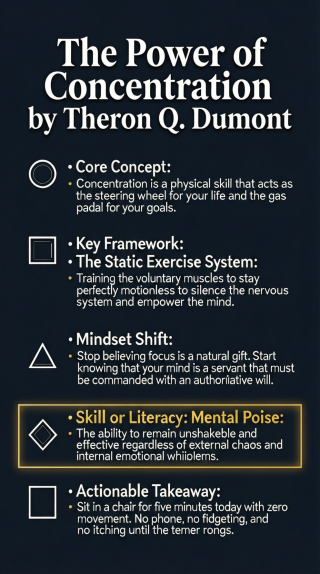
Why We Recommend this Book
This book is a vital resource if you find yourself struggling to maintain focus in an age where your attention is being constantly auctioned off to the highest bidder.
The Power of Concentration provides a clear path to shift your mind from a state of passive reaction to one of active, intentional command over your own thoughts and physical impulses.
The principles found here have long served as a quiet foundation for high-performance thinkers and leaders who recognize that the ability to concentrate is the primary requirement for any significant achievement.
The Power of Concentration
The Power of Concentration by Theron Q. Dumont takes you from distraction to laser-sharp focus FASTER. It provides a clear path to mastering your mind, helping you achieve lasting success in all areas of life.
Get the full book
DOWNLOAD ebook
Questions to ask yourself before reading The Power of Concentration
- When was the last time I worked for sixty minutes straight without checking a notification, grabbing a snack, or letting my mind wander to a different task?
- Am I actually looking for a practical skill to practice, or am I just looking for the temporary hit of feeling productive by reading about success?
- If I am honest with myself, which specific habit or person am I currently blaming for my lack of progress instead of taking responsibility for my own focus?
- What is the exact financial or personal cost of my current inability to stay concentrated on my highest priorities?
- Am I truly willing to commit to ten minutes of total silence every day, even when it feels boring, repetitive, or uncomfortable?

Overview: The Power of Concentration by Theron Q. Dumont
The Power of Concentration is a timeless book that teaches readers how to harness the incredible power of focused thinking.
Written by Theron Q. Dumont, a pioneer in personal development, this book provides practical techniques and insights to help readers improve their ability to concentrate, build mental discipline, and achieve their goals with unwavering determination.
Dumont emphasizes that success in any area of life, be it personal, professional, or spiritual, depends on your ability to focus your thoughts and energy on what truly matters.
Through simple yet profound exercises, the book empowers readers to overcome distractions, build self-confidence, and develop an iron will.
If your mind often feels scattered or you struggle to stick to your goals, The Power of Concentration offers simple, actionable steps to regain focus and control. Instead of letting life pull you in different directions, let Dumont guide you to mastery over your mind.
For deeper insights, consider reading the full book or revisiting its exercises regularly.
Click on the Tabs Below to Read The Power of Concentration Summary
The Power of Concentration by Theron Q. Dumont teaches readers how to harness the strength of focused thought and willpower to overcome distractions, build self-discipline, and achieve personal and professional success.
Who should Read The Power of Concentration and why?
Here are the people who will get the most out of this book:
- The Chronic Multi-tasker: If you feel like your brain has twenty tabs open and you can’t seem to close any of them, this book is for you. You likely feel busy but not productive. You finish your day exhausted but realize you didn’t actually move the needle on your biggest goals. This book will help you stop the mental leaks and teach you how to pour all your energy into one task at a time.
- The Aspiring Professional with Imposter Syndrome: If you feel like you have the talent but lack the presence to lead, Dumont’s ideas on mental poise will change your life. You might struggle to speak up in meetings or feel easily rattled by criticism. By practicing these lessons, you will gain a level of internal steadiness that others will notice. You will stop reacting to your environment and start commanding it.
- The Habit-Looper: If you have been trying to quit a bad habit for years and keep failing, the Law of Replacement in this book is the tool you are missing. You have likely tried to use brute force willpower and failed because you were still focusing on the habit you hated. Dumont gives you a mechanical way to rewire your focus so the old habit simply starves to death.
Who This Book Is Not For
This book is not ideal for you if you are currently looking for a quick fix or a motivational pep talk. Dumont doesn’t offer fluff. He offers work.
If you are in a phase of life where you truly cannot commit ten minutes of quiet time each day, or if you aren’t ready to take full responsibility for your own distractions, you will find these lessons frustrating. This is a training manual for the mind. If you aren’t ready to do the mental push-ups, you won’t see the results.
Basically, if you are tired of feeling scattered and you are willing to sit still and train your brain like a muscle, this will be one of the most practical things you ever read.
If you just want to read about success without changing your daily habits, it’s probably better to skip it for now.
Lesson 1: Concentration Finds the Way
Lesson 1: Success is not a matter of luck; it is the result of a mind that has learnt to focus its energy on a single point until it breaks through.
Imagine you have two versions of yourself living inside your head. One version is your advancing nature. It wants you to grow, learn, and succeed. The other is your retreating nature.
It is the part of you that feels lazy, fearful, or content with staying exactly where you are. Theron Dumont starts the book by telling us that your life is essentially a tug-of-war between these two. The side that wins isn’t the strongest one; it is the one you choose to concentrate on.
Most people think of concentration as just focusing on a task, like doing your taxes or studying for a test. But Dumont sees it as a filter for your entire reality.
If you focus on your weaknesses, they grow. If you focus on your potential, you start to see paths forward that were invisible to you before. This is a very practical way to look at mindset. It isn’t magic; it is about where you point your mental energy.
He uses a great example of a person who is looking for an opportunity. Most people sit around waiting for a lucky break to fall into their lap. Dumont argues that opportunity is something you create through intense focus. When you concentrate on a specific goal, your brain starts scanning the environment for anything that can help you get there. A conversation at a coffee shop or a random headline in a newsfeed suddenly becomes a lucky break only because you were already looking for it.
A Challenge to Your Assumptions
Pause for a second. You might think that being realistic about your flaws is a good thing. We are often told to be self-aware and analyze our failures.
Dumont would actually argue that obsessing over your failures is a mistake. Many people spend so much time analyzing why they failed that they accidentally train their minds to be experts in failure. They concentrate so hard on the retreating nature that they lose the ability to see the advancing one. There is a big difference between learning a quick lesson and dwelling on a setback.
Here is how you can actually use this today:
- The Two-Nature Check: Whenever you feel a sense of dread or laziness about a project, stop and acknowledge that your retreating nature is talking. Physically tell yourself that you are switching your concentration to the advancing side.
- Search for the Good: Dumont suggests looking for the good in every person and every situation. This sounds like cliché positive thinking, but it’s actually a functional tool. If you look for the good in a difficult boss, you find ways to work with them. If you only look for the bad, you become paralyzed by resentment.
- The Mental Image: Start your day by holding a clear, steady image of what you want to accomplish. Not a vague wish, but a sharp mental picture. If you want to be a better public speaker, don’t just hope it goes well. See yourself standing firmly and speaking clearly.
My Opinion
In my opinion, the hardest part of this chapter to apply is the idea that we get back exactly what we give out.
Dumont claims that if you send out thoughts of spite or failure, that is exactly what will come back to you. While that might feel a bit mystical, the practical truth is that your attitude dictates how people respond to you. If you walk into a room expecting people to be cold, your body language will likely make them act that way.
One common misunderstanding is that concentration should be a strained effort.
You shouldn’t be clenching your teeth or giving yourself a headache. True concentration, as explained here, is a quiet, steady persistence. It is like the sun through a magnifying glass. The sun is always there, but it only starts a fire when you hold the glass steady in one spot long enough.
Most of us keep moving the glass because we get bored, and then we wonder why we never see any heat.
If you take nothing else from this chapter, remember this: You are the gardener of your own mind. You can’t stop weeds from appearing, but you can choose which plants you water. If you water the advancing thoughts with your attention, they will eventually crowd out the weeds. It takes work, but it is the only way to actually change your life from the inside out.
Lesson 2: The Self-Mastery: Self-Direction Power of Concentration
Lesson 2: You do not need more time; you need more presence. When you are fully in the moment, you accomplish more in an hour than a scattered mind does in a day.
If Lesson 1 was about choosing your direction, Lesson 2 is about taking the wheel. Dumont argues that most people are like a boat without a rudder; they drift wherever the winds of emotion or the currents of other people’s opinions take them.
To have the power of concentration, you must first have self-mastery. This means you decide what you think about, rather than letting your thoughts be decided for you by a buzzing phone, a stray worry, or a loud neighbour.
A big idea here is that concentration is a muscular habit of the mind. Just as you can’t walk into a gym and lift a hundred pounds on your first day, you can’t expect to have perfect focus if you’ve spent years letting your mind wander.
Dumont suggests that the cause of poor concentration is often just a lack of training.
We have become used to being impulsive. When we feel a tiny urge to move or look away, we do it. To fix this, you have to start practicing physical stillness.
A Challenge to Your Assumptions
You might think that mental focus is purely happening inside your brain. You might assume that as long as your mind is on the task, it doesn’t matter if you are fidgeting, tapping your foot, or pacing around.
Dumont says this is a mistake. He explains that there is a deep connection between your voluntary muscles and your mental state. If you cannot keep your body still for ten minutes, you have no hope of keeping your mind still.
Physical restlessness is a leak where your mental energy escapes. By forcing your body to be quiet, you are actually training the brain centres that control focus.
Here is how you can actually apply this self-direction power:
- The Silence Cure: Spend a few minutes every day in a quiet room. Sit perfectly still. Don’t itch your nose, don’t tap your fingers, and don’t shift your weight. This isn’t just about being quiet; it is about asserting authority over your body. When you prove you can control your muscles, you gain the confidence to control your thoughts.
- Watch the Energy Leaks: Notice throughout your day how much energy you waste on useless movements or unnecessary talking. Every time you gossip or worry about something you can’t change, you are scattering your force. Dumont wants you to conserve that energy so you can blast it toward your main goal like a fire hose.
- Develop Your Magnetism: He mentions that people who can concentrate become magnetic. This isn’t some weird aura; it’s practical. When you are fully present and focused on a person during a conversation, they feel it. You become influential because you aren’t distracted. Most people are only half-listening because they are thinking about what to say next. If you concentrate entirely on the other person, you gain a level of power over the interaction that others lack.
My Opinion
I’ll be honest, some of the advice in this chapter feels a bit old-fashioned, especially the idea that you should avoid all impulsivity.
In the modern world, being quick and reactive is sometimes seen as a strength. However, the judgment here is that reactive people are easily manipulated. If you react to every notification or every slight, you aren’t in charge of your life; the person or thing that triggered you is.
Self-direction is the only way to remain the boss of your own time.
One common misunderstanding is that self-mastery means being a cold, emotionless robot. That’s not it at all.
It just means that you choose when to be emotional. You don’t let a bad mood ruin your productivity unless you decide that feeling that mood is the most important thing to do right now. It is about moving from being a victim of your circumstances to being the architect of your environment.
When you start applying this, you will realize that the hardest person to manage isn’t your boss or your spouse; it is the person in the mirror.
But once you can direct yourself, directing your career and your future becomes much easier. You stop wishing for things to happen and start commanding them to happen through steady, directed effort.
Lesson 3: How to Gain What You Want Through Concentration
Lesson 3: Your mind is like a magnifying glass; as long as you move it around, you create no heat, but hold it still and you can start a fire.
Lesson 3 is about the engine of desire. Dumont introduces a concept that might sound a bit like modern law of attraction, but he explains it through the lens of mental efficiency.
He argues that the world is full of things you want, wealth, friends, health, or success, but you aren’t getting them because your mental signals are too weak and scattered.
The core idea here is mental demand. Most people just wish for things. They say they want a better job or a happier life, but their minds are simultaneously full of doubts, fears, and distractions.
This creates a conflicted signal. To get what you want, your desire must be so concentrated that it becomes a focused demand. You have to learn how to saturate your mind with the thought of your goal until your subconscious starts working on it automatically.
A Challenge to Your Assumptions
You might think that wanting something really badly is the same thing as concentrating on it.
You might say, I think about my debt or my loneliness all the time, so why isn’t it getting better? Dumont points out that this is a major mistake. Thinking about the lack of something is not the same as concentrating on the attainment of it. If you concentrate on your poverty, you are actually demanding more poverty.
You are training your brain to see obstacles and limitations. To use this power correctly, you must concentrate on the presence of the thing you want, not the absence of it.
Here is how you can practically use this idea of mental attraction:
- The Clear Objective: You cannot concentrate on a blur. If you want more money, pick a specific amount. If you want a better relationship, define exactly what that looks like. Vagueness is the enemy of concentration. Your mind needs a sharp target to hit.
- The Belief Factor: Dumont insists that you must believe you can attain what you are concentrating on. If you try to concentrate on success while secretly believing you are a failure, you are wasting your energy. You have to align your belief with your focus. This isn’t just about being happy; it’s about removing the mental friction that slows you down.
- Daily Mental Demand: Set aside time each day to quietly but firmly demand what you want from yourself and the universe. Don’t beg or plead. Just state the requirement clearly in your mind. This keeps your goal at the forefront of your brain, making you notice opportunities that others miss because they are too busy worrying.
My Opinion
I find this chapter to be one of the most polarizing in the book. Some readers might find the talk of mental currents and attracting things from the ether a bit too mystical. However, if you look at it through a psychological lens, it makes perfect sense.
When you are 100% focused on a specific outcome, your behaviour changes. You speak with more confidence, you work with more intensity, and you stop wasting time on things that don’t matter. The attraction is a byproduct of your total commitment.
A common misunderstanding is that you can just sit on your couch, concentrate on a pile of gold, and it will appear. Dumont is very clear that concentration finds the way, but you still have to walk down that path.
Concentration gives you the idea, the courage, and the persistence to act, but the action is what bridges the gap between the mental world and the physical one.
To use this today, stop being a person who merely wishes. Start being a person who demands.
Pick one thing you want more than anything else right now. Spend tonight clearing out all the buts and maybes from your mind. Just for ten minutes, hold that one desire as if it is already a fact. Feel the reality of it. That is the beginning of gaining what you want.
Lesson 4: Concentration, the Silent Force that Produces Results in All Business
Lesson 4: The person who can sit perfectly still for five minutes has more power than the person who can run a mile but cannot control their own twitching hands.
Here, Dumont takes the mental tools we have been discussing and moves them directly into the workplace. He argues that concentration is the hidden engine of efficiency.
Many people think that being busy is the same as being productive, but Dumont disagrees. He believes that a person who works with a scattered mind wastes most of their energy, while a person who uses the silent force of concentration can achieve in two hours what others do in an entire day.
The core idea here is that thought is a real, literal force. In a business setting, this force works in two ways.
First, it sharpens your own skills, allowing you to see solutions that others miss. Second, it acts as a silent language that other people pick up on. When you are deeply concentrated on your business goals, you radiate a sense of calm power and reliability. This makes customers, bosses, and partners want to work with you because they feel your mental strength.
A Challenge to Your Assumptions
You might think that to be successful in business, you need to be the loudest person in the room or the one who is constantly talking. You might assume that force means being aggressive.
Dumont says this is a mistake. He argues that the most powerful force in business is actually silent.
Noise is usually a sign of wasted energy. Think of a steam engine: the loud hissing steam is the energy that is escaping and doing no work. The silent pressure inside the boiler is what actually moves the train. In the same way, the person who talks the most often has the least concentrated power. True force is quiet, steady, and focused.
Here is how you can use the silent force in your professional life:
- The Single-Tasking Rule: Dumont suggests that you should never have more than one thing in your mind at a time. When you are writing an email, be the best email writer in the world. When you are in a meeting, listen with your whole being. Do not let your mind leak into what you are doing next or what you did yesterday.
- Awaken Your Latent Possibilities: He claims that we all have hidden talents that only come to the surface when we apply the heat of concentration. If you feel stuck in your career, it is likely because you haven’t yet concentrated enough energy on a single point to break through the surface of your current limitations.
- Inspiring Confidence: To sell an idea or a product, you must first be solidly sold on it yourself. If your thoughts are divided or doubtful, the other person will instinctively sense your lack of conviction. If your mind is a single, concentrated beam of belief, they will find it almost impossible to resist your influence.
This chapter is incredibly practical for fighting decision fatigue and burnout.
We often feel exhausted not because we did too much work, but because our minds were jumping between twenty different things at once. The judgment here is that multitasking is a lie that destroys your professional value.
By applying Dumont’s silent force, you actually end your day feeling more energized because you haven’t wasted your mental fuel on friction and distraction.
A usual misunderstanding is that this requires you to be a workaholic. It’s actually the opposite.
If you concentrate perfectly while you work, you can finish your tasks faster and truly leave work at the office. The goal is to have such control over your mind that when you decide to stop working, you can concentrate just as intensely on your rest and your family.
Next time you sit down at your desk, try this: Declare a zone of silence for your mind. Shut out the world and the future.
Focus so intensely on the task in front of you that you forget yourself. You will find that the work almost starts to do itself, and the results will be far beyond anything you’ve produced while rushing.
Lesson 5: How Concentrated Thought Links All Humanity Together
Lesson 5: Do not let your environment dictate your mood. True concentration means carrying your own quiet atmosphere with you into the middle of a storm.
Dumont takes a fascinating turn here. He moves from how concentration affects you to how it affects the world around you.
He suggests that we are not isolated islands. Instead, our minds are like radio stations, constantly sending and receiving signals. When you concentrate deeply on a goal, you aren’t just thinking in a vacuum; you are actually tuning into a frequency that connects you with other people, ideas, and environments that match your focus.
The core idea here is mental link-up. Dumont argues that by focusing your thoughts, you can actually mold your environment.
If you concentrate on success and helpfulness, you start to attract people who are also looking for success and helpfulness. It is as if your concentrated thought acts as a bridge, bringing the right resources and the right people into your life at the exact moment you need them.
A Challenge to Your Assumptions
You might think that your thoughts are private and have no impact on anyone else unless you speak them out loud.
You might assume that as long as you act politely, it doesn’t matter if you are secretly resentful or pessimistic. Dumont says this is a mistake. He says that your underlying mental state is felt by others, whether they realize it or not. If you are concentrating on fear or unfavourable conditions, you are essentially broadcasting a stay away signal to the very opportunities you want.
You cannot build a beautiful life while harboring ugly thoughts.
Here is how you can use this linking power to change your surroundings:
- Mold Your Environment: Stop complaining about where you are. Dumont insists that if you concentrate intensely on the environment you want, you will either find the power to change your current one or the path to a new one. Your focus dictates what you notice. If you focus on beauty, you see the flower in the sidewalk crack. If you focus on the trash, that’s all you see.
- The Method of Removal: To get rid of unfavourable conditions, don’t fight them directly with anger. Instead, concentrate them out of existence. You do this by pouring so much mental energy into the positive alternative that the negative condition loses its fuel and eventually withers away.
- Realize Your Ambitions: Treat your ambition as a living thing that needs to be connected to the rest of the world. By holding your ambition in your mind with total clarity, you create a mental hook that looks for a corresponding eye in the outside world.
I’ll be honest: this is where the book gets most challenging for a logical mind to accept. The idea that thought travels like a wireless telegram sounds very 1920s.
However, if you look at it through the lens of social psychology, it makes perfect sense. People who are focused and positive naturally attract collaborators. People who are miserable and scattered naturally repel them.
The link isn’t necessarily a magical beam; it’s the unstoppable influence of a person who knows where they are going.
Don’t make this mistake. People try to concentrate for five minutes, don’t see a new friend or a business deal walk through the door, and quit.
Dumont would say that the current takes time to build. You have to be consistent in your broadcasting before the world can tune into your station. It’s about the steady pressure of your thought over weeks and months.
Today, try to be mindful of what frequency you are broadcasting. If you want to be surrounded by ambitious, kind people, you must first concentrate on being ambitious and kind yourself.
You don’t find your tribe; you attract them by the quality of your most frequent thoughts. Stop focusing on what is wrong with the world and start focusing on the world you want to live in. That is how the link begins.
Lesson 6: The Training of the Will to Do
Lesson 6: The habit of doing things well enough is a leak in your mental tank. Do every small task with total focus, and the big tasks will take care of themselves.
The previous lessons were about where to point your mind, Lesson 6 is about the fuel that keeps it pointed there. Dumont focuses here on the Will. He defines the Will not as some vague feeling of wanting, but as the inner energy that controls every conscious act you perform.
Think of your mind as a car; concentration is the steering wheel, but the Will is the engine. Without a strong Will, you can have the best intentions in the world, but you will never leave the driveway.
The core idea is that the Will can be strengthened through exercise just like a physical muscle. Most people think they are born with a certain amount of willpower and that is that.
Dumont argues this is wrong. You are simply out of practice. By performing small, deliberate acts of Will every day, you build up a reservoir of mental power that makes you a man or woman among men—someone who actually finishes what they start.
A Challenge to Your Assumptions
You might think that willpower is something you only need for big things, like quitting a job or starting a business. You might assume that for the small stuff, you can just go with the flow.
Dumont says this is not true. He believes that every time you give in to a small impulse, like checking your phone when you meant to read, or hitting snooze when you meant to get up, you are actually weakening your Will.
You are training yourself to be a follower of your whims rather than a leader of your life. The big moments of Will are won or lost in the small moments of daily discipline.
Here is how you can practically train your Will to Do :
- The Unpleasant Task First: Dumont suggests doing something every day that you don’t want to do, simply because you decided to do it. It doesn’t have to be a major project. It could be washing the dishes immediately or making that awkward phone call. By doing the thing you’re avoiding, you are asserting the authority of your Will over your comfort.
- Watch Your Movements: He brings back the idea of physical control. If you find yourself fidgeting, stop. If you find yourself talking aimlessly, be silent. This conscious restraint is like a gym workout for your Will. It builds the “inner energy” that you will need when real obstacles arise.
- Determination and Perseverance: These aren’t just personality traits; they are results of a trained Will. Dumont explains that a person with a strong Will doesn’t see obstacles as reasons to stop, but as weights to be lifted to get even stronger.
My Opinion
It can be hard to hear that our lack of success might come down to a weakness of character that we’ve allowed to develop. However, the judgement here is also incredibly empowering.
It means that you aren’t a victim of your personality. You can rebuild yourself. If you don’t like how easily you get distracted, you don’t need a new hack ; you need to start training your Will.
Most people think that a strong Will means being stubborn or aggressive toward others. That’s not what Dumont is talking about.
A truly strong Will is quiet and internal. It is the ability to keep yourself on track when no one is watching and when you don’t feel like it. It is self-governance, not bossing other people around.
To start today, pick one small thing you’ve been putting off. Don’t wait for motivation to strike. Motivation is a feeling, and feelings are fickle. Instead, use your Will.
Decide to do it, and then do it simply because you said you would. Each time you do this, you are adding a drop of power to your mental battery. Eventually, that battery will be strong enough to power your biggest dreams.
Lesson 7: The Concentrated Mental Demand
Lesson 7: You cannot think two thoughts at once. To kill a negative thought, do not fight it; simply replace it with a thought of your goal.
If Lesson 6 was about the engine of the Will, Lesson 7 is about the steering wheel and the gas pedal combined. Dumont introduces a concept called the mental demand.
This is more than just a request or a hope. It is a firm, unwavering requirement you make of yourself and the universe. He argues that the world doesn’t give you what you want; it gives you what you demand with a concentrated mind.
The main idea is that most of us are too wishy-washy. We say, I would like to be successful, or, I hope I get that promotion. Dumont says this is like trying to cut through a log with a butter knife.
A mental demand is different. It is a sharp, heavy axe. When you make a demand, you exclude all distracting thoughts. You don’t allow maybe or if to enter your mind. You hold the thought that this thing must and shall be, and you hold it until it manifests.
A Challenge to Your Assumptions
You might think that demanding something sounds arrogant or entitled. You might assume that you should be humble and wait for life to reward your hard work. Dumont argues that this passivity is a mistake. He believes that the mightiest power in the world is free for you to use, but it requires a masterful attitude.
If you approach life like a beggar, you will receive crumbs. If you approach it as a master making a legitimate demand on your own latent powers, you unlock resources you didn’t know you had.
It’s not about being rude to people; it’s about being authoritative with your own mind.
Here is how you can use the concentrated mental demand in your life:
- Eliminate the Conflict: A demand only works if it is undivided. If you demand wealth but spend half your day thinking about how hard it is to pay rent, you are cancelling out your own order. You must learn to silence the poverty thoughts the moment they arise.
- The Silent Command: You don’t need to shout your demands. In fact, Dumont suggests they are more powerful when kept silent and steady. Deep within your mind, maintain a constant, firm requirement. It’s like a background program running on a computer; it should be there even when you are doing other things.
- The Feeling of Certainty: When you make a demand, you must act and feel as though the result is already on its way. If you order a package online, you don’t pace the floor wondering if it exists; you simply wait for the delivery. Your mental demand should have that same level of calm certainty.
To be sincere with you, this lesson can feel a bit intense. The idea of demanding things from the universe can feel like you’re trying to play God. However, the light interpretation here is that this is really about decisiveness.
Most people fail because they never truly decide. They keep their options open, which is just another way of saying they are scattered. A mental demand is an act of extreme decisiveness that forces your brain to stop looking for excuses and start looking for ways to win.
Don’t fall into the trap of thinking that a mental demand replaces hard work. It doesn’t. What it does is organize your hard work. When you demand a result, you suddenly find the energy to work longer, the focus to work smarter, and the courage to take risks.
The demand is the blueprint; you still have to build the house, but now you actually have a plan to follow.
To apply this today, pick one specific goal. Stop wishing for it. Spend five minutes in total silence and demand it of yourself. Say it internally with the same authority you would use to tell your feet to walk. Don’t ask for permission. Just set the requirement and see how your perspective shifts from “I can’t” to “How will I?”
Lesson 8: Concentration Gives Mental Poise
Lesson 8: Concentration gives you the power to see opportunities where others see obstacles. It is the light that reveals the hidden path to your desires.
If you have ever felt like a leaf blowing in the wind, easily upset by a rude comment, a bad news headline, or a sudden change in plans, then Lesson 8 is for you. Dumont introduces the idea of mental poise.
This isn’t just about being calm; it is about being unshakeable. He argues that the man who can concentrate is always well-poised because he is the master of his own internal environment. He doesn’t let the outside world dictate how he feels on the inside.
The core idea is that leaky mental energy is what causes us to lose our balance. When you are scattered, every little external force can push you over.
But when you are concentrated, you are like a heavy, solid object that is difficult to move. Concentration acts as a shield, allowing you to stay focused on your goals while the chaos of life swirls around you without touching you.
A Challenge to Your Assumptions
You may believe that being sensitive to your surroundings is a good thing, that it makes you empathetic or aware. You might also assume that if things are going wrong, you should feel stressed or upset.
Dumont says this is a wrong move. He argues that losing your poise is actually a form of mental weakness. It means you have given away your power to your circumstances.
Being in tune with the world shouldn’t mean being a victim of it. You can be aware of a problem without letting it shatter your internal peace. True poise is the ability to remain effective under pressure.
Here is how you can use concentration to build mental poise:
- Control Your Reactions: Practice being a conscious observer of your own emotions. When someone says something that would usually make you angry, concentrate on your breath or a single point in the room. By focusing on something else, you create a gap between the insult and your reaction. In that gap, you find your poise.
- The Power of Presence: Dumont points out that successful lives are concentrated lives. When you are fully present in the now, you don’t worry about the past or fear the future. Most of our loss of poise comes from living in a time that isn’t currently happening. Concentration anchors you to the present moment, which is the only place where you actually have power.
- Influencing Others: There is a very practical social benefit here. When you have mental poise, you naturally make others feel as you do. Have you ever noticed how one calm person can quiet a panicked room? That is the power of a concentrated mind. By maintaining your own balance, you silently command the environment around you.
My Opinion
We are constantly being invited to lose our poise for the sake of clicks and engagement. The judgment here is that your peace is your most valuable asset. If you lose your poise, you lose your ability to think clearly and act decisively.
Protecting your mental balance isn’t selfish; it’s a prerequisite for being a person of influence.
Many people believe mental poise means being stiff or emotionless. It’s actually the opposite. A person with true poise is graceful. Think of a high-wire walker; they aren’t rigid, they are constantly making tiny, fluid adjustments to stay centred.
Concentration gives you the mental flexibility to handle life’s bumps without falling off the wire.
To apply this today, pick a situation that usually gets to you, maybe it’s heavy traffic or a specific coworker. Before you enter that situation, concentrate on a feeling of absolute stillness.
Resolve that no matter what happens, you will remain the master of your own mood. You will find that when you refuse to be moved, the world eventually stops trying to push you.
Lesson 9: Concentration Can Overcome Bad Habits
Lesson 9: Every time you overcome an impulse to be distracted, your Will grows stronger. Every time you give in, your Will grows flabbier.
Here, Dumont tackles one of the biggest obstacles to a successful life: the power of habit. He describes habit as the deepest law of human nature. It can either be a powerful enemy that keeps you stuck or a wonderful ally that automates your success.
The problem most people face is that they have allowed their concentration to be hijacked by bad habits, and they feel powerless to change.
Dumont’s message is clear: any habit can be broken if you understand how to use the wedging power of concentration.
The main idea here is that a habit is essentially a mental path that has been worn deep by repeated use. Every time you perform a bad habit, you make that path easier to follow next time.
To break it, you don’t just wish it away; you have to use your concentration to stop the flow of mental energy to that old path and force it into a new one. You aren’t just quitting something; you are replacing a destructive focus with a constructive one.
A Challenge to Your Assumptions
The best way to break a bad habit is NOT to focus on it and fight it with all your might. You might assume that if you want to stop smoking or stop procrastinating, you should keep telling yourself, Don’t do it, don’t do it. Dumont says this is a fatal mistake.
When you concentrate on not doing something, you are still concentrating on the habit itself. Your mind doesn’t understand the not ; it only sees the image of the habit you are trying to avoid.
By fighting it directly, you are actually feeding it more mental energy. The secret is to ignore the old habit and concentrate entirely on its opposite.
Here is how you can practically use concentration to rewire your habits:
- The Law of Replacement: Don’t try to leave a mental vacuum. If you want to stop a bad habit, you must immediately choose a good one to take its place. If you have a habit of complaining, concentrate intensely on finding things to praise. The moment the old urge hits, pivot your focus to the new advancing thought.
- The First Three Days: Dumont acknowledges that the beginning is the hardest. He suggests that if you can use your concentrated Will to resist a habit for just a few days, the mental path starts to fill in, and the new path starts to form. You have to be a watchman at the gate of your mind during this critical period.
- Visualizing the New You: Spend time every day concentrating on a mental picture of yourself free from the habit. Don’t see yourself trying to quit; see yourself as someone who has already moved past it. This creates a new mental blueprint that your subconscious will begin to follow.
My Opinion
This is one of the most practical chapters for anyone who feels stuck. We often blame our genetics or our past for our bad habits, but the truth here is that habit is just a lack of mental direction.
It might feel like a physical prison, but the bars are made of your own repeated thoughts. Once you realize you have the key of concentration, the prison door is actually unlocked.
A common misunderstanding is that breaking a habit requires inspiration. It doesn’t. It requires routine. You don’t wait to feel like changing; you command the change through the daily, repetitive exercise of your focus.
It’s about being more persistent than the habit is.
To start today, identify one small, nagging habit you want to get rid of. Stop talking about how hard it is to quit. Instead, pick its opposite. Every time the old habit knocks on your door, don’t answer.
Instead, turn around and concentrate with everything you have on the new, better action. You are the master of your mental tracks; start laying down a new line today.
Lesson 10: Business Results Gained Through Concentration
Lesson 10: Deep breathing is the fuel of focus. You cannot have a clear mind if you are starving your brain of the oxygen it needs to function.
In Lesson 10, Dumont circles back to the professional world, but with a sharper focus on results. He argues that a successful business is never the result of mere chance or luck. Instead, it is the physical manifestation of an intense, persistent desire.
If you look at any great enterprise, you will find at its centre a person who concentrated so deeply on their vision that they effectively forced it into reality. This chapter is about moving from being a passive employee or a struggling owner to becoming a master of your commercial destiny.
The main idea here is the business attitude. Dumont explains that your internal mental state creates a kind of atmosphere around you. If your mind is filled with thoughts of competition, fear of failure, or hard times, you are literally broadcasting a signal that repels prosperity.
To get business results, you must concentrate on growth, service, and abundance. You have to train your mind to see the money and the opportunities that are already flowing through the world, rather than focusing on the scarcity everyone else is talking about.
A Challenge to Your Assumptions
You might think that to be successful in business, you need to spend all your time looking at what your competitors are doing or assume that winning means beating someone else.
Dumont says when you concentrate on your competitors, you are giving them your mental energy. You are letting them set the pace for your mind. Dumont argues that there is enough for everyone and that your real job is to concentrate so intensely on your own unique value that competition ceases to exist for you. The master doesn’t compete; the master creates.
Here is how you can practically apply these business principles:
- The Power of Intense Desire: Ask yourself: Do I just want success, or am I concentrating on it? Dumont says you must have a desire so intense that it consumes all minor distractions. This desire acts like a magnet, drawing to you the ideas and people necessary to fulfil it.
- Attracting Others’ Ideas: This is a fascinating concept. Dumont suggests that when you concentrate on a business problem, you actually pick up on the thought-waves of other successful people who have solved similar problems. By holding your mind in a state of concentrated receptivity, you will suddenly discover brilliant ideas that feel like they came from nowhere.
- Broaden Your Vision: Most people fail because they think too small. They concentrate on the pennies and miss the gold mines. Use your concentration to expand your mental horizon. See your business or your career not as it is now, but as it could be in its highest, most successful form.
My Opinion
My judgement on this chapter is that it is the ultimate antidote to imposter syndrome. We often feel like we don’t belong in the room because we lack certain credentials. Dumont argues that your mental credentials, your ability to concentrate and hold a vision, are far more important than any diploma. If you can concentrate better than the person across the table, you have the upper hand, regardless of your background.
A lot of people think that business results only mean money. While Dumont certainly talks about wealth, he emphasizes that true business success is about efficiency and harmony.
If you are making a million dollars but your mind is a wreck and you are constantly stressed, you aren’t actually concentrating correctly. True concentration produces a smoothly running machine, both in your office and in your head.
To use this today, take a look at your current work project. Are you just getting through it, or are you pouring your whole self into it? For the next hour, act as if this one task is the most important thing in the universe.
Concentrate on how you can do it better, faster, and with more spirit than ever before. You’ll find that when you change your mental investment, the external results start to change almost immediately.
Lesson 11: Concentrate on Courage
Lesson 11: Courage is simply concentration applied to your strengths rather than your fears. Focus on the solution, and the fear will vanish.
Dumont introduces a vital partner to concentration: courage. He argues that concentration without courage is like having a high-performance car but being too afraid to drive it.
Many people have the mental ability to focus, but they are paralyzed by what ifs and potential dangers. This chapter is about using your focus to starve your fears and feed your bravery until you become a person of action.
The core idea here is that fear is just a form of negative concentration. When you are afraid, you are actually concentrating very intensely, but on the wrong thing. You are focusing on failure, loss, or embarrassment.
Dumont explains that because your mind can only truly hold one major thought at a time, the secret to courage is simply to force your concentration onto the task at hand so completely that there is no room left for fear to exist.
A Challenge to Your Assumptions
You might think that courageous people simply don’t feel fear. They do. You don’t have to wait for the fear to go away before you can start your project or speak your mind either.
Dumont argues that courage isn’t the absence of fear, but the displacement of it. If you wait to feel brave, you might wait forever.
Instead, you must use your concentration to crowd out the fear. If you focus 100% on the how of your work, your brain literally lacks the processing power to worry about the outcome.
Here is how you can practically build this concentrated courage:
- Banish the Doubts: Treat a doubtful thought like a trespasser. The moment a thought of “I might fail” enters your mind, don’t argue with it. Just replace it with a concentrated thought of your goal. Doubts grow when you give them attention; they die when you ignore them.
- Focus on the Step, Not the Mountain: Courage often fails because we look at the giant end goal and feel overwhelmed. Dumont suggests concentrating only on the immediate next move. It takes very little courage to take one step. If you concentrate only on that step, and then the next, you will find you have climbed the mountain without ever having to face the fear of the whole height.
- The Financial Link: Dumont makes a blunt point: lack of courage is a primary cause of financial difficulty. Most people stay poor not because they lack talent, but because they lack the courage to concentrate on a big idea and see it through. By concentrating on courage, you unlock your ability to spot and seize wealth-building opportunities.
My Opinion
My interpretation of this chapter is that it provides a very mechanical solution to an emotional problem. We usually treat fear as a deep psychological issue, but Dumont treats it as a simple focusing error.
The idea here is that worrying is a waste of mental currency. Every minute you spend concentrating on a threat is a minute of power you have stolen from your success.
A common misunderstanding is that concentrating on courage means acting recklessly. That isn’t the case. True courage is calculated and calm.
It involves looking at a situation, deciding on the best course of action, and then concentrating so hard on the execution that you don’t have the leaky energy required to tremble or hesitate.
To use this today, identify one thing you are currently avoiding because of a slight gut feeling of dread. Stop analyzing the dread. Instead, concentrate entirely on the first small action required to face it. Whether it’s making a call or hitting send on a proposal, do it with a mind that is blind to everything except the action itself. You’ll find that once the action starts, the fear vanishes.
Lesson 12: Concentrate on Wealth
Lesson 12: Wealth is a mental state before it is a bank balance. Focus on providing immense value, and the universe will provide the fair exchange.
Here the author tackles a topic that many people feel conflicted about: money. He doesn’t treat wealth as a matter of luck or greed. Instead, he views it as a natural result of right thinking.
He argues that no one was intended to be poor. Poverty, in his view, is a sign of a malnourished mind that hasn’t learned how to concentrate on the laws of abundance. This chapter is about shifting your mental gears from survival mode to success mode.
The core idea in this chapter is that wealth is a means to an end. Dumont believes that through wealth, we can uplift ourselves and humanity.
To attract it, you must first recognize that the world is a place of infinite supply. Most people fail to acquire wealth because they concentrate on scarcity, they focus on their bills, their debts, and how “hard” it is to make a living. By doing this, they are actually training their minds to be experts in being broke.
To change your bank account, you must first change your mental focus.
A Challenge to Your Assumptions
Wealth DOES NOT come from taking or outsmarting others. You might assume that for you to have more, someone else must have less. Dumont teaches that true wealth comes from the law of fair exchange. You must give a fair exchange for what you receive. Wealth is not about getting something for nothing; it is about concentrating on the value you can provide to the world.
When you focus on providing immense value and demand a fair return, wealth flows to you as a natural consequence. Money is just the world’s way of saying thank you for the value you created.
Here is how you can practically concentrate on wealth:
- The First Step toward Wealth: Start by identifying exactly what you want and why. Vague desires get vague results. If you want to be wealthy, define what that looks like for you. Hold that image with absolute clarity.
- Avoid the Poverty Talk : Dumont is very strict about this. Do not talk about being poor. Do not hang out with people who constantly complain about money. These are destructive mental currents. You must guard your mind against the poverty habit as if it were a contagious disease.
- Believe in the Supply: You have to train yourself to see opportunities for wealth everywhere. When you walk down a street, don’t just see buildings; see the commerce, the ideas, and the human needs being met. The world is a gold mine, but you can only see the gold if you are looking for it.
My Opinion
In my opinion, this chapter is where people’s money blocks really get triggered. We are often taught that wanting money is bad or unspiritual. The idea here is that poverty is not a virtue.
It limits your ability to help others and fulfil your potential. The most practical thing you can do for the world is to make the most of yourself, and in our society, that requires financial resources.
A lot of people think that concentrating on wealth makes you materialistic. It’s actually the opposite. When you have mastered the law of concentration regarding wealth, you stop worrying about money because you know how to create it.
It frees your mind to focus on higher things, like wisdom and helping others, because the money problem has been solved by your mental discipline.
To use this today, stop saying “I can’t afford it.” That phrase is a concentration on lack. Instead, ask your mind, “How can I afford it?” or “What value can I provide to earn this?” This simple shift moves you from a passive victim of your bank balance to an active creator of your fortune. Your mind is the ultimate mint; start printing thoughts of wealth today.
Lesson 13: You Can Concentrate, but Will You?
Lesson 13: Most people have the ability to focus, but few have the Will to use it. The power is already in you; you just have to stop making excuses.
In this lesson, Dumont stops teaching you how to build the machine and starts asking you why you aren’t driving it. This is a chapter about personal responsibility. He argues that almost everyone has the inherent ability to concentrate.
We do it naturally when we watch a thrilling movie or play a game we love. The problem isn’t a lack of ability; it is a lack of will to apply that ability to the things that actually matter.
This chapter is a wake-up call to stop making excuses for why you aren’t where you want to be.
The main point here is that there is more ability not used than is used. Most people live their lives at about twenty percent of their mental capacity.
They wander through their days, letting their minds be led by whatever happens to be the loudest or easiest thing to look at. Dumont insists that no set of circumstances, no matter how difficult, can keep a determined person from succeeding if they choose to use their power of concentration. Success is a choice that you make every single hour of the day.
A Challenge to Your Assumptions
Don’t keep thinking your environment is the reason you can’t focus. Dumont says that waiting for the perfect conditions is just a sophisticated way of being lazy.
In fact, he suggests that stumbling blocks are actually stepping stones. The very obstacles that are frustrating you right now are the weights you need to lift to make your concentration strong.
If everything were easy, your mind would remain flabby and weak.
Here is how you can practically step up to the plate:
- Stop the Self-Pity: Dumont is very blunt: feeling sorry for yourself is a massive drain on your concentration. It directs your energy toward your retreating nature. The next time you feel like a victim, pivot immediately to a thought of what you can actually do right now.
- The Will to Choose: Realize that every time you choose to focus on your work instead of your phone, you are winning a battle. Concentration is not a one-time decision; it is a series of tiny victories. Start looking at your day as a training ground for your Will.
- Persistence over Talent: He notes that the world is full of talented failures. The people who succeed are the ones who may have less natural ability but have the dogged persistence to keep their mind on one point until they break through.
My Opinion
This chapter is just like where your friend tells you to stop complaining and get to work. The truth here is that we often use lack of focus as a shield to protect ourselves from the fear of failure.
If we say we can’t concentrate, then it isn’t our fault if we don’t succeed. Dumont strips that shield away and tells you that the power is already in your hands, you just have to be willing to use it.
People mistake the truth and mostly think that concentration should feel natural or easy once you find your passion. That’s a myth. Even when you are doing work you love, there will be days when you don’t want to do it.
Real concentration is an act of Will that you perform regardless of how you feel. It is the ability to say yes to your goal and no to your temporary moods.
To use this today, stop waiting for the right time to start that project you’ve been putting off. There is no right time. There is only now. Use your Will to force your mind onto the task for just fifteen minutes.
Don’t ask yourself if you feel like it. Just do it because you can. You’ll find that the ability was there all along; it was just waiting for you to give the command.
Lesson 14: Art of Concentrating with Practical Exercise
Lesson 14: Practice stillness when you don’t need it, so that you can rely on it when you do. The “Static Exercises” are the push-ups of the mind.
Now, Dumont stops talking about the theory and starts giving you the actual training manual. He calls concentration an art, and like any art, be it painting or playing the piano, it requires specific, repetitive practice to master.
This chapter is famous for its Static Exercises. These might seem strange or even boring at first, but they are designed to do one thing: give you absolute command over your voluntary muscles so that you can eventually have absolute command over your thoughts.
The key idea here is that physical stillness is the foundation of mental power. If your body is constantly twitching, shifting, or reacting to every little itch, your brain is busy processing those physical leaks of energy.
By training yourself to be perfectly still, you quiet the background noise of the nervous system. This creates a state of receptivity where you can finally hear the messages from your deeper mind or what Dumont calls the universal mind.
A Challenge to Your Assumptions
Stop thinking that practicing concentration means sitting at your desk and trying to work really hard or that if you are busy, you are concentrating.
Real practice according to Dumont happens when you have nothing to do but focus. If you can’t stay focused when there are no distractions, you certainly won’t be able to stay focused when your boss is yelling or your bills are due.
You have to build the skill in a controlled environment first. Don’t confuse activity with concentrated power.
Here are the practical exercises Dumont wants you to start today:
- The Chair Exercise: Sit in a comfortable chair and see how long you can remain perfectly still. This doesn’t mean mostly still; it means not moving a finger, not blinking excessively, nothing. Start with five minutes. It is harder than it sounds. It forces you to assert the I Am over the body.
- The Finger Focus: Sit up straight, raise your right arm to the level of your shoulder, pointing to the side. Turn your head and look directly at your hand, and keep your arm perfectly steady for one minute. Do the same with the left. This trains your nerves to obey your Will.
- The Water Glass Test: Fill a glass with water and hold it out in front of you. Concentrate on the water so that it does not move or ripple. This is a visual feedback loop that shows you exactly when your concentration wavers.
- The Best Time to Practice: Dumont suggests practicing these in the morning or just before bed when the world is quiet. This helps rejuvenate every cell of your brain and body by giving them a break from the constant static of daily life.
My Opinion
These exercises are the secret sauce of the book, but they are also the part most people skip. We want the results (wealth, power, success) without doing the push-ups. The IDEA here is that there are no shortcuts.
If you can’t control your own arm for sixty seconds, you have no business trying to control a corporation or a complex career. These exercises are the litmus test for how much you actually want to change.
A common EXCUSE people use is that these exercises are meditation in the sense of emptying the mind. They aren’t.
They are exercises in focused attention. You aren’t trying to think of nothing; you are trying to think of exactly one thing (stillness) and holding it there. It is active, not passive.
To use this today, don’t just read this and move on. Try the Chair Exercise right now. Set a timer for three minutes. Sit still. When your brain tells you to move, say “No, I am the master.”
You will feel a surge of power the moment you realize that you decide what your body does, not your impulses. That is the beginning of the art of concentration.
Lesson 15: Concentrate So You Will Not Forget
Lesson 15: You do not have a bad memory; you have a bad habit of not paying attention. To remember something, you must first truly see it.
According to Dumont, a bad memory is usually just a polite name for a lack of concentration.
We often complain that we have a poor memory for names, faces, or facts, but the truth is that we never truly saw or heard them in the first place. This chapter is about how to use your focus to burn information into your mind so deeply that forgetting becomes almost impossible.
Memory, according to Dumont, is simply the mental record of how much attention you paid to a specific moment.
The core idea in this chapter is the strength of the initial impression. If you look at something with a scattered mind, the impression is faint, like writing in the sand.
But if you look at it with concentrated focus, the impression is like an engraving in steel. To remember something, you don’t need to repeat it a hundred times; you need to look at it once with 100% of your mental power. Memory is not about storage; it is about the quality of the intake.
A Challenge to Your Assumptions
You might think that some people are just born with a photographic memory and others aren’t. Forgetting is not a natural part of getting older or being busy. According to Dumont, your memory is a servant that has become lazy because you haven’t given it clear orders.
Most of the time when you forget a person’s name, it’s because you were thinking about what you were going to say next while they were introduced. You didn’t forget the name; you never actually received it.
Stop blaming your brain and start blaming your lack of presence.
Here is how you can use concentration to build a steel-trap memory:
- The Single Focus Rule: When you are reading or listening, give the subject your undivided attention. If your mind wanders for even a second, go back and re-read. Do not allow your eyes to move over words while your mind is in the kitchen or at the office.
- Visual Association: When you want to remember something, take a few seconds to visualize it clearly in your mind’s eye. If it’s a name, visualize the person’s face and see the name written across their forehead. This extra second of concentration acts like a save button for your brain.
- The Memory Review: At the end of the day, spend ten minutes reviewing your day in reverse. Start from when you went to bed and work your way back to when you woke up. This exercise forces you to concentrate on the details of your own life, strengthening the memory muscles for everything else.
My Opinion
In my opinion, this is the most immediate way to see the benefits of concentration. You can test this today and see results by tomorrow. The truth is that forgetfulness is a form of disrespect, to yourself and to others. It shows that you aren’t fully there.
By deciding to remember, you are deciding to be a more powerful, present version of yourself.
You may be thinking that cramming information is a form of concentration. It isn’t. Cramming is mental congestion. True memory concentration is calm and deliberate.
It is about taking one piece of information, focusing on it until it is clear, and then moving to the next. It is better to remember three things perfectly than to half-remember a hundred.
To apply this today, the next time you meet someone or read a page of a book, stop yourself. Consciously say, “I am going to concentrate on this so I will not forget.” Notice the colour of the person’s eyes or the specific phrasing of a sentence.
Give it that one second of total focus. You will be shocked at how much your bad memory suddenly starts to improve when you actually start showing up for your life.
Lesson 16: How Concentration Can Fulfil Your Desire
Lesson 16: Desire is the engine of concentration. If you want something deeply enough, your mind will naturally find a way to make it a reality.
Here, Dumont returns to the core of human motivation: desire. He makes a bold claim that the very fact that you have a deep, persistent desire to do something is proof that you have the innate ability to do it.
Nature doesn’t give a bird the desire to fly without giving it wings. In the same way, your longings are actually internal signals of your potential. This chapter is about turning those vague longings into a solid reality by using concentration as the bridge.
The main idea is that desire is a concentrated force. When you want something with your whole heart, you are already concentrating on it.
However, most people dissipate this force by wanting twenty different things at once, or by wanting something for five minutes and then doubting it for an hour. To fulfil a desire, you must protect its intensity.
You have to feed that desire with your attention until it becomes a mental fire that consumes every obstacle in your path.
A Challenge to Your Assumptions
You might think that desire is something that just happens to you, or that it’s a feeling you either have or you don’t. Dumont argues that you can actually build and concentrate your desire through Will. You don’t have to wait for inspiration to strike like lightning.
You can create a steady flame by intentionally focusing on the benefits of your goal and the joy of its fulfilment. Desire is a tool you wield, not a mood that rules you.
Here is how you can practically use concentration to fulfill your desires:
- The Desire-Ability Link: Every time you feel a desire to improve your life, tell yourself: The desire to do implies the ability to do. This simple mantra shuts down the retreating nature that tries to tell you that you aren’t good enough. If you can conceive it, you can concentrate it into existence.
- Gratifying Every Wish: Dumont suggests that man has within him the power to gratify his every wish, provided it is in harmony with his higher self. The secret is to concentrate on the goal as a finished fact. Don’t focus on the struggle to get there; focus on the possession of the result.
- The Miraculous Help: He claims that when you concentrate intensely on a desire, you receive miraculous help from your own subconscious and the world around you. This isn’t magic; it’s just that a singularly focused mind notices resources and connections that a scattered mind ignores.
My Opinion
My judgement on this chapter is that it’s the ultimate permission slip. Many of us feel guilty for wanting wealth, power, or success. Dumont reframes these desires as evolutionary urges. The only sin in his eyes is having a desire and being too lazy or too distracted to concentrate on fulfilling it.
He sees fulfilment as a duty you owe to your own potential.
A common misunderstanding is that this means you should be obsessive in a way that makes you miserable.
True concentration on a desire should actually bring you joy and energy. If your desire is making you anxious, you aren’t concentrating on the fulfilment ; you are concentrating on the fear of not getting it.
You have to shift your focus back to the certainty of the result.
To apply this today, take your biggest wish, the one you’re almost afraid to say out loud. Stop treating it as a dream and start treating it as an upcoming appointment.
Concentrate on the reality of it for ten minutes tonight. Feel the clothes you’ll wear, the words you’ll say, and the satisfaction you’ll feel. By doing this, you are fusing your desire with your focus, and that is the first step toward making it real.
Lesson 17: Ideals Develop by Concentration
Lesson 17: Your life will always move in the direction of your most frequent thoughts. Concentrate on your ideal self until you become that person.
In Lesson 17, Dumont moves from the practical how-to of getting things to the spiritual blueprint of who you are becoming.
He argues that your happiness and success depend entirely on your ideals. An ideal is a mental model of perfection, the person you want to be, the work you want to do, or the life you want to lead. This chapter is about using concentration to bridge the gap between your current reality and that high ideal.
Without concentration, your ideals are just daydreams; with it, they become the guiding stars of your physical life.
The key idea is that we grow into the likeness of our most frequent thoughts. If you concentrate on an ideal of strength, you gradually become strong.
If you concentrate on an ideal of service, you become helpful. Dumont suggests that your mind is constantly building your character, and your ideals are the architectural plans. By concentrating on these plans, you force your subconscious mind to start the construction in the real world.
A Challenge to Your Assumptions
Having high ideals is NOT just for poets or dreamers, and that in the real world, you have to be practical and realistic.
You might assume that thinking about your perfect self is a waste of time when you have bills to pay. Dumont says this is a mistake. He argues that there is nothing more practical than an ideal. A person without an ideal is like a traveler without a destination; they walk a lot of miles but never get anywhere.
Your ideal is what gives your concentration its power. Without a why, your how will eventually fail.
Here is how you can use concentration to develop your ideals:
- Formulate Your Standard: Don’t just wish to be better. Concentrate on a specific ideal. What does the perfect version of you look like in your career? How does that person handle stress? How do they treat others? Write down this ideal and focus on it daily until it is as real to you as your own hand.
- The Physical Outworking: Dumont insists that once you have an ideal, you must work it out in physical life. Don’t wait until you feel like that ideal person. Start acting like them now. If your ideal is a successful business leader, start concentrating on the habits and the poise of a leader today.
- The Sustaining Power: When you face a setback, don’t focus on the failure. Concentrate on your ideal. Remind yourself that the setback is temporary, but the ideal is permanent. This keeps you from getting discouraged and helps you stay on the path.
My Opinion
This chapter is the moral compass of the book. It reminds us that concentration is a tool, and like any tool, it can be used for good or for ill.
The while idea here is that success without an ideal is empty. You can use concentration to get wealthy, but if you don’t have an ideal of how to use that wealth for the better, you will still be unhappy. An ideal gives your success a soul.
A common belief is that an ideal is something unreachable. Dumont would say that an ideal is reachable exactly to the degree that you can concentrate on it.
It isn’t a fantasy; it is a future reality that is currently under construction. The only thing that makes it feel unreachable is a scattered mind that keeps changing its plans.
To use this today, take five minutes to sit in silence and visualize your highest ideal for yourself. Don’t worry about how you will get there yet. Just concentrate on the feeling of being that person. Let that ideal saturate your mind. When you open your eyes, try to carry that ideal self into your next conversation or your next task.
You aren’t faking it; you are concentrating it into existence.
Lesson 18: Mental Control Through Creation
Lesson 18: You were born to be a creator, not just a consumer. Use your focus to build new ideas instead of just reacting to the ideas of others.
Dumont shifts the focus from receiving to producing. He argues that the mind is not just a sponge meant to soak up information, but a factory meant to create. He introduces the idea that creative thinking is the highest form of concentration.
When you are creating, whether it is a new business plan, a piece of art, or a solution to a family problem, you are using your mental forces at their maximum potential. This chapter is about moving from a consumer mindset to a creator mindset.
The key idea is that you are the master of your mental images. Most people let their minds be filled with junk images from the news, social gossip, or random worries. Dumont insists that you must take control of your mental screen and consciously create the images you want to see manifested in your life.
You don’t just think about things; you build them in your mind first. This mental construction is the necessary precursor to physical creation.
A Challenge to Your Assumptions
You might think that creativity is a gift that only some people possess or that if you aren’t an artist or an inventor, this lesson doesn’t apply to you.
Dumont says that every human being is a creator by nature. Every time you plan your day or solve a minor problem, you are creating. The only difference between a genius and an average person is that the genius concentrates their creative power on a single point, while the average person scatters it over a thousand trifles.
Creativity is just concentration applied to a new idea.
Here is how you can practically use mental control through creation:
- The Blueprint Method: Before you start any project, spend time concentrating on the finished result. See it in your mind in vivid detail. The more solid you make the mental image, the easier it will be for your physical hands to build it. A blurred mental blueprint leads to a shaky physical structure.
- Silence the Critics: When you are in the creation phase, you must use your concentration to shut out all criticism—both from yourself and from others. Creation requires a mental laboratory where you are free to experiment without fear. Once the creation is finished, you can use your focus to refine it, but while it is being born, you must protect it with a shield of concentration.
- Daily Mental Invention: Practice inventing solutions to small problems every day. Even if the problem doesn’t exist yet, ask yourself: How could this be done better? This keeps your mind in a state of creative readiness, so when a big opportunity arrives, your creative muscles are already warmed up.
My Opinion
In my opinion, this chapter is about reclaiming your agency. We live in a world that wants us to be passive consumers of content. Dumont is telling us to be the producers.
A life spent only reacting is a life wasted. To be truly happy and successful, you must be a creator. You must use your concentration to bring something new into the world, even if it is just a new way of organizing your own home.
Creative creation is not a relaxing, easy process as many assume. It’s actually the most intense form of labour.
True creation requires you to hold a thought in your mind until it literally takes shape. It involves a level of mental effort that can be exhausting, but it is the only kind of effort that leads to true mastery and lasting satisfaction.
To use this today, pick one problem in your life, no matter how small. Instead of complaining about it or looking for someone else’s solution, concentrate on creating your own.
Sit in silence and build a mental model of the solution. Don’t stop until the image is clear. Then, take the first step toward making that mental model a physical reality. You are the architect; it’s time to start building.
Lesson 19: A Concentrated Will Development
Lesson 19: A truly developed Will is silent and steady. It does not need to shout to be heard; it simply stays on the point until the world moves.
In this Lesson , Dumont provides the capstone for the Will. The earlier lessons taught you that the Will is a muscle, this lesson explains how to achieve its final form. He argues that a truly developed Will is not explosive or loud; it is a steady, silent, and irresistible pressure.
It is the difference between a firecracker and a deep-sea current. This chapter focuses on how to reach a state where your Will is so perfectly aligned with your concentration that you no longer have to try to focus, you simply are focused.
The idea here is mental equilibrium. A developed Will doesn’t get hyped up or stressed out. It remains calm because it knows its own power.
Dumont suggests that the highest development of the Will is the ability to hold a single thought for as long as you choose without any effort or strain. When you reach this level, you have achieved the ultimate state of self-mastery: you are the absolute dictator of your internal world.
A Challenge to Your Assumptions
You might think that a strong Will means being a hustler who is always grinding and pushing or that it is about forcing yourself to do things you hate.
He argues that the most powerful Will is the one that is the most relaxed. If you have to struggle to concentrate, your Will is still weak. A strong Will is like a master commander who only needs to whisper an order for it to be obeyed. If there is friction in your mind, your Will is not yet fully developed.
Here is how you can practically finalize your Will development:
- The Habit of Resolution: Never make a resolution you don’t keep. If you tell yourself you will wake up at 6:00 AM, and you don’t, you have lied to your own Will. This creates a leak in your authority. Only resolve to do things you actually intend to do, and then do them without exception.
- The Silent Affirmation: Throughout the day, silently affirm your mastery. Use phrases like “I am the master of my thoughts” or “My Will is becoming invincible.” This isn’t just positive thinking ; it is programming the subconscious to accept your Will as the supreme law of your life.
- Energy Conservation: Stop wasting your Will on small, useless things. Don’t argue over trivialities. Don’t waste energy on getting even. Save your Will-power for the things that build your life and your character. A person who is strong-willed about petty things is usually weak-willed about big things.
My Opinion
Maturity is the measurement of your Will. An immature person is a slave to their impulses; a mature person is a master of their direction.
This is the stage where you stop working at concentration and start living in concentration.
A common misunderstandingI have noticed is that a developed Will makes you rigid. It’s actually the opposite. A strong Will gives you the freedom to be flexible.
Because you know you can focus whenever you want, you can afford to relax when you want. You aren’t afraid of being distracted because you know you can snap back to centre in an instant. It is the freedom of a master, not the cage of a perfectionist.
To apply this today, look at your word to yourself. Did you promise yourself you’d work out? Did you promise to be kind to a specific person? Make your word law. For the next 24 hours, do everything you told yourself you would do, exactly when you said you’d do it.
Experience the silent strength that comes from knowing that when you speak, your body and mind listen. That is the beginning of an invincible Will.
Lesson 20: Concentration Reviewed
Lesson 20: Concentration is not a trick you learn; it is a way you live. To master your mind is to master your destiny.
In the final lesson, Dumont doesn’t just summarize the book; he provides a final synthesis. He argues that concentration is not just a trick for business or a mental exercise for better memory, it is the fundamental law of life.
This lesson is a call to integrate everything you have learned into a permanent way of being. He makes it clear that reading these lessons is useless unless you have undergone a mental transformation where you no longer see yourself as a victim of circumstances, but as a master of your own mental forces.
The core idea is perpetual focus. Dumont explains that you shouldn’t just do concentration for ten minutes a day; you should live in a state of concentrated awareness. Whether you are eating, walking, talking, or working, you should be fully present.
The ultimate goal of this course is to eliminate the scattered self and replace it with a unified self, a person whose thoughts, desires, and actions are all pointed in the same direction.
He argues that concentration is a life-long discipline. The moment you think you’ve mastered it and stop practicing, your mental muscles begin to atrophy.
You don’t finish concentration any more than you finish being healthy. It is a continuous process of refining your Will and sharpening your focus
Take note that challenges will still come, and you will still feel tired or distracted at times. However, the difference is that you now have the tools to handle it.
You no longer have to be knocked off balance by life. You have the poise, the will, and the focus to stay your course through any storm.
Make a commitment to one single practice you learnt in this book. Don’t try to do all 20 at once forever.
Pick the one that resonates most, whether it’s the Stillness Exercise or the Law of Replacement, and vow to do it every day for the next month. Consistency is the highest form of concentration. You have the map; now, start the journey.
Here are things you need to start doing right now to implement the principles in The Power of Concentration
This implementation guide strips away the 1918 mysticism and focuses on the mechanical training of your attention. Theron Q. Dumont’s core argument is that focus is a physical skill, not a personality trait. If you can’t control your eyelids, you can’t control your life. Here is how to build that control from the ground up.
1. The Stillness Foundation (Physical Mastery)
Dumont argues that mental leaks start with physical twitches. If you are constantly adjusting your posture, you are wasting the energy needed for deep thought.
Step-by-Step Actions
- Find a quiet chair where you can sit upright with your feet flat on the floor and hands in your lap.
- Set a timer for 5 minutes.
- Sit perfectly still. Do not scratch an itch, do not blink excessively, and do not shift your weight.
- When the timer goes off, write down one word describing your mental state in a physical notebook.
Small Start Today Action
Sit in a chair for exactly 5 minutes right now. No music, no phone. Just stay physically motionless. If you move, the session doesn’t count.
Real-Life Anchor
Perform this every morning immediately after waking up, before you check your phone. Use your phone’s built-in timer, but keep the device face down.
Timeline and Progress
- Days 1 to 7: You will feel restless and annoyed. Progress is simply completing the 5 minutes without standing up.
- Weeks 2 to 4: You will notice the itch or urge to move but choose not to react to it. This is true progress.
Challenges and Pitfalls
- Mistake: Trying to clear your mind. This is not meditation; it is physical training. Don’t worry about your thoughts; focus only on your muscles.
- How to overcome: If you feel an itch, tell yourself, My mind is the master, my body is the servant.
- Avoid: Using a back massager or overly soft cushions to make it easier. Discomfort is part of the training.
Tracking Metrics
Total consecutive days completed without a physical twitch.
Should I let my body or my mind decide when it is time to move?
2. The Visual Anchor (Concentrated Gaze)
Your eyes are the primary gateway for distraction. Training your gaze to stay on a single point forces the brain to stop scanning for new stimuli.
Step-by-Step Actions
- Place a small, clear object (like a coin or a black dot on a white paper) at eye level, about 3 feet away.
- Set a timer for 2 minutes.
- Stare at the object. Try to minimize blinking.
- Observe the object’s details: the texture, the edges, the way light hits it.
Small Start Today Action
Draw a black dot the size of a dime on a piece of paper. Tape it to the wall at eye level and look at it for 2 minutes without looking away.
Real-Life Anchor
Do this at your work desk before starting your most important task of the day. This acts as a warm-up for your brain.
Timeline and Progress
- Days 1 to 5: Your eyes will water and you’ll want to look away. Progress is reaching the 2-minute mark.
- Weeks 1 to 2: The object will seem to become more vivid. You will feel a sense of calm focus.
Challenges and Pitfalls
- Mistake: Staring blankly while daydreaming. Your mind must stay on the object, not drift to your to-do list.
- How to overcome: Narrate the object’s features silently in your head to keep your focus locked.
- Avoid: Doing this in a room with a TV or moving fan in your peripheral vision.
Tracking Metrics
The number of seconds you can go before your eyes naturally drift away from the target.
Am I looking at this object, or am I just waiting for the timer to beep?
3. The Law of Replacement (Breaking Habits)
You cannot delete a bad habit; you can only overwrite it. This takeaway focuses on the mental pivot required to stop self-destructive loops.
Step-by-Step Actions
- Identify one minor negative habit (e.g., checking social media when bored).
- Choose a specific, 30-second positive replacement (e.g., taking three deep breaths or reciting a specific goal).
- The moment you feel the urge for the bad habit, physically stop and perform the replacement.
- Immediately return to your primary task.
Small Start Today Action
Open the Notes app on your phone. List the one habit you want to stop and the one action you will do instead. Commit to this for the next 4 hours.
Real-Life Anchor
This happens in the transition moments—when you finish one task and are about to start another. Note the trigger in your digital calendar as an all-day event titled Replacement Day.
Timeline and Progress
- Days 1 to 3: You will fail often. Progress is simply noticing that you had the urge.
- Weeks 1 to 3: You will start to catch yourself before the habit starts. This is the win.
Challenges and Pitfalls
- Mistake: Getting angry at yourself when you slip up. Anger is a distraction.
- How to overcome: Treat the slip-up as data. Observe it and move back to the replacement immediately.
- Avoid: Trying to replace five habits at once. Pick only one.
Tracking Metrics
The daily ratio of successful replacements to total urges. (Tally this in your phone notes).
Is this current urge helping me reach my ideal, or is it just a leak of my energy?
4. The Evening Review (Memory and Awareness)
Memory is the result of attention. Reviewing your day in reverse strengthens the mental pathways of what you actually experienced.
Step-by-Step Actions
- Sit on the edge of your bed before lying down.
- Recall your day in reverse order, starting from the current moment.
- Try to remember specific details: What did you eat for lunch? What was the first thing a colleague said to you?
- Spend exactly 10 minutes on this.
Small Start Today Action
Tonight, before you go to sleep, recount your evening from dinner until now in reverse. Don’t skip the small details like washing your face or locking the door.
Real-Life Anchor
Perform this while sitting on your bed, after the lights are off but before your head hits the pillow. No phone allowed in the room.
Timeline and Progress
- Week 1: The day will seem like a blur. You’ll only remember big events.
- Month 1: You will start noticing small details throughout the day because you know you have to report them to yourself tonight.
Challenges and Pitfalls
- Mistake: Turning the review into a worry session about tomorrow.
- How to overcome: If you start worrying, say out loud, I am only observing the past, not solving the future.
- Avoid: Writing this down. It should be a purely mental exercise to build internal visualization power.
Tracking Metrics
Consistency of the review (did you do it?) and the perceived clarity of the memories (1 to 10 scale).
What did I actually notice today, and what did I simply sleepwalk through?
5. The Demand Method (Goal Sincerity)
Dumont suggests that we don’t get what we want; we get what we demand. This means turning a wish into a non-negotiable mental requirement.
Step-by-Step Actions
- Pick one major goal.
- Write it down as a present-tense fact (e.g., I am a focused, high-performing manager).
- Spend 5 minutes twice a day concentrating on the feeling of this being true.
- Reject any thought that contradicts this demand.
Small Start Today Action
Write your one demand on a post-it note and stick it to your bathroom mirror. Read it slowly while looking yourself in the eye for 60 seconds.
Real-Life Anchor
Do this during your morning bathroom routine and again right before the Evening Review. Use the physical mirror as your anchor.
Timeline and Progress
- Weeks 1 to 2: You will feel like a liar. Progress is staying in the room while you feel that way.
- Months 1 to 3: Your behavior will subtly shift to match the demand. You’ll find yourself working harder or speaking more confidently without thinking about it.
Challenges and Pitfalls
- Mistake: Wishing or begging. A demand is not a prayer; it is a command to your own subconscious.
- How to overcome: Use a firm, internal voice. Imagine you are an officer giving an order that must be obeyed.
- Avoid: Sharing your demand with skeptical friends. Keep it silent and internal to preserve its pressure.
Tracking Metrics
Number of times per day you successfully shut down a self-doubting thought and replaced it with your demand.
Am I asking for permission to succeed, or am I commanding myself to do what is necessary?
6. The Silent Force (Social Concentration)
This is the most difficult takeaway. It involves maintaining your focus and poise while interacting with other people, refusing to be drawn into their chaos or emotional whims.
Step-by-Step Actions
- In your next conversation, commit to listening 100%.
- Do not think about your response while the other person is talking.
- Keep your body still while listening. Don’t fidget with your phone or look around the room.
- Speak only when you have a clear, concentrated thought to share.
Small Start Today Action
In your very next conversation (even a brief one with a cashier or family member), look them in the eye and listen to every word they say without interrupting or checking your phone.
Real-Life Anchor
Use your next scheduled work meeting or family dinner. Before the interaction starts, take one deep breath and say to yourself, I am a silent force.
Timeline and Progress
- Days 1 to 7: You will realize how much you usually interrupt or tune out. Progress is simply staying quiet.
- Weeks 4+: People will start commenting on how focused or calm you seem. You will feel more in control of social situations.
Challenges and Pitfalls
- Mistake: Staring intensely at people in a way that makes them uncomfortable.
- How to overcome: Focus on the bridge of their nose and keep a relaxed, pleasant expression.
- Avoid: Trying to do this while you are tired or hungry. Save it for when you have the mental energy to spare.
Tracking Metrics
The number of conversations per day where you successfully listened without checking your phone or interrupting.
Am I reacting to this person, or am I responding with intention?
About the Author: Theron Q. Dumont
About the Book: The Power of Concentration
About the Author: Theron Q. Dumont
Theron Q. Dumont, whose real name was William Walker Atkinson, was a prominent figure in the New Thought movement in the early 20th century.
He was an accomplished author, publisher, and attorney known for his works on self-improvement, mental science, and spiritual development.
Writing under multiple pseudonyms, including Yogi Ramacharaka and Theron Q. Dumont, Atkinson aimed to help readers harness the power of their minds to improve their lives.
His works focus on practical methods for developing mental strength, concentration, and personal success.
About the Book: The Power of Concentration
Author: Theron Q. Dumont (pseudonym of William Walker Atkinson, a pioneer in the New Thought movement).
Published: 1918.
Genre: Self-help, personal development.
Format: The book is typically structured into 13 short lessons or chapters, each focusing on a specific aspect of concentration and its practical applications.
Page Count: 150 pages
Read Time: The book can be completed in about 3–4 hours, making it accessible for readers with limited time.
Language: Written in a straightforward, motivational style, suitable for readers of all levels.
Themes: Focus, willpower, self-discipline, and mental clarity.
Audience: Anyone looking to enhance their ability to concentrate and achieve their goals.
Test your Knowledge of The Power of Concentration
-
Start your The Power of Concentration Quiz